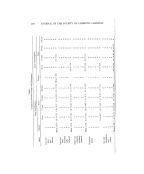
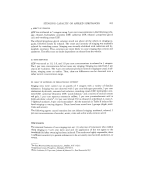
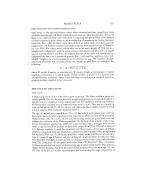
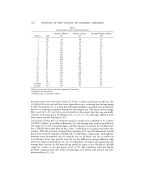
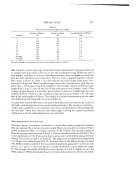
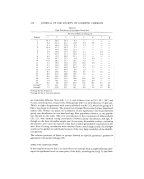
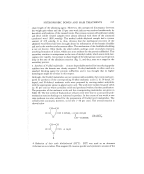
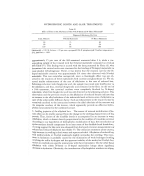
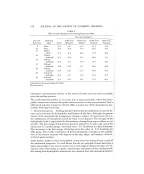
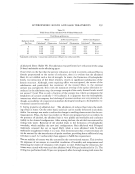
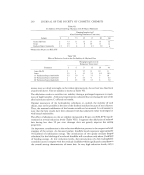
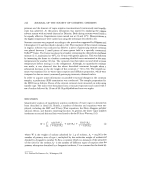
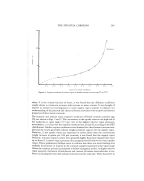
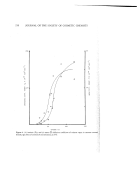
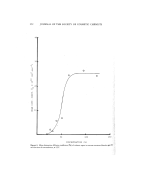
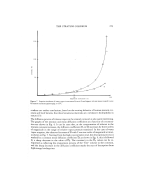
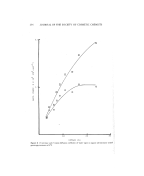
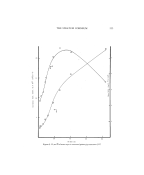
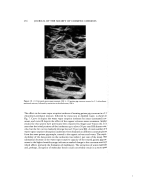
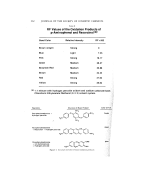
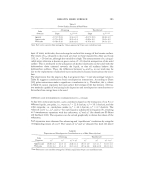
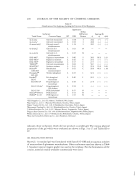
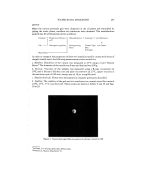
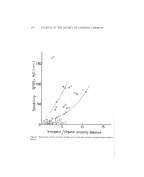
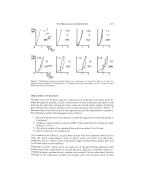
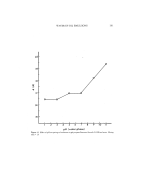
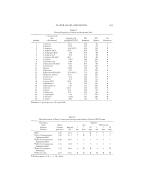
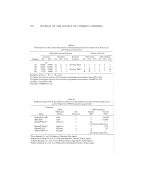
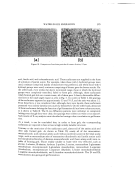
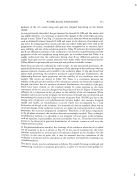
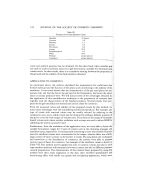
FEMALE SCALP 227 The average diameters within the Caucasian group range from just under 60 to 85/am in a natural distribution pattern. The correlation between mean diameter and age is only 0.45 for the whole group that is, of no significance. With the exclusion of the Orientals, the correlation approaches zero. Therefore, the age, at least between the midtwenties and early forties, is not a governing factor for hair diameter within a somewhat varied population. Nor was the diameter found to correlate with the number of fibers, sites, or any specific group and compound size. The variation in fiber size on individual heads is shown in Table V. The standard deviation ranges from 5 to 17 per cent, but independently from any other characteristics. The range of absolute diameter of individual fibers is rather wide from 37 to 111/am, and it would certainly increase with larger data bases. Nonetheless, the findings of Barman and coworkers (10, 11, 12, 13, 14, 15, 16) of 10 to 15 per cent fiber content in the 25/am range cannot be substan- tiated with the present results, as we found only one fiber below 40/am. The occur- rence of fibers below 40/am diameter is very low in commercially available human hair as well when determined both by weight and microscopic methods. Even in wool, a 25 /•m fiber is classified as medium fine. The range of diameters on individual panelists, as expressed by the thick-thin ratio, is more restricted. On some subjects the fibers are closely homogeneous with a ratio of less than 1.3. Only in one case did the value exceed 2.0. This thick-thin ratio shows a weak positive correlation (0.49) with fiber population density and similarly weak, but negative correlation with mean fiber diameter and age of the subjects. However, the exclusion of the Orientals from the data base eliminates all significance from these already weak correlations. VISUAL APPEARANCE OF THE HAIR The hair of the panelists differed in a number of characteristics--length, curl, style, cosmetic modifications, and product use--in addition to the measured fiber population density and diameter values. Due to this large number of variables, strict conclusions cannot be drawn concerning the visual bulkiness of hair as a function of the measured parameters on the basis of 20 panelists. Nonetheless, the indications were clear that the fiber diameter had a stronger influence on the visible bulk and elevation of the hair over the head than the population density. Even the curl level and hair setting seemed to be more important factors than the fiber number. Only when a number of these characteristics--low density and diameter with straight configuration--happened to combine, was the total hair mass judged to be very small and weak by visual methods, as in the case of subject 3. When the hair was long--waist length--and very straight, as for Subject 19, a somewhat similar judgment was arrived at, in spite of the very high fiber number and average diameter. On the other hand, wavy hair--not necessarily natural wave--with average to high diameter can show up with high bulk even at low to very low fiber densities, as were seen on panelists 1, 2, 4, and 5. Subject 12 showed the highest bulkiness with naturally strongly waved thick hair, even though the density was only average and the hair reached below shoulder level. CONCLUSIONS Based on the population density, the number of fibers on a full adult head of hair may have to be revised upward by a considerable amount to ].50,000 to 200,000. The indi-

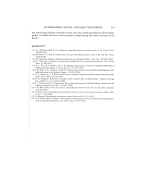
228 JOURNAL OF THE SOCIETY OF COSMETIC CHEMISTS ß :. vidual variability in fiber number, grouping and diameter is very great and no correla. tions of statistical significance were found for any of these characteristics. Nor were these characteristics related to age, at least within the age range studied. Deficiency in fiber number or even in diameter can be overcome by other characteristics to provide a hair mass with the visual impression of bulk and fullness. REFERENCES (1) (2) (3) (4) (5) (6) (7) (8) (9) (lO) (11) (12) (13) (14) (15) (16) (i7) (18) (19) (20) (21) (22) (23) (24) (25) P.S. Hough, J. E. Huey, and W. S. Tolgyesi, Hair body, J. Soc. Cosmet. Chem., 27,571 (1976) E. M. Cottington, A. Fookson, and W. S. Tolgyesi, Mechanics of hair combing, Presented at Fiber So- ciety Meeting, Atlanta, Georgia, May 5, 1975. P.M. Waldman and R. K. Brown, "Physiology of the skin and its appendages," in M. S. Balsam, and E. Sagarin, Eds., Cosmetics.' Science and Technology, 2nd ed., Wiley-Interscience, New York, 1974, p. 183. R.J. Harry, Harry's Cosmeticology, 6th ed., Chemical Publishing Co., Inc. New York, 1973, p. 341. N. Orentreich, "Scalp hair replacement in man," in W. Montagna and R. L. Dobson, Eds., Advances in Biology of the Skin, vol. IX, Hair Growth, Pergamon Press, Oxford, England, 1969, p. 99. '::: i!::•i.•i M. Bernstein and S. Robertson, Racial and sexual differences in hair weight, Amer. J. Phys. Anthropol.,.:i? I 10, 379-85 (1927). D. Hrdy, Quantitative hair form variation in seven populations, Amer. J. Phys. Anthropol., 39, 7-17 . ( 1973). '.?: M. Steggerda and H. Seibert, Size and shape of head hair from six racial groups, J. Heredity, 32, 315 18 (1941). D. Verna[l, A study of the size and shape of cross sections of hair from four races of men, Amer. J. Anthropol., 19, 345- 50 (1961). J. M. Barman, V. Pecoraro, and I. Astore, Metodologia, tecnica y computaciones en el estudio estado trofico del sistema piloso, Arch. Argent. Dermatol., 12, 55-64 (1962). , .? ß J. M. Barman, V. Pecoraro, and L. Astore, Method, technic and computations in the study of the:i:' trophic state of the human scalp hair, J. Invest. Dermatol., 42,421-25 (1964). V. Pecoraro et al., The normal trichogram in the child before the age of puberty, J. Invest. Dermatol??• 42,427- 30 (1964). J. M. Barman, I. Astore, and V. Pecoraro, The normal trichogram of the adult,J. Invest. Dermatol., 44,:• 233-36 (1965). Ibid. V. Pecoraro, J. M. Barman, and I. Astore, "The normal trichogram of pregnant women," in Montagna and R. L. Dobson, Eds., Advances in Biology of the Skin, vol IX, Hair Growth, Pergamon:'5.! Press, Oxford, England, 1969, Pp. 203-10. J. M. Barman, I. Astore, and V. Pecoraro, "The normal trichogram of people over 50 years but ap(:i•)i parently not bald," in W. Montagna and R. L. Dobson, Eds., Advances in Biology of the Skin, vol. IX,': • Hair Growth, Pergamon Press, Oxford, 1969, England, Pp. 211-20. G. Moretti et al., "Biochemical aspects of hair growth," in W. Montagna and R. L. Dobson, Eds., vances in Biology of the Skin, vol. IX, Hair Growth, Pergamon Press, Oxford, 1969, England, Pp. 5 3. A. Rook, Endocrine influences on hair growth, Brit. Med. J., 1,609-14 (1965). N. E. Yin, R. H. Kissinger, W. S. Tolgyesi, and E. M. Cottington, The effect of fiber diameter on cosmetic aspects of hair, J. Soc. Cosmet. Chem., 28, 139 (1977). H. Oberste-Lehn, and A. Nobis, Die haaranordnung beim menschen und bei einigen saugetieren, ß Anat. Entwicklungsgesch., 123,589 (1964). H. Oberste-Lehn, "Effects of aging on the papillary body of the hair follicles and on the eccrine sweat g.•' glands," in W. Montagna, Ed., Advances in Biology of the Skin, vol. VI, Aging, Pergamon Press, Oxford,?• England, 1965, Pp. 17-34. L. Giacometti, "The anatomy of the human scalp," in W. Montagna, Ed., Advances in Biology of the ..
Skin, vol. VI, Aging, Pergamon Press, Oxford, England, 1965, Pp. 97-120. H. T. Behrman, The Scalp tn Health and Disease, C. V. Mosby Company, St. Louis, 1952, p. 32. F. Pinkus, Handbuch derHaut-u. Geschlechtsk, Vol. 1, Julius Springer, Berlin, 1929. A. F. Savill, The Hair and Scalp, 3rd ed., Williams and Wilkins Co., Baltimore, 1•945.
Purchased for the exclusive use of nofirst nolast (unknown)
From: SCC Media Library & Resource Center (library.scconline.org)