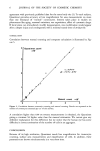
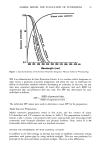
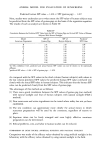
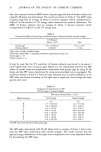
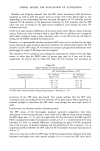
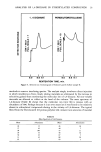
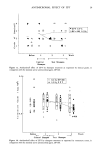
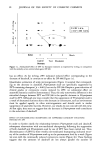
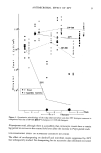
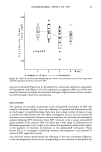
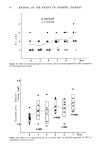
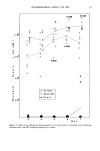
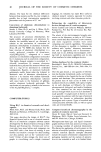
30 JOURNAL OF THE SOCIETY OF COSMETIC CHEMISTS • o o o ß ZPT !.0 % O D P-300 0.2O/o Before 1 2 3 Wee k ,L I I Control Test Shampoo Shampoo Figure lc. Antidandruff effect of ZPT by shampoo treatment as expressed by itching, in comparison with the similarly active antimicrobial agent, DP-300. has no effect. As for itching, ZPT indicated reduced effect corresponding to the decrease of dandruff, in contrast to no effect by DP-300 (Figure lc). Quantitative estimation of scalp microorganisms (Figure 2) revealed that correspond- ing to the decrease in dandruff, Pityrosporum ovale are specifically suppressed by ZPT-containing shampoo (p 0.001), but not by DP-300. Despite a great reduction of clinical grades or corneocyte counts induced by ZPT, no substantial effect on anaerobic bacteria could be demonstrated. Thus, the only noteworthy difference in the microbial changes between ZPT and DP-300 is the specific decrease in Pityrosporum ovale by ZPT. Although one may consider that this suppression of Pityrosporum ovale is a result of decreased nutrients due to the decrease in corneocytes, such an environment must be applied equally to other microorganisms and should result in similar suppression of anaerobic bacteria. However, our results do not coincide with this view. At first sight, they seem to suggest that the decrease in Pityrosporum ovale contributes to the reduction of dandruff. EFFECT OF NON-MEDICATED SHAMPOOING ON SUPPRESSED DANDRUFF SITUATIONS INDUCED BY ZPT In order to further clarify the relationship between Pityrosporum ovale and dandruff, subsequent observations with non-medicated shampooing following the suppression of both dandruff and Pityrosporum ovale by use of ZPT have been carried out. Thus, discontinuance of ZPT by three weekly non-medicated shampooing indicated recov- ery of the number of Pityrosporum ovale up to the pretreatment level by a week (Figure 3a) even with the continuedly reduced corneocyte counts (Figure 3b). These findings suggest that the amounts of dandruff do not always parallel the number of

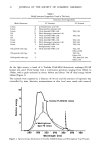
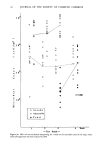
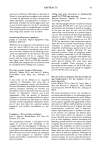
ANTIMICROBIAL EFFECT OF ZPT 31 1 06 •10 $ I 04 1 03 t o o o ©o Ye ß o Anaerobic bacteria ,, •e s t Shampoo Figure 2. Quantitative microbiology of the scalp observed before and after ZPT shampoo treatment in comparison with that of DP-300. I ß ZPT shampoo O [] DP-300 shampoo. Pityrosporum ovale, although there is a possiblity that corneocyte counts have a certain lag period to recover to the control level even after the increase in Pityrosporum ovale. NON-SHAMPOOING EFFECT ON SUPPRESSED DANDRUFF SITUATIONS The effect of no-shampooing on dandruff and microbial counts suppressed by ZPT was subsequently studied. No shampooing for six successive days disclosed recovered
Purchased for the exclusive use of nofirst nolast (unknown)
From: SCC Media Library & Resource Center (library.scconline.org)