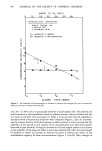
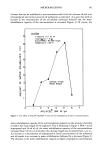
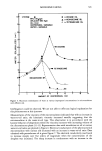
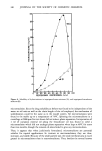
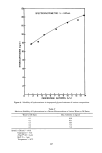
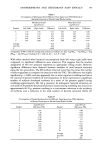
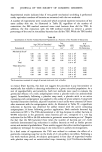
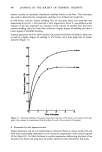
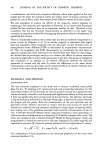
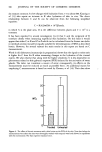
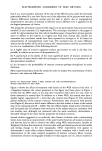
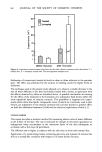
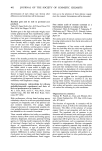
346 JOURNAL OF THE SOCIETY OF COSMETIC CHEMISTS 40 36 ... 28 ,,, 24 o 0:20 o o 12 ? / 0 I0 20 30 40 50 60 70 80 9,0 I00 PERCENTAGE ISOPROPANOL (v/v) Figure 8. Solubility of hydrocortisone in isopropanol-water mixtures (A), and isopropanol-tetradecane mixtures (B). microemulsion. Since the drug solubility as before was found to be independent of the water-to-oil ratio as well as the chain length of the oil employed, the mechanism of solubilization could be the same as in the model system. All microemulsions were found to be stable up to a temperature of 70øC. Spinning the microemulsions in a centrifuge at 5000 rpm for two hours did not induce phase separation. Incorporation of 2 ml of carnation mineral oil along the hexadecane oil was found to yield a microemulsion which did not undergo phase separation when kept at 40øC for more than two months, though the mineral oil alone failed to give any microemulsion. Thus, it appears that when judiciously formulated, microemulsions are potential vehicles for topical applications. In contrast to macroemulsions, they are clear, isotropic, and stable. Because of the small particle size, the total interfacial area is much greater in microemulsions than in macroemulsions. Thus, besides the several known

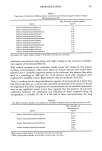
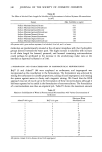
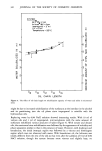
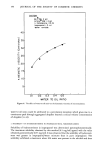
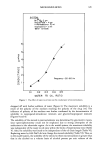
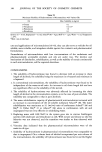
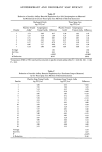
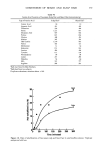
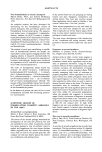
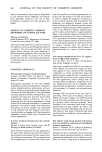
19, 18- 16- 14- 4- I 2- I 0 I E 12 E z I0 0 0 o 8 0 6 SPECTROPHOTOMETRIC X. = 243nm I I I I I I I I I J • I 2 3 4 5 6 7 8 9 I0 II 12 13 14 PERCENTAGE GLYCEROL (v/v) Figure 9. Solubility of hydrocortisone in isopropanol-glycerol mixtures of various compositions. Table V Maximum Solubility of Hydrocortisone in n-Decane Microemulsions at Various Water-to-Oil Ratios Water-to-Oil Ratio Max. Solubility in mg/ml 0.1 8.3o 0.2 8.51 o.3 6.85 o.4 7.35 0.5 7.10 System: n-Decane = 10 ml Isopropanol - 4 ml Arlacel © 186 = 4 gm Brij © 35 = 2 gm Temperature = 20øC 347
Purchased for the exclusive use of nofirst nolast (unknown)
From: SCC Media Library & Resource Center (library.scconline.org)