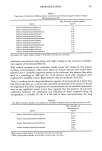
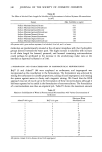
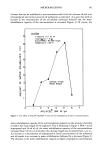
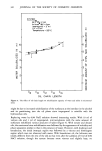
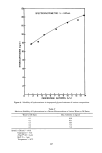
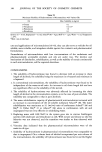
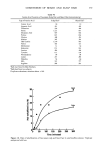
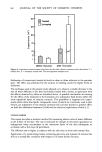
348 JOURNAL OF THE SOCIETY OF COSMETIC CHEMISTS Table VI Maximum Solubility of Hydrocortisone in Microemulsions with Various Oils Oil Max. Solubility in mg/ml n-Octane 8.2 n-Tetradecane 8.5,8.3* n-Pentadecane 7.8 n-Hexadecane 8.1 System: oil = 10 ml, Isopropanol = 3.5 ml, Arlacel © 186 = 4 gm, Brij © 35 = 2 gm, Water = 3 ml, Temperature = 20øC. *With 3 ml of 0.9% NaCl. uses and applications of microemulsions (36-43), they can also serve as vehicles for oil soluble, water soluble, and interphase soluble species for cosmetic and pharmaceutical formulations. Formulations of microemulsions with low concentrations of the surfactants and pharmaceutically acceptable alcohols and oils are under way. The kinetics and mechanism of dissolution, solubilization, as well as the stability of certain cortisteroids in such microemulsions, will be reported elsewhere. CONCLUSIONS 1. The solubility of hydrocortisone was found to decrease with an increase in chain length of alcohols, the solubility being the maximum in n-butanol and minimum in n-heptanol. 2. In conventional microemulsions, the solubility of hydrocortisone was found to be independent of the water-to-oil ratio. An increase in oil chain length did not have any significant effect on the solubility of the steroid. 3. The solubility of hydrocortisone was adversely affected by increasing the chain length of alcohol in the microemulsion system, as in the case of pure alcohols. The solubility was comparable to that in pure alcohols. 4. The water solubilization capacity of pharmaceutical microemulsions increased with an increase in concentration of the oil soluble surfactant Arlacel © 186. The water solubilization was maximum at 5:1 (wt/wt) ratio of surfactants Arlacel © 186 and Brij © 35. Either Brij © 35 or Arlacel © 186 alone in combination with oil and isopropanol was not very effective in solubilizing water. 5. Replacing water with 0.9% NaCI in the system gave rise to viscous birefringent systems with dodecane and tetradecane as oils. With octane and decane as oils this behavior was not observed, and the transition was similar to that observed with water. 6. Viscosity data indicated that the pharmaceutical microemulsions were of the water-in-oil type. 7. Solubility of hydrocortisone in pharmaceutical microemulsions was comparable to that in isopropanol. On a volume basis of alcohol incorporated per unit volume of the microemulsion, the solubility of hydrocortisone was found to be six fold higher

MICROEMULSIONS 349 in a microemulsion containing 6 gm of the total surfactant, 10 ml of oil, and 3.5 ml of alcohol at a water-to-oil ratio of 0.10 as compared to that in pure isopropanol. ACKNOWLEDGMENT The authors wish to express their thanks to Owen-Alcon Laboratories, Fort Worth, Texas for their unrestricted research grant, and the support provided by the University of Florida to carry out this research. REFERENCES (1) S. H. Yalkowsky, in Techniques of solubilization of drugs, Drugs and the Pharmaceutical Sciences, Vol. 12, ed. S. H. Yalkowsky (Marcel Dekker, Inc., 1981), p vii. (2) A. T. Florence, in Techniques of solubilization of drugs, Drugs and the Pharmaceutical Sciences, Vol. 12, ed. S. H. Yalkowsky (Marcel Dekker, Inc., 1981), Chapter. 2. (3) J. M. Brown, Colloid Science, Vol. 3 (Chemical Society, London, 1979). (4) Remington Pharmaceutical Sciences, 15th Ed. (Mack Publishing Co., Easton, 1973), p 327. (5) Facts and comparisons, Drug Information (1980), ed. Edwin K. Kastrup, p 1607. (6) V. K. Bansal, K. Chinnaswamy, C. Ramachandran, and D. O. Shah, Structural aspects of microemulsions using dielectric relaxation and spin label techniques, J. Colloid Interface Sci., 72, 524-537 (1979). (7) S. Friberg, in Microemulsions.' Theory and Practice, ed. L. M. Prince (Academic Press, New York, 1977), p 133. (8) V. R. Kokatnur, U.S. Patent, 2,111,100 (1935). (9) T. P. Hoar and J. H. Schulman, Transparent water-in-oil dispersions: The oleopathic hydro-micelle, Nature, 152, 102-103 (1943). (tO) L. M. Prince, ed., Microemulsions: Theory and Practice (Academic Press, New York, 1977). (tt) J. H. $chulman and D. P. Riley, X-ray investigation of the structure of transparent oil-water disperse systems I.,J. Colloid Sci., 3, 383-405 (1948). (12) J. H. $chulman and J. A. Friend, Light scattering investigation of the structure of oil-water disperse systems II,J. Colloid Sci., 4, 497-509 (1949). (13) J. H. Schulman, W. Stoeckenius, and L. M. Prince, Mechanism of formation and structure of microemulsions by electron microscopy,J. Phys. Chem., 63, 1677-1680 (1959). (14) W. Stoeckenius, J. H. $chulman, and L. M. Prince, The structure of myelin figures and microemul- sions as observed with the electron microscope, Kolloid Z., 169, 170-180 (1960). (15) C. E. Cooke and J. H. $chulman, in Surface Chemistry, ed. P. Ekwall, K. Groth, and V. Runn $trom-Ries (Academic Press, New York, 1965) pp 231-251. (16) W. I. Higuchi and J. Misra, Solubilization in nonpolar solvents: Influence of the chain length of solvent on the solubilization of water by dioctyl sodium sulfosuccinate, J. Pharm. Sci., 51,455-458 (1962). (17) S. G. Frank and G. Zografi, Solubilization of water by dialkyl sodium sulfosuccinates in hydrocarbon solutions, J. Colloid Interface Sci., 29, 27-35 (1969). (18) D. O. Shah, R. D. Walker,Jr., W. C. Hsieh, N.J. Shah, S. Dwivedi,J. Nelander, R. Pepinsky, and D. W. Deamer, SPE Paper 5815 Presented at Improved Oil Recovery Symposium of SPE of AIME, Tulsa, Oklahoma, March 22-24, 1976. (19) E. Sjoblom and S. Friberg, Light scattering and electron microscopy determinations of association structures in W/O microemulsions,J. Colloid Interface Sci., 67, 16-30 (1978). (20) W. Gerbacia and H. L. Rosano, Microemulsions: Formation and stabilization,J. Colloid Interface Sci., 44, 242-248 (1973). (21) A. W. Adamson, A model for miceliar emulsions,J. Colloid Interface Sci., 29, 261-267 (1969). (22) K. Shinoda and H. Kunieda, Conditions to produce so-called microemulsions: Factors to increase the mutual solubility of oil and water by solubilizer,J. Colloid Interface Sci. 42, 381-387 (1973).
Purchased for the exclusive use of nofirst nolast (unknown)
From: SCC Media Library & Resource Center (library.scconline.org)