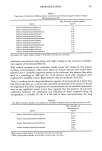
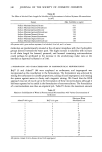
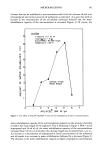
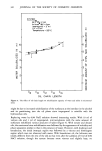
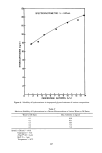
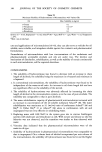
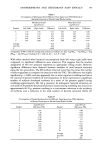
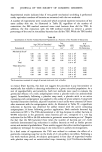
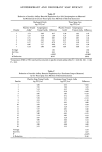
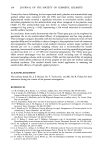
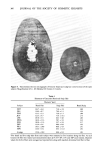
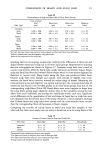
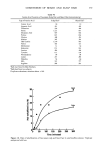
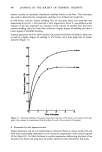
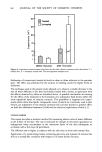
COMPARISON OF BEARD AND SCALP HAIR 381 Table VII Permanent Set and Supercontraction of Caucasian Beard and Scalp Hair Property Beard Hair • Scalp Hair b Permanent Set, (%) 15.7 _+ 0.9 12.7 + 1.1 Supercontraction, (%) 25.7 + 1.1 19.0 + 1.5 aBulk hair from ten subjects. bBulk hair from De Meo Brothers. Values are averages of four determinations along with standard deviations. In boiling sodium bisulfite, a disulfide bond cleaving agent, the beard hair attained higher levels of permanent set and supercontraction than the scalp hair (Table VII). The results indicate that the facial hair, having a lower level of stabilizing disulfide links, is more susceptible to molecular rearrangements. CONCLUSIONS A comparative study of the morphology, chemical composition, mechanical properties, and chemical reactivity revealed significant differences between scalp hair and facial hair. Morphologically, differences were found between beard and scalp hair in cross- sectional'area and shape, number of cuticle layers, cuticular pattern and medullation, in all three ethnic groups investigated. In addition, racial origin leads to minor variations in fiber size, geometry, and pigmentation. Chemically, the most significant difference between the two fiber types was the lower disulfide bond density in beard hair, as indicated by its lower cystine content. The lower elastic modulus, faster swelling rate, and higher reaction rate of beard hair with a variety of reagents was the result of the less extensive disulfide bonding in this fiber than in scalp hair. REFERENCES (1) J. A. Swift, New developments in electron microscopy,J. $oc. Cosmet. Chem., 22,477-486 (1971). (2) R. Dawber and S. Camaish, Scanning electron microscopy of normal and abnormal hair shafts, Arch. Dermatol., 101,316-323 (1970). (3) J. A. Swift and A. C. Brown, The critical determination of fine changes in the surface architecture of human hair due to cosmetic treatment,J. Soc. Cosmet. Chem., 23,695-702 (1972). (4) N.H. Leon, Structural aspects of keratin fibers,J. Soc. Cosmet. Chem., 23,427-445 (1972). (5) L.J. Wolfram and M. Lindemann, Some observations on the hair cuticle, J. Soc. Cosmet. Chem., 22, 839-850 (1971). (6) J. Menkart, L.J. Wolfram and I. Mao, Caucasian hair, Negro hair and wool: Similarities and differences,J. Soc. Cosmet. Chem., 17, 769-787 (1966). (7) R. A. Wall and L. R. D. Hunter, Normal adult hair--structure and properties, Cosmetics and Perfumery, 89 (2), 31-36 (1974). (8) R. C. Clay, K. Cook, andJ. I. Routh, Studies in the composition of human hair,J. Am. Chem. Soc., 62, 2709-2710 (1940). (9) J. A. Swift and B. Bews, The chemistry of human hair cuticle. I. A new method for the physical isolation of cuticle,J. Soc. Cosmet. Chem., 25, 13-22 (1974). (10) J. F. Corbett, The chemistry of hair care products,J. Soc. Dyers Colour., 92, 285-303 (1976). (11) J. A. Swift, Chemical composition of various morphological components isolated from human hair cuticle, Cosmetics and Toiletries, 91, 46-48 (July 1976).

382 JOURNAL OF THE SOCIETY OF COSMETIC CHEMISTS (12) L.J. Wolfram, The reactivity of human hair. A review, in Hair Research Status and Future Aspects, ed. C. E. Orfanos, W. Montagna and G. Stuttgen (Springer-Verlag, Berlin, 1981), pp 479-500. (13) J. A. Swift, Ph.D. Thesis, University of Leeds, England, 1963. (14) M. Trotter, A study of facial hair in the white and Negro races, 1Vashington University Studies, 9 (2), 273-289 (1922). (15) K. Hashimoto, Ultrastructure of cuticle of human beard hair, in The First Human Hair Symposium, ed. A. C. Brown (Medcom Press, New York, 1974), pp 286-301. (16) E. H. Wyatt andJ. M. Rigott, Scanning electron microscopy of hair, Br.J. Dermatol., 96 (6), 627-633 (1977). (17) K. Radig, Uber das Washstum der Barthaare und dessen Beeinflussung durch Krankheiten, Derm. Mschr., 160, 335 (1974). (18) Method of test for solubility of wool in urea-bisulfite solution, specification of test methods, International Wool Secretariat, London, 1965. (19) J. B. Caldwell and B. Milligan, Estimation of cross-links in wool from the extent of formic acid swelling,J. Text. Inst., 61,588-596 (1970). (20) A. G. Matoltsy, A study of the medullary cells of the hair, Experimental Cell Res., 5, 98-110 (1953). (21) J. H. Bradbury and J. u. O'Shea, Keratin fibres. II. Separation and analysis of medullary cells, Aust. J. Biol. Science, 22, 1205-1215 (1969). (22) R. S. Gandhi, Set/supercontraction characteristics of keratin fibers, Text. Res. J., 39, 1096-1102 (1969). (23) T. Mitchell and M. Feughelman, The variability of set in keratin fibers, Text. Res. J., 28, 453-456 (1958).
Purchased for the exclusive use of nofirst nolast (unknown)
From: SCC Media Library & Resource Center (library.scconline.org)