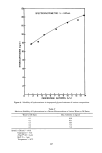
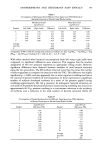
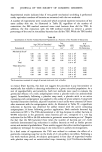
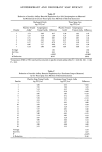
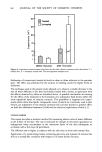
j. Soc. Cosmet. Chem., 34, 383-393 (November 1983) Electrometric technique for the in vivo assessment of skin dryness and the effect of chronic treatment with a lotion on the water barrier function of dry skin G. P. SERBAN, S. M. HENRY, V. F. COTTY, G. L. COHEN, and J. A. RIVELEY, Research and Development Laboratories, Bristol-Myers Products, 1350 Liberty Avenue, Hillside, NJ 07207. Received August 1, 1983. Presented at the Third International Symposium on Bioengineering and the Skin, Philadelphia, July 23, 1981. Synopsis Changes in skin capacitance induced by occlusion with a film of anhydrous petrolatum were measured with the aid of a pressure insensitive dry electrode on the forearms of 27 healthy volunteers, most of whom showed signs of superficial skin dryness. In subjects with dry skin the rate of increase in capacitance, which has been determined to signify diffusion of water to the surface of stratum corneum, was higher than in subjects with skin lacking manifestations of dryness. These results appear to support the concept that dry skin has a diminished ability to retain water. The difference could also be explained based on topographical characteristics and the presence of scales in dry skin. Chronic treatment with an ordinary skin lotion rendered dry skin normal-like with respect to its water barrier function. The technique presented here may have wider applications for testing the functional integrity of stratum corneum in vivo. INTRODUCTION In previous experiments (1) we observed that electrical measurements taken with a dry metal probe before and after occlusion with anhydrous white petrolatum were useful for analyzing the nature of changes in skin hydration induced by a brief solvent exposure. Solvent treatment caused (a) an increase in skin impedance signifying dryness, and (b) after occlusion, a decrease in impedance at a rate faster than that in untreated skin. Both effects would be expected if the solvent reduced the ability of the most superficial layers of the stratum corneum to retain water. A lowering in skin impedance after treatment with petrolatum has been reported by others (2,3), and it is attributed to the known properties of this material to hydrate the skin by reducing transepidermal water loss (4). Based on these facts, we inferred that the effect described in (b) above reflected the rate at which water from insensible perspiration reached and hydrated the surface of stratum corneum. In dry skin this rate is expected to be higher 383

384 JOURNAL OF THE SOCIETY OF COSMETIC CHEMISTS in conformance with Fick's law of passive diffusion, which when applied to this case implies that the lower the hydration within the surface layers of stratum corneum, the greater the rate at which water from deeper levels diffuses towards such drier regions. We also attempted to analyze the effects of the respective solvent exposure by employing a wet electrode and evaporimetry. However, in our hands these techniques yielded far less conclusive data on an equivalent number of sites. Therefore, it was considered that the dry electrode measurements, as described in this paper, may constitute an expedient method for investigating phenomena related to the presence of superficial skin dryness. There is considerable evidence that cosmetically dry skin [a condition categorized in a recent review by Kligman et al. (5) as xerosis vulgaris] is associated with higher electrical impedance when measured with dry electrodes (2) and increased rates of transepidermal water diffusion (TEW) as determined by evaporimetric measurements (6). Thus, the impedance and TEW characteristics in cosmetically dry skin show an apparent analogy with those observed in the solvent-dried skin. Based on this analogy, we decided that the technique used by us to observe the effects of solvent treatment may also be applicable to study similar parameters in dry skin. The present investigation was conducted in an attempt to: (a) observe differences between the electrical properties of normal and dry skin (b) relate the differences to the water barrier characteristics in the two skin types and (c) assess the effects of chronic treatment with a lotion on the water barrier properties of dry skin. MATERIALS AND METHODS INSTRUMENTATION The test electrode employed in the study was a vacuum controlled metal probe (Bor-Tru Inc., W. Redding, CT) constructed and used as described elsewhere (1). The main characteristics of this electrode are that the pressure exerted by it against the skin can be accurately controlled, and that with brief applications (fifteen to thirty seconds) it does not significantly alter existing levels of skin hydration. The reference electrode, a strip of aluminum foil folded to eliminate sharp edges, is held by the subject between the tongue and the palate. Both the characteristics of the test electrode and the placement of the reference electrode in contact with the oral mucosa (in which the resistance is relatively low and constant) contribute to a high degree of reproducibility, thus solving one of the problems associated with electrical measurements of skin in vivo. A Hewlett-Packard © (Model 4262a) capacitance-resistance meter generating 1.5 volts across the terminals and set to a frequency (f) of 100 Hz completed the circuit. The meter was interfaced with a Hewlett-Packard © Model 85 Microcomputer, which was programmed to control the meter and to calculate impedance (Z), phase angle (0), and capacitative reactance (Xc) from the primary resistance (R) and capacitance (C) values Z = 4R 2 + Xc 2, 0 = cotan Xc/R and X• = 1/(2 7r fC). The relationship of these parameters to the electrical properties of skin have been reviewed elsewhere (7,8).
Purchased for the exclusive use of nofirst nolast (unknown)
From: SCC Media Library & Resource Center (library.scconline.org)