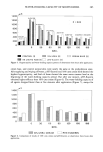
MOISTURE MEASUREMENT BY NIR SPECTROSCOPY 251 no treatment. NIR reflectance measurements were made prior to treatment and at least once a week for the duration of the study. Ambient temperature and relative humidity were not closely controlled but were monitored over the measurement period. Reflectance measurements were made with a Quantum 1200 analyzer (LT Industries) in the region of 1200-2400 nm, using 30 scans per spectrum. The subjects' legs were placed directly against the detector port, with a foam cushion around the rim of the port to block stray light. The spectrometer was placed on a low stool, and subjects could easily reach the detector port from a sitting position. Spectra were collected at least eight hours following the most recent application to ensure that no residual product was present. DATA TREATMENT The spectra were converted to apparent absorbance (log l/R, where R is reflectance) and averaged over all the subjects for each product at each time point. Averaging the data in this manner minimizes the effect of individual variation by limiting the influence of outliers. The averaged spectra within a study were subjected to a multiplicative scatter correction (MSC) to correct for the changes in apparent absorption due to scattering. MSC was first proposed by Geladi et al. for determinations of meat composition (8) and has since been used in a variety of NIR applications (9). MSC corrects each spectrum to an "ideal" spectrum, in this case an average spectrum, and determines both additive and multiplicative scattering effects. MSC assumes a constant scattering coefficient over the wavelength interval used and only minor changes in concentration. Over the wavelength interval used here, 1400-2200 nm, the scattering coefficient of skin has been shown to be fairly constant (10,11), and the variation in spectral intensity is small. From the MSC-corrected data, concentration changes can be determined, and from the difference in the original and MSC-corrected spectra, changes in scattering can be determined. Relative concentrations were determined from second derivative intensities. Differenti- ation is a common means of resolution enhancement, and because it is a linear operation, the resulting spectral intensities follow Beer's Law if it held for the original spectrum (12). RESULTS BAND ASSIGNMENTS The log 1/R spectra of skin and water are compared in Figure 1. The major features in both are the bands near 1450 and 1920 nm, corresponding to the first overtone of the OH stretch in water and the combination mode of the OH stretch and HOH bend in water, respectively. Skin also shows weak features near 1730 and 1750 nm due to lipids. The features in the water combination region are enhanced using second derivatives, as shown for both water and skin in Figure 2. Water shows a major band at 1892 nm and weaker bands at 1906 and 1924 nm. Longer wavelengths generally indicate greater hydrogen bonding. According to Luck, these wavelengths correspond to unbonded (free) water and water with one and two hydrogen bonds, respectively (13). The same three bands appear in skin, with different relative

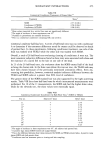
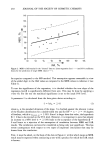
252 JOURNAL OF THE SOCIETY OF COSMETIC CHEMISTS .35 1200 1400 1600 1800 2000 2200 2400 Fim Figure 1. Apparent absorbance spectra of skin and water. intensities, plus a stronger band at 1879 nm. These wavelengths suggest slightly different assignments from those of Luck. The band at 1879 nm is due to weakly bonded water (free water), and may be the water giving rise to the evaporative flux across the SC. The 1890-nm band of skin corresponds to the strongest band of liquid water and will be referred to as bulk water, while the longer wavelength bands at 1909 and 1927 nm are due to more strongly bound water, which may be that associated with protein. The free water and protein-bound water are expected to be found within the stratum corneum, while bulk water, and possibly some protein-bound water, are expected to be found in the epidermal layer just below the SC. These assignments are summarized in Table I. EFFECT OF HUMIDITY ON SKIN WATER CONTENT Figure 3 compares the second derivative spectra of untreated skin at two humidities. At an absolute humidity of 3.7 g/m 3 (corresponding to 19% relative humidity at 22øC), the water bands near 1879, 1909, and 1927 nm shift to longer wavelength (stronger hydrogen bonding) compared to the spectrum at 8.2 g/m 3 (42% RH at 22øC) and become less intense, while the band at 1890 nm (bulk water) does not shift but becomes more intense. At lower humidity, therefore, the free and protein-bound water molecules are somewhat more strongly hydrogen-bonded. Figure 4 shows the correlation between absolute humidity and the second derivative intensities of free water (1879 nm) from the untreated control sites using data pooled from five separate studies. The absolute humidity in these studies is limited to the range corresponding to 3%-50% RH at 22øC. The increase in intensity at 1879 nm with
Purchased for the exclusive use of nofirst nolast (unknown)
From: SCC Media Library & Resource Center (library.scconline.org)