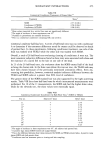
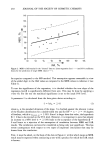
MOISTURE MEASUREMENT BY NIR SPECTROSCOPY 253 c nm Figure 2. Second derivative spectra of skin and water in the water combination region. increasing humidity indicates a greater concentration of free water and supports the assignment that this is water that is readily transported across the skin barrier and thus gives rise to the flux across the SC. In his review on measurements of water in skin, Potts noted that the SC thickens with hydration, providing a more substantial barrier to water loss (3). The maximum flux found in those studies, as measured by TEWL, was found at 30%-40% relative humidity (6.9-9.2 g/m 3) at 25øC. Figure 4 seems to correlate with this observation. The increases in more tightly bound water (1909 and 1927 nm) are shown in Figures 5 and 6. These parallel the increase observed for free water, suggesting that there may be free exchange between the two types of water. Bulk water (1890 nm), on the other hand, decreases with increasing humidity, as shown in Figure 7. Although the data for water at 1879, 1909, and 1927 nm were pooled from five studies without discontinuity, differences between the five clinical studies are apparent in the data at 1890 nm. The reason for the discontinuity may be related to minor changes in the thickness of the cushion between the detector port and the Table ! Assignments in Water Combination Region of Skin nm Assignment 1879 Free water 1890 Bulk water 1909 Protein-bound water 1927 Protein-bound water

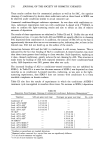
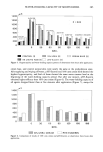
254 JOURNAL OF THE SOCIETY OF COSMETIC CHEMISTS 1•4-0 ' 18'60 ' 1•80 ' 19'00 ' 19'20 ' 19'40 Figure 3. Effect of humidity on the second derivative spectra of skin. subjects' legs, leading to differences in the depth of penetration of near-infrared radia- tion. Within each study, however, the negative correlation with humidity holds. Bulk water should be that which is located below the stratum corneum and is expected to be constant. The apparent decrease can only be attributable to another phenomenon such as decreased penetration of radiation below the SC. Recall that Potts has observed a thickening of the SC with humidity (3). The longer resulting path length for NIR radiation through the SC could leave a shorter path length below the SC. Thus, the SC appears to plump out as the humidity increases. The total path length of radiation, however, does not appear to change significantly. EFFECT OF PRODUCT APPLICATION ON SKIN WATER CONTENT After treatment with all three product types, skin shows a noticeable increase in ap- parent absorbance throughout the wavelength range of 1400-2200 nm, accompanied by an increase in the baseline offset (Figure 8). The effect is most likely due to decreased scattering of NIR radiation, possibly accompanied by an increase in water content. Subjective evaluations under visible light indicate a glossier appearance for treated skin, suggesting that visible light, at least, is less scattered. The MSC correction to the spectra was used to eliminate the apparent increase in absorbance due to scattering and to leave only effects due to changes in water content. Because of the strong effects of humidity on water band intensities, relative water concentration changes produced by different products were compared at single time points (constant humidity). For example, Figure 9 shows relative concentration changes for the three formulations at the four water wavelengths after two weeks of product
Purchased for the exclusive use of nofirst nolast (unknown)
From: SCC Media Library & Resource Center (library.scconline.org)