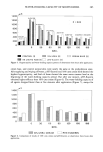
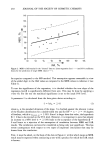
MOISTURE MEASUREMENT BY NIR SPECTROSCOPY 255 1200 1100 ? 1879 ß • 1000 '- 900 ß • 800 700 600 500 obsolufe humidify, g/m3 Figure 4. Correlation of free water (1879 nm) and absolute humidity. application. The data were collected at 35% RH at 23øC and were corrected by sub- tracting the control and baseline measurements. The results are thus relative to the baseline measurements that were collected at 30% RH. The plasticizer ingredient in the simple base (A) and in the more complex formulation (C) induce similar effects the levels of free (1879 nm) and protein-bound water (1909 and 1927 nm) decline while that of bulk water (1890 nm) increases. Differences in the net water band intensities between these two formulations are not significant. Propylene glycol (B), which is not expected to act as a moisturizer, shows decreases in free water and protein-bound water comparable to those of the other two formulations, but also results in a decrease in bulk water. The decrease in free water (1879 nm) with all three products occurs in spite of the small increase in humidity relative to the baseline measurements. It may arise from increased flux across the skin surface, which would result in less free water trapped within the SC, or from an overall decrease in SC thickness. The protein-bound water follows the behavior of the free water, as it does when the humidity changes. The increase in bulk water (1890 nm) with the plasticizer may signal an increase in the depth of penetration of reflected radiation into the epidermis as the SC becomes thinner. Product application, therefore, appears to have the opposite effect on stratum corneum thickness than does increasing humidity. EFFECT OF PRODUCT APPLICATION ON SCATTERING All three formulations result in decreased scattering after product application, observed as an increase in apparent absorbance and calculated as the difference between the

256 JOURNAL OF THE SOCIETY OF COSMETIC CHEMISTS 6OO 550 .•500 1909 nm 450 400 'D_ 350 c• 300 250 •• 2OO 1 obsolufe humidify, g/m3 Figure 5. Correlation of bound water (1909 nm) and absolute humidity. 10 original and MSC-corrected spectra (Figure 10). The relative change in scattering among the three formulations is independent of the wavelength used, and C A B, where B, the penetration enhancer, shows the least decrease in scattering compared to the untreated site. The two formulations containing the plasticizer, A and C, cause a greater decrease in scattering and are comparable to each other. DISCUSSION The validity of using NIR reflectance data for assessing skin condition depends upon both the depth from which the measured radiation is coming and the degree of change in this depth upon product application. Ideally, in evaluating moisturizing products, the depth of penetration of near-infrared radiation should be limited to the stratum corneum. Increased depth of penetration could result in a higher apparent concentration of water, especially that which is termed here as bulk, due to the greater degree of hydration of deeper tissue. The depth of penetration of radiation into the skin depends on several factors. When NIR radiation impinges on skin, it undergoes regular (specular or mirror-like) reflec- tance, absorption, internal scattering, and diffuse reflectance. The degree to which each occurs depends on the structure, the refractive index, the absorptivity, and the scatter- ing coefficient. Figure ! ! illustrates some possible pathways for light reflected off skin. Anderson et al. (! 1) suggest that at the 1950 nm combination band of water, specular reflectance from
Purchased for the exclusive use of nofirst nolast (unknown)
From: SCC Media Library & Resource Center (library.scconline.org)