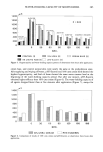
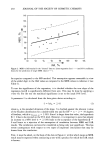
MOISTURE MEASUREMENT BY NIR SPECTROSCOPY 259 180 160 140 .120 • 100 '- 60 40 20 1879 [•i•A•B •C 1890 i i 1909 1927 wavelength (nm) Figure 10. Net scattering effect after product application. b a epidermis dermis Figure 11. Possible pathways for NIR radiation in the skin: a) specular reflectance b) diffuse reflectance c) absorption d) multiple internal scattering. Changes in the depth of penetration of radiation depend on changes in the refractive index or in skin surface morphology. The refractive index of the stratum corneum is about 1.55 at the sodium D line (14), but has been found to decrease upon hydration

260 JOURNAL OF THE SOCIETY OF COSMETIC CHEMISTS (15,16). A lowered refractive index should result in decreased scatter and, consequently, deeper penetration of radiation and higher apparent absorbance. Humidity-induced hydration, however, does not appear to cause a significant increase in the path length of near-infrared radiation into the skin. Under high humidity, the increase in free water content apparently gives rise to swelling of the SC, while the decrease in bulk water suggests that less radiation consequently penetrates below the SC. Thus, there is no major change apparent in the net depth of penetration of radiation or significant change in the refractive index in this region with hydration. Therefore, the humidity results provide evidence that NIR reflectance is a superficial measurement at 1879 nm since free water is presumed to be restricted to the SC. On the other hand, the presence of bulk water suggests that some portion of the reflected radiation has penetrated into the epidermis. The depth into the epidermis is likely to be small otherwise the bulk water absorbance would overwhelm the spectrum. In contrast to the humidity effects, certain products can affect scattering properties by smoothing the skin surface. Normal skin has been shown to have fewer and shallower crevices and an absence of flaky, uplifted scales compared to dry skin (17,18). The formation of a smoother surface should result in less scattering of radiation, as noted for the three formulations in Figure 10. Because all three show decreased scatter without increased free water, the mechanism by which skin is made smoother may not necessarily be hydration. In fact, it appears that no hydration per se occurs with product application in the cases examined here. The decrease in free water combined with the increase in bulk water suggests that the SC is becoming thinner, opposite to the plumping effect observed with increasing humidity. The thinning may be due to compacting of the tissue or to removal of the driest, outer portion of the SC. Thus, maintenance of at least moderate humidities and application of moisturizers may both be beneficial to skin, but through different mechanisms. Increased humidity hydrates the skin, while moisturizers of the type applied in this study appear to smooth skin. NIR reflectance thus appears to show potential as a method for evaluating both the smoothness and water content of skin. Further work to validate the treatment data with regard to separating the effects of scattering and concentration needs to be done. NIR may also offer a means for measuring SC thickness on free water/bulk water intensities. SUMMARY We have introduced NIR reflectance as a method to directly determine changes in free, bulk, and protein-bound water and to assess scattering effects in skin in the evaluation of skin care products. In addition, the effect of humidity on different types of water in skin can be examined. From our initial studies, it appears that increasing ambient humidity (up to 50% RH) is associated with increased levels of free water in the skin, while the products we used act primarily to smooth the skin surface, observed as a decrease in the scattering of radiation. Our results further indicate that although the water we see is primarily in the stratum corneum, some of the reflected radiation comes from the epidermis.
Purchased for the exclusive use of nofirst nolast (unknown)
From: SCC Media Library & Resource Center (library.scconline.org)