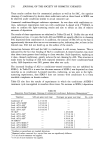
270 JOURNAL OF THE SOCIETY OF COSMETIC CHEMISTS Table I SAC Tress Experiments • Treatment No. tresses treated Shine 2 SODS 18 1.72 (0.23) SAC 3 1.15 (0.07) SAC/TEALS 6 0.67 (0.12) SAC/SODS 18 1.47 (0.27) SAC/SDES-2 3 1.53 (0.07) Shine values connected by a vertical line were not significantly different. Numbers in parentheses are standard deviations. to form an insoluble complex that was more dulling to the hair than the original deposited soil. That such a complex was actually being formed was confirmed by dye-staining exper- iments, such as were performed in reference 2, in which it was shown that the anionic dye, Red 80, could not stain hair or wool swatches treated with SAC and then washed with TEALS. Since the light-scattering results showed that SAC still remained on the surface of these swatches, these results indicate that the cationic SAC was unavailable for binding to Red 80 because of complexation with lauryl sulfate anion. The above type of complex formation occurs on the surface of hair because of the insolubility of the SAC:lauryl sulfate interaction product. It was therefore reasoned in reference 2 that changing the chain length of the detergent might render the interaction product more soluble such a detergent could then effectively clean the SAC from the hair surface rather than form an insoluble complex with it. This reasoning is shown to be correct by the results in Table I. The shine numbers of SAC-treated tresses washed with the shorter-chain surfactants SODS (C8 and C10 mixture) and SDES-2 were observed to increase in value, becoming almost as great as the value for clean hair. This indicates that these two detergents, unlike TEALS, were effective in removing SAC from the hair surface. We therefore conclude that, as a result of shortening the detergent chain length, SODS and SDES-2 did not form insoluble complexes with SAC, thus leading to improved cleaning of conditioner. CONDITIONER/DETERGENT RADIOTRACER EXPERIMENTS In order to test the above light-scattering conclusions, and also to compare the shine values in Table I to relative conditioner/detergent depositions, a series of radiotracer experiments was run measuring deposition on wool swatches after various SAC and detergent treatments. The results of these measurements are tabulated in Table II. Note that ALS (ammonium lauryl sulfate) rather than TEALS was employed in the measurements in Table II. This was considered to be an acceptable substitute, since both TEALS and ALS produced the same light-scattering results with SAC. The data in Table II show that, as was concluded above, SDES-2 is superior to lauryl sulfate detergents in cleaning SAC deposits. After washing SAC-treated swatches, ALS removed only 31% of the deposited conditioner vs 62% for SDES-2. In addition, it is

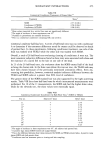
SURFACTANT INTERACTIONS 271 Table II Deposition From Detergent Cleaning of SAC: Radiotracer Measurements •'2 Treatment 3 SAC per gram wool (mg) Detergent per gram wool (mg) Total deposit 4 1% SAC 6.68 (0.40) -- 6.68 (0.40) 5% ALS -- 1.94 (0.18) 1.94 (0.18) 1% SAC/5% ALS 4.58 (0.72) 4.09 (0.57) 6.73 (0.94) 5% SDES-2 -- 1.86 (0.22) [ 1.86 (0.22) 1% SAC/5% SDES-2 2.52 (0.47) 2.12 (0.33) 2.78 (0.57) • Numbers in parentheses are standard deviations. 2 Measured values connected by a vertical line were not significantly different. 3 0.3 ml of each treatment was applied. 4 Total deposits for conditioner/detergent washes are calculated by summing conditioner plus detergent deposits minus the detergent deposits on clean wool. seen that ALS deposition on conditioner-treated swatches was more than twice that on clean substrates. This confirms that lauryl sulfate anions interact with cationic SAC to form an insoluble complex. In the case of SDES-2, binding to clean or conditioner- treated swatches was virtually the same, proving, as was indicated by light scattering, that SDES-2 does not interact with SAC to form insoluble complexes on keratin sub- strates. The last column in Table II lists the total amount of deposit found on swatches after different treatments. For SAC-treated swatches washed with ALS, it can be seen that no net cleaning occurred: although some conditioner was removed by ALS, this was re- placed by detergent binding to the remaining SAC. In the case of the SDES-2 wash, on the other hand, the net effect was to remove 60% of the original deposit, thus again demonstrating the superiority of SDES-2 in cleaning conditioner. It should be noted in Table II that the amount of total deposit measured after washing conditioner-treated wool with detergent was adjusted by subtracting that amount of deposit measured after washing clean wool. This does not mean to imply that the subtracted detergent was not part of the conditioner/detergent complex, but was done simply to emphasize the excess of deposit resulting from washing conditioner-treated wool over that resulting from washing clean wool alone. Table III shows the results of radiotracer experiments in which CTAC was substituted for SAC. The results in this case were similar to those obtained with the latter condi- tioner. Almost three times as much ALS bound to CTAC-treated swatches as SDES-2, Table III Deposition From Detergent Cleaning of CTAC: Radiotracer Measurements • Treatment 2 CTAC per gram wool (mg) Detergent per gram wool (mg) 1.7% CTAC 7.13 (0.58) 1.7% CTAC/20% ALS 4.25 (0.13) 1.7% CTAC/5% ALS -- 1.7% CTAC/20% SDES-2 2.88 (0.33) 1.7% CTAC/5% SDES-2 -- 4.30 (0.63) 1.47 (0.15) Numbers in parentheses are standard deviations. 0.3 ml of each treatment was applied.
Purchased for the exclusive use of nofirst nolast (unknown)
From: SCC Media Library & Resource Center (library.scconline.org)