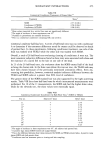
272 JOURNAL OF THE SOCIETY OF COSMETIC CHEMISTS indicating, as with SAC, that while CTAC does not interact with SDES-2 to form an insoluble complex, it does form such complexes with ALS on the wool surface. Because of this complex formation, only 40% of deposited CTAC was removed from wool swatches by ALSvs 60% by SDES-2. Total deposits could not be directly calculated because different concentrations of detergent were used in different experiments. It seems clear from the data, however, that, as with SAC, washing CTAC-treated swatches with ALS would result in little or no net cleaning. SURFACTANT SERIES EXPERIMENTS The preceding radiotracer experiments confirmed that light scattering can be used to evaluate cleaning of conditioners by surfactants. Using this methodology, the condi- tioner cleaning efficiency of a series of alkyl ether sulfates having carbon chain lengths of 6, 8, 10, and 12 and degrees of ethoxylation of 1, 3, and 5 was evaluated. Table IV presents the results for those detergents having a degree of ethoxylation of one. The results indicate that alkyl (lEO) ether sulfates with carbon chain lengths of 6, 8, and 10 are all effective in removing SAC from hair. The same was not found to be true for the C12 detergent, SLES-1EO, which, like TEALS, dulled the hair as a result of complex formation with SAC. The light-scattering results for the 3EO and 5EO detergents tested were found to be similar to those obtained with the corresponding lEO species. This indicates that, at least up to 5EO, formation of insoluble detergent:conditioner complexes is determined primarily by the length of the hydrophobic portion of the detergent rather than by the degree of ethoxylation. CLEANING OF SAC/TEALS COMPLEXES The preceding material showed that shorter-chain alkyl ether sulfates were superior to conventional, C12-based detergents in cleaning SAC and CTAC, because they do not form the insoluble conditioner:detergent complexes on hair that are formed by the latter surfactants. The above-mentioned experiments gave no indication, however, of the effectiveness of Table IV Shine of SAC/Detergent-Treated Hair • Treatment Shine 2 SODS 1.72 (0.23) SAC/C6- lEO 3 1.79 (0.22) SAC/C8- lEO 1.57 (0.09) SAC/C 10- lEO 1.58 (0.16) SAC/C 12- lEO 0.88 (0.07) SAC/TEALS 0.67 (0.07) • Shine values connected by a vertical line were not significantly different. 2 Numbers in parentheses are standard deviations. 3 This is a sodium hexyl ether sulfate substituted with one ethoxy group. The following surfactants in the column are all alkyl (lEO) ether sulfates with the designated carbon chain lengths.

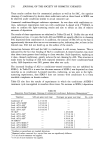
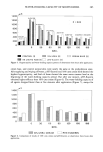
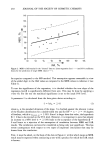
SURFACTANT INTERACTIONS 273 shorter-chain surfactants in cleaning the insoluble SAC:detergent complexes left on hair by the use of conventional detergents. This was tested by performing light-scattering measurements on tresses that were washed twice with SODS or TEALS following deposition of a TEALS/SAC complex on the surface. In Table V, it is seen that attempting to remove the TEALS/SAC complex with TEALS did not result in significant cleaning, leaving tresses that were still sub- stantially dulled. The SODS treatment, on the other hand, restored most of the original shine, indicating that the complex was effectively cleaned. We conclude, therefore, that detergents such as SODS are superior cleaners, not only of conditioner, but of the insoluble conditioner:detergent complexes left on hair as a result of washing with conventional detergents. Half-head tests. In addition to tests on single fibers and on tresses, light-scattering results can be obtained from experiments on actual heads of hair. In order to test detergent/conditioner interactions under conditions as close as possible to actual con- sumer use, therefore, a series of half-head tests was run in which SAC/TEALS and SAC/SODS treatments were compared. Table VI lists the results of these treatments on ten panelists. A plus sign in the column labeled subjective shine means the SODS-washed side was judged shinier by the eval- uators, while a positive value in the delta shine column indicates that the SODS-treated side had the larger measured shine value. In all ten cases, the SAC/SODS-treated half of the head was found to have the greater measured shine value, while in only one case was the SAC/TEALS-treated side judged to have the greater subjective shine. Application of a simple sign test to these results indicates a difference between the TEALS- and SODS-treated sides at a greater than 99% level of confidence. This confirms that the dulling effects arising from formation of insoluble complexes can be easily observed under conditions similar to actual consumer use. The one discrepancy above, between instrumental and subjective evaluations, is prob- ably an orientation effect. Shine is observed when an object scatters much more light in a particular direction than in other directions (1). Thus, even if individual hairs in an array are very shiny, the less parallel they are to each other the less they will reflect light in the same direction, resulting in a decrease in perceived shine. The hair in half-head test 6 was quite curly, so it is reasonable to assume it would be more sensitive to orientation effects of this type. Note that the largest differences in measured shine were observed with permed or Table V SAC/TEALS Complex Experiments • Treatment Shine 2 SODS 1.72 (0.23) Complex (SAC/TEALS) 0.67 (0.12) Complex/TEALS 0.87 (0.11) Complex/SODS 1.43 (0.23) Shine values connected by a vertical line were not significantly different. Numbers in parentheses are standard deviations.
Purchased for the exclusive use of nofirst nolast (unknown)
From: SCC Media Library & Resource Center (library.scconline.org)