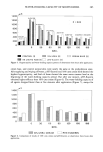
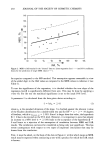
276 JOURNAL OF THE SOCIETY OF COSMETIC CHEMISTS These results confirm that for commercial products as well as for SAC, the superior cleaning of conditioners by shorter-chain surfactants such as those found in SODS can be observed under conditions similar to actual consumer use. Commercial conditioner/detergent radiotracer experiments. As was done with conditioner ac- tives, radiotracer experiments were run with conditioner A doped with [•4C]SACL in order to confirm the light-scattering results and also to obtain an idea of relative amounts of deposition. The results of these experiments are tabulated in Tables IX and X. Unlike the case with conditioner actives, it is seen that both ALS and SODS are equally effective in cleaning SAC deposited from conditioner A. In addition, the amount of SAC left on the hair is approximately the same after one or two treatment cycles, indicating that, at least in this limited case, SAC did not build up on the surface of the swatch. Interaction between ALS and the SAC in conditioner A still occurs, however. This is indicated by the fact that binding of ALS to conditioner A-treated swatches was more than three times greater than binding to clean swatches. Such deposition, replacing as it does, cleaned conditioner, greatly reduces the net cleaning by ALS. This situation is made worse by buildup of ALS with repeated treatment: after three conditioner/wash cycles, ALS deposition was 28% greater than after one cycle. The increased binding of ALS to conditioner-treated swatches was not exhibited by SDES-3. In Table IX it is seen that the same amount of SDES-3 was deposited on clean swatches as on conditioner A-treated swatches, indicating, as was seen in the light- scattering experiments, that SDES-3 does not interact with conditioner A to form insoluble complexes on keratin surfaces. Table IX also lists the results of experiments in which the conditioner A/SDES-3 treatment cycle was applied to swatches three times. No increase in SDES-3 deposition Table IX Deposition From Detergent Cleaning of Commercial Conditioner: Radiotracer Measurements •'2 Treatment SAC per gram wool (mg) Detergent per gram wool (mg) No. cycles Conditioner A 3 -- Cond. M5% SODS 3 Cond. M5% hLS 3 -- Cond. M5% SODS 3 -- Cond. M5% ALS 3 -- 5% ALS 4 1.18 (0.08) Cond. M5% ALS 4 3.57 (0.13) Cond. M5% ALS 4 3.79 (0.18) Cond. M5% ALS 4 4.58 (0.19) 5% SDES-34 1.11 (0.19) Cond. A/5% SDES-34 1.08 (0.08) Cond. A/5% SDES-34 1.17 (0.30) Cond. M5% SDES-34 0.98 (0.31) 4.27 (0.59) 1.83 (0.67) 1.67 (0.24) 2.05 (0.56) 2.03 (0.55) -- -- -- -- -- __ -- -- Numbers in parentheses are standard deviations. Measured values connected by a vertical line were not significantly different. 0.3 ml of each treatment was applied. 0.15 ml of each treatment was applied.

SURFACTANT INTERACTIONS 277 Table X Deposition From Shampoo Cleaning of Commercial Conditioner: Radiotracer Measurements • Treatment 2 SAC per gram wool (mg) TEALS per gram wool (mg) Total deposit 3 Conditioner A 3.17 (0.19) -- 3.17 (0.19) Shampoo B 4 1.37 (0.10) 1.37 (0.10) Cond. A/Shampoo B 1.66 (0.25) 3.09 (0.52) 3.28 (0.59) • Numbers in parentheses are standard deviations. 2 0.15 ml of each treatment was applied. 3 Total deposit for the conditioner/shampoo treatment was calculated by summing the SAC and TEALS and subtracting the TEALS deposits on clean wool. 4 This is a TEALS-containing commercial shampoo. was observed with repeated treatment, indicating that, unlike ALS, SDES-3 does not build up on conditioner-treated swatches. Table X shows the results of experiments in which shampoo B, a TEALS-containing commercial shampoo, was used to wash conditioner A-treated swatches. As was the case with SAC and TEALS alone, the shampoo exhibited increased deposition in the presence of conditioner as a result of SAC/TEALS complex formation. Because of this increased deposition, no net cleaning was observed: the total deposits before and after shampooing were comparable. This indicates that for fully formulated commercial products as well as for the active ingredients, formation of insoluble complexes between cationic condi- tioners and anionic detergents can occur on hair. CONCLUSIONS In this paper, light-scattering measurements, supplemented by radiotracer techniques, were used to demonstrate the formation on hair surfaces of dulling, insoluble complexes between common conditioner actives and the lauryl and laureth sulfate detergents used in virtually all commercial shampoos. Washing deposited conditioner active with the above C12 detergents was shown to result in little net cleaning as a result of buildup of both conditioner and detergent on the hair surface. Detergents with hydrophobic chain lengths less than 12 were shown to be superior to laureth sulfates in cleaning conditioner because of the absence of complex formation and also because of their ability to solubilize any previously formed complex. In the case of commercial conditioners, buildup was observed only from C 12 detergents, rather than from detergent and conditioner. This led to less dulling however, enough increased deposition from detergent was observed to occur, to again lead to little net cleaning by commercial shampoos. The above-documented buildup from conditioning, shampoo cycles could be a contrib- uting factor to the common consumer belief that the cleaning effectiveness of any particular shampoo decreases over time. A better understanding of the possible causes for decreases in cleaning with repeated use, such as the interactions documented in the present work, could result in products that would command more consumer loyalty.
Purchased for the exclusive use of nofirst nolast (unknown)
From: SCC Media Library & Resource Center (library.scconline.org)