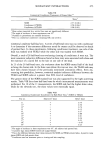
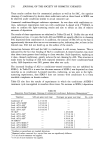
274 JOURNAL OF THE SOCIETY OF COSMETIC CHEMISTS Table VI SAC Half-Head Tests. (SODS vs TEALS) Test no. Subjective • shine Delta 2 shine 13 q- 0.26 2 + 0.12 3 + 0.11 4 + 0.38 5 + 0.50 6 - 0.44 74 q- 0.80 85 + 0.38 9 + O.63 104 q- 0.80 • A positive sign means SODS-treated side judged shinier. 2 This is the difference between shine values measured for SODS and TEALS-treated sides. A positive value means SODS side had greater shine. 3 Tests 1-3 were performed on the same woman. 4 These women had permed hair. 5 Tests 8 and 9 were performed on same woman before and after application of a hair-straightening treatment. straightened hair. This is not surprising since chemically treated hair has a greater number of negative charges on the surface and would be expected to bind more cationic conditioner. This is confirmed by the observation from radiotracer experiments that permed hair binds 2.3 times more SAC than virgin hair (6). Cleaning of commercial conditioners. The preceding experiments dealt for the most part with SAC, a conditioner active found in many commercial products. Experiments were also performed with conditioner A, a commercial conditioner containing SAC and ceteth-2, in order to determine whether the results reported for SAC would also be observed with commercial products. Tresses treated with conditioner A and then washed with TEALS were found to exhibit much less dulling than was observed when washing SAC-treated tresses. This is prob- ably the result of solubilization of the SAC by the ceteth-2 oil. In order to increase the sensitivity of the experiments, therefore, measurements were made using permed tresses which, as was noted in the preceding section, adsorb more conditioner than does virgin hair. Table VII tabulates the light-scattering results from a typical permed hair experiment. In this case it is seen that, as was observed for SAC-treated hair, washing conditioner A-treated hair with TEALS resulted in duller tresses than those washed with the shorter- chain surfactants comprising SODS. This was confirmed by panelists who subjectively evaluated tresses according to the methods described in reference 1. These results indicate that, although the dulling effect is smaller, formation of insoluble complexes between TEALS and SAC still occurs with commercial conditioners. Note that the shine values in Table VII were obtained at 45 ø incidence and thus cannot be compared directly with the 30 ø incidence shine values listed in the previous tables. The reason for this is that specular reflection increases with increasing angle of incidence (Fresnel's equations, reference 3).

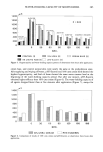
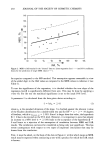
SURFACTANT INTERACTIONS 275 Table VII Commercial Conditioner Treatments of Permed Hair •'2 Treatment Shine 3 SODS Conditioner A4/SODS Conditioner A/TEALS 2.57 (0.28) 2.58 (0.06} 2.08 (0.05) Shine values connected by a vertical line were not significantly different. The angle of incidence in these experiments was 45 ø . Numbers in parentheses are standard deviations. This is a commercial conditioner containing SAC and ceteth-2. Commercial conditioner half-head tests. A series of half-head tests was run with conditioner A to determine if the treatment differences noted for tresses could be observed on heads of permed hair. In these experiments, following conditioner treatment, one side of the head was washed with TEALS while the other side was washed with SODS. Overall, a total of 26 half-head tests evaluating cleaning of conditioner A were run. The most consistent subjective differences found in these tests were associated with shine and the existence of a coated feel to the hair on one side of the head. In 23 of the 26 half-head tests, the evaluators chose the SODS-treated half of the head as being the cleaner side. In the three cases where this was not true, the TEALS side may have been chosen because of the previously mentioned orientation effects. Even dis- counting this possibility, however, statistical analysis indicates a difference between the TEALS and SODS sides at a greater than 99% level of confidence. The greater shine of the SODS-washed hair was also supported by the light-scattering results. Table VIII lists those half-head tests for which instrumental measurements were performed. For 10 of the 11 measurements, the SODS side had the higher shine value, while for the eleventh test, the shine values were essentially equal. Table VIII Commercial Conditioner (Conditioner A) Half-Head Tests. • (SODS vs TEALS) Test no. Subjective 2 shine Delta 3 shine 11 + 0.74 114 q- 0.50 124 - 0.74 13 + 0.15 14 + 0.37 144 + 0.88 154 + 0.61 164 + 0.26 174 + 0.23 184 + -- O. 07 194 + 0.23 • The angle of incidence in these experiments was 45 ø. All subjects had permed hair. 2 A positive sign means SODS-treated side judged shinier. 3 This is the difference between shine values measured for SODS and TEALS-treated sides. A positive value means SODS side had greater shine. 4 Conditioner was last treatment prior to viewing and hair sampling.
Purchased for the exclusive use of nofirst nolast (unknown)
From: SCC Media Library & Resource Center (library.scconline.org)