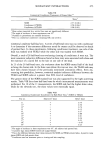
242 JOURNAL OF THE SOCIETY OF COSMETIC CHEMISTS 120 lOO 8o 6o 4o 2o -- _ - / / - O 1 2 3 4 5 6 7 Months at room temp. Figure 1. Stability of kukui nut oil at room temperature. Percentages of linolenate (C18:3n-3) remaining in kukui oil aoeter incubation. Closed triangles, in air, no antioxidants open triangles, in air open squares, under N2 closed squares, under N2, no antioxidants. after three months. Antioxidants protected against rancidity induced by exposure to air (open triangles). Stability tests done under a nitrogen atmosphere were considered to be models for kukui oil stability during shipping to a potential customer. The data (open squares) suggest that kukui oil remained stable for three to five months. Figure 2 is an elevated-temperature stability test. The data in Figure 2 suggest that 90% of the kukui oil remained non-rancid for about 17 days at 60øC. This contrasts with the results of the peroxide value test. Kukui oil without antioxidants exposed to air had peroxide values of 44 -+ 2.3 after 23/4 days exposure to 60øC and 133 -+ 63 after 17 days. With antioxidants and exposure to air, kukui oil had peroxide values of 7.0 -+ 0.3 and 41 -+ 6.3 at 23/4 and 17 days, respectively. Under a nitrogen atmosphere in the presence of antioxidants, peroxide values were 4.3 -+ 0.9 and 31 -+ 4.6 at the same incubation times. A repeat of the elevated-temperature test with the same batch of oil yielded indistin- guishable results using the linolenate test, while another repeat of the elevated- temperature test with a different batch of oil yielded similar but statistically different results. SKIN PENETRATION Table I is an example of a typical stripping. In the control region of the skin (no oil applied), lipid is concentrated in the top layers of skin. There was less and less oil as one

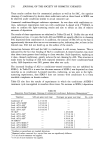
EMOLLIENT ACTION OF KUKUI NUT OIL 243 120 I I I .• 1 oo ß • 8o • 6o --• 4o ¸ • 20 0 I I I o 5 lO 15 20 Days at 60 degrees Figure 2. Stability of kukui nut oil measured at 60øC. Percentages of linolenate (C18:3n-3) remaining in kukui oil after incubation. Closed triangles, in air, no antioxidants open triangles, in air open squares, under N2 closed squares, under N2, no antioxidants. went down into the skin via the strippings. For this sample, total fatty acids were 251 •g/strip in the fifth stripping. Table I also shows the penetration of kukui oil into the skin. As with the control, there was less and less oil as one went down through the layers of the stratum corneum. The level of fatty acids in the fifth stripping (1037 •g/strip) was significantly higher than Table I Strippings of Control (no oil applied) and Kukui Oil PatcheP Control Kukui oil Stripping no. 1 2 3 4 5 2 3 4 5 C12 Laurate 73 70 42 18 26 123 22 91 80 C 14 Myristate 64 53 32 24 21 65 18 43 37 Unknown 133 16 8 0 8 0 0 0 0 C16 Palmirate 380 123 81 54 44 393 105 99 79 C16:ln-7 Palmitoleate 65 23 18 9 8 14 6 5 6 C 18 Stearate 119 66 51 22 30 86 52 46 36 C18:ln-9 Oleate 356 132 181 42 84 458 215 179 125 C18:2n-6 Linoleate 421 49 46 21 17 3234 529 415 264 C18:3n-3 Linolenate 307 30 31 74 10 1849 473 392 405 C20:ln-9 Eicosenoate 0 0 0 0 0 17 0 0 0 Total fatty acids 1922 564 495 266 251 6243 1424 1275 1037 Example is from subject A. Units are p,g fatty acid/stripping.
Purchased for the exclusive use of nofirst nolast (unknown)
From: SCC Media Library & Resource Center (library.scconline.org)