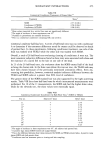
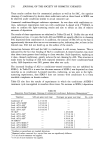
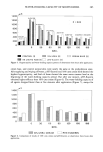
286 JOURNAL OF THE SOCIETY OF COSMETIC CHEMISTS pH5-Eucerin, which retained the ability to hold water at nearly the same level. At 180 seconds, all agents still had water content levels higher than the normal skin control (Figure 5). DISCUSSION The water content of stratum corneum in our test is chiefly concerned with the amount of the rapidly gained and lost "bound water" in stratum corneum (12). The baseline conductivity of normal skin is around 180 MS, which is higher than in other reports (7). This could be due to the climate in Thailand, which is warm and humid. Normal skin has a high hygroscopicity but a low water-holding capacity, and water content drops sharply in 30-60 seconds. This experiment, like previous reports (13-18), showed that moisturizers can increase the water content of the prehydration state and improve water-holding capacity. Com- paring water content at the prehydration state at five minutes and three hours after application of moisturizers, we found that the water content of the latter is less than that of the former. There are many reasons to explain this event: perhaps the properties of the agents are not stable due to degradation, or when we wiped off water, part of the agents may have also been removed. pH5-Eucerin showed the highest water content, meaning that this agent is more stable and longer-lasting. We were disappointed that we could not continue the experiment longer than three hours because the volunteers were not available. This meant that we could not establish when the water content of all treat- ments dropped to the level of normal skin. Among these agents, pH5-Eucerin obtained the highest hygroscopicity, both at five 5% LACTIC ACID _.,•.S 14oo 1200r 1 1000 t • 120 lOO 600 60 4oo F - 4o =øøl ...... I =o o, • - '•o •o' ,'o -,•o 1•o 18o 8e½. •'- AFTER 5 MIN, • AFTER 3 HR. pH5-Eucerin 14øø/• 1200 I 1000 • 800 V 400• 0 30 60 90 120 sec, •'-- AFTER 5 MIN. • AFTER 3 HR. 10% UREA CREAM 0 30 60 90 120 150 180 -4-- AFTER 5 MIN. • AFTER 3 HR. CREAM BASE I // ,00?/ T ...... 150 180 0 30 60 90 120 150 180 SeC. •'-- AFTER õ MIN. • AFTER 3 HR. Figure 7. Hygroscopicity and water-holding capacity of all agents, comparing observations five minutes and three hours after application.

WATER-HOLDING CAPACITY OF MOISTURIZERS 287 minutes and three hours after application of agents, and 10% urea cream was second in rank. For the water-holding capacity aspect, at five minutes after application 10% urea cream was the most efficient agent. It sustained a high water content, which declined slowly. At the same time, pH5-Eucerin seemed to drop faster than the rest, but at the end there were no differences among all agents in the water-content aspect. When compared to three hours after application, the water-holding capacity of pH5-Eucerin declined at nearly the same rate after five minutes observation. On the other hand, other agents showed lower water-holding capacity than pH5-Eucerin. We concluded that pH5-Eucerin is more effective than other agents because 1. The conductance of the prehydration state of pH5-Eucerin is higher than others at observation both five minutes and three hours after application. This reflects the higher water content on the skin surface. 2. pH5-Eucerin can obtain highest hygroscopicity at observation both five minutes and three hours after application. 3. For the water-holding capacity aspect, pH5-Eucerin obtains nearly the same rate of decrement at observation five minutes and three hours after application. This means that pH5-Eucerin still has high stability after three hours application. Among the institute formulas, 10% urea cream was the most effective agent, but urea is one of the popular agents used in commercial preparation, and we feel that it is worthwhile to prescribe it for patients with pathological dry skin conditions (19). ACKNOWLEDGMENTS We would like to thank all of the staff in the photobiology unit of the Institute of Dermatology, who helped us to carry out the testing procedures the volunteers the pharmaceutical unit of the Institute of Dermatology, which prepared the testing agents and the staff of the BDF Company who supplied PH5-Eucerin and did the computer analysis. REFERENCES (1) I. H. Blank, Further observation on factors which influence the water content of the stratum corneum, J. Invest. Dermatol., 21, 259-269 (1953). (2) A.M. Kligman, "The Biology of the Stratum Corneum," in The Epidermis, W. Montagna and W. C. Lobitz, Eds. (Academic Press, New York, 1964), pp. 387-433. (3) I. H. Blank, Factors which influence the water content of the stratum corneum, J. Invest. Dermatol., 18, 433-440 (1952). (4) O. T. Jacobi, About the mechanism of moisture regulation in the horney layer of the skin, Proc. Sci. Sect. Toilet Goo& Assoc., 31, 22-24 (1959). (5) P.M. Elias, Lipids and the epidermal permeability barrier, Arch. Dermatol. Res., 270, 95-117 (1981). (6) C. W. Blichmann, J. Serup, and A. Winther, Effects of single application of the moisturizer: Evaporation of emulsion water, skin surface temperature, electrical conductance, electrical capaci- tance, and skin surface (emulsion) lipids, Acta. Derre. Venereol. (Stockh.), 69, 327-330 (1989). (7) H. Tagami, Y. Kanamaru and K. Inoue, et al., Water sorption-desorption test of the skin in vivo for functional assessment of the stratum corneum, J. Invest. Dermatol., 78, 425-428 (1982). (8) J. L. Leveque, Physical methods for skin investigation, Int. J. Dermatol., 22, 368-375 (1983). (9) J. L. Leveque and J.de Rigal, Impedance methods for studying skin moisturization, J. Soc. Cosmet. Chem., 34, 419-428 (1983).
Purchased for the exclusive use of nofirst nolast (unknown)
From: SCC Media Library & Resource Center (library.scconline.org)