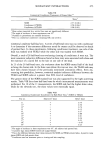
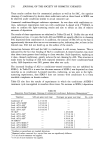
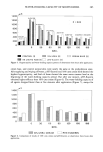
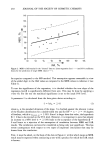
296 JOURNAL OF THE SOCIETY OF COSMETIC CHEMISTS variable in the correlation, this would, furthermore, seem to imply that MB testing has no discriminating power with respect to testing skin roughness. This consequence does not fit the general empirical experience with the test (5), and it has, hence, to be concluded that both methods are subject to substantial and possibly similar measure- ment errors that will make the validity of the discrimination of small effects, and hence of small product differences, questionable. This point is supported by the existence of the outlier for IA testing. Though we accepted the point as an outlier to conduct the statistical analysis of the data, this decision is in reality rather difficult to justify. The outlier does not relate to a single data point, which might be omitted on the basis of the assumption of a single measurement error, but it actually is the mean roughness value measured for the product applied by 20 test persons. This leads to the conclusion that image analysis is either prone to substantial, random, experimental errors or that in this case a systematic measurement bias passed undetected for a whole series of tests. In any case, the outlier is difficult to understand and its existence certainly gives weight to the assumption that IA testing is subject to experimental errors comparable to those of the methylene blue method. Comparing the test results for the two methods on a semantic basis, the results in Table IV show that image analysis comes to substantially better ratings in the classification scheme than the methylene blue test. A total of 17 products is rated as good or very good by IA, while no product is classed as very good by MB and only 8 as good. In contrast to image analysis, MBR testing indicates that skin roughness is largely unchanged or only slightly improved after cosmetic product use. While the overall ratings are already substantially different for the two test methods, the individual classifications show a high degree of inconsistency. Only in six cases do both tests come to equal ratings in 11 cases ratings are obtained that are one class apart. In four cases ratings are even dissimilar to the extent of two classes, so that, for example, products 10 and 11 are rated very good (+ + ) by IA and only acceptable by MB, and products 21 and 22 are rated good by IA and unacceptable by the MB test (see Table I). In view of the similar quality of the correlations found by Schrader et al. (2) for the scanning method vs IA (r = 0.315) and for skin moisture evaluation vs IA (r = - 0.59), similar arguments and conclusions as for MB vs IA (r = 0.484) can plausibly be expected to apply to these methods. However, a complete evaluation of the data in reference 2 is outside the scope of the present article. CONCLUSION Both methods for the assessment of skin roughness, namely the methylene blue and the image analysis tests, obviously exhibit substantial variability in their results, which even with a rather rough classification system lead to inconsistent test results for the 22 skin care products investigated. This, in turn, leaves some serious questions, if not doubts, with respect to the validity, reproducibility, and accuracy of the tests and, hence, with respect to the requirements set out by Stiftung Warentest (3) for such tests, namely that (in translation), "Modern methods of investigation help us to unequivocally and objectively prove effects and

SKIN ROUGHNESS ASSESSMENT 297 record even small differences," where the results for specified commercial products are passed on to the consumer for his information and as buying recommendations. REFERENCES (1) K. Schrader, Grundlagen und Rezepturen der Kasmetika, 2. Auflg. (Hiithig Buch Verlag, Heidelberg, 1989). (2) K. Schrader and S. Bielfeldt, Comparative studies of skin roughness measurements by image analysis and several in viva skin testing methods, J. Sac. Cosmet. Chem., 42, 385-391 (1991). (3) Sonderheft, Kasmetik (Stiftung Warentest, Berlin, 1992). (4) J. H. Zar, Biastatistical Analysis, 2nd ed. (Prentice-Hall, Englewood Cliffs, NJ, 1984). (5) G. Padberg, Modifizierte Methylenblau-Methode zur Priifung des Rauhigkeitsgrades der Haut- schicht, J. Sac. Cosmet. Chem., 20, 719-728 (1969).
Purchased for the exclusive use of nofirst nolast (unknown)
From: SCC Media Library & Resource Center (library.scconline.org)