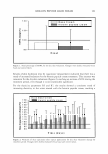
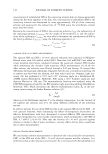
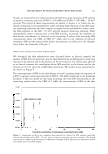
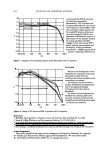
SDS MICELLES IN SKIN BARRIER PERTURBATION 117 of the surfactant tails and the high water-air surface free energy promote the adsorption of the surfactant molecules onto the surface (40). The increase in the surface pressure due to surfactant surface adsorption leads to a lowering of the surface tension, er. Beyond a certain threshold surfactant concentration, the CMC, it becomes more favorable, from a free energy point of view, for the surfactant molecules added to the solution to form micelles, rather than to continue to adsorb at the surface. This is reflected in a negligible change in surface tension, er, with increasing surfactant concentration, X, beyond the CMC. The "break" in the er versus X curve, therefore, approximates the concentration at which micellization first takes place (40). In order to determine this "break," the equilibrium surface tensions of SDS in water and of SDS in water + 10 wt% glycerol were measured as a function of the logarithm of the SDS solution concentration using a Kruss K-11 tensiometer (Kruss, Charlotte, NC) with a platinum plate. Additional experimental details can be found in reference 41. The experimental uncertainty in the surface tension measurements was approximately 0.05 dyn/cm. The temperature was held constant at 25.0 ± 0.1 °C by a thermostatically controlled jacket around the sample. A plot of er as a function of the logarithm of the surfactant concentration, X, was generated using the procedure outlined above for the SDS and for the SDS + 10 wt% glycerol aqueous micellar solutions. Linear regression was used to determine the best fit line on either side of the break in the curve, and the value of the SDS concentration at the intersection of these two best-fit lines was taken as the experimental CMC value. THEORETICAL DETERMINATION OF THE RADIUS AND NUMBER DENSITY OF THE SKIN AQUEOUS PORES Tang et al. (7) have recently demonstrated the existence of a linear-log relationship between the mannitol skin permeability, PJ and the average skin electrical resistivity, R. Specifically, within statistical error, the following relation holds (7): log P = log C - log R (4) where C = (k B T/2z2Fc i00 e 0 )*(D H(},-p)/D: n H(A ion )) is a constant that depends on the average skin aqueous pore radius, r pore ' through H(A p ) and H(A ion ), as follows (7 ,8,42): 1 H(AJ = fll - 2.1044},.,. i + 2.089Af - 0.948A�), for Ai 0.4 (5) where i = p (permeant, in our case, mannitol) or ion, r p ore = pore radius, A i = r/r pore ' and pi (the partition coefficient of i) = (1 - A/. Note that equation 5 considers only steric, hard-sphere particle (p or ion)-pore wall interactions, and does not account for longer range interactions, such as electrostatic and van der Waals interactions (7). Although the ions (and the permeant molecules) in the contacting solutions may be charged, Tang et al. have shown that equation 5 is valid provided that the Debye-Hi.ickel screening length-the length scale associated with the screening of electrostatic interactions be tween the ions (or between the charged permeants) and the negatively charged skin aqueous pore walls-is much smaller than the average skin aqueous pore radius, r p ore (7). 1 Tt is noteworthy that the skin aqueous pores have a distribution of pore radii (9). In this paper, we imply the average pore radius to be the mean of this distribution of pore radii, and denote this as the radius of the aqueous pores.

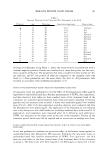
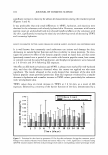
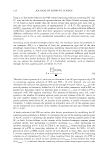
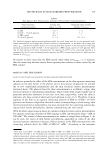
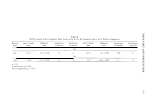
118 JOURNAL OF COSMETIC SCIENCE Tang et al. also showed that for the PBS control contacting solution containing Na+ and c1- ions, and also for the mannitol aqueous solution, the Debye-Hi.ickel screening length "S:.7 A, which is much smaller than the typical average skin aqueous pore radii, that is, than the sizes of the aqueous pores, of approximately 15-25 A (7). The quantities, v and D: 1n appearing in C refer to the permeant and to the ion infinite-dilution diffusion coefficients, respectively (note that these quantities correspond typically to the bulk diffusion coefficients of the permeant and of the ion in the dilute donor contacting solutions used in the in vitro transdermal permeability and electrical resistivity mea surements). According to the hindered-transport theory (42), the hindrance factor for permeant or ion transport, H(A), is a function of both the permeant/ion type and of the skin membrane characteristics. The four intrinsic membrane characteristics of the skin barrier are: (i) the porosity, B, which is the fraction of the skin area occupied by the aqueous pores, (ii) the tortuosity, T, which is the ratio of the permeant diffusion path length within the skin barrier to the skin barrier thickness, (iii) the average pore radius, r po w and (iv) the skin barrier thickness, LlX. Based on these four membrane characteristics, one can express the permeability, P, of a hydrophilic permeant, such as mannitol, through the skin aqueous pores as follows (6,7,42): (6) Therefore, from equations 4-6, once one can determine P and R upon exposure of p-FTS to contacting aqueous solutions of SDS and SDS + 10 wt% glycerol, one can also determine the radius of the aqueous pores as the average skin pore radius, r por e' and the ratio of porosity-to-tortuosity, defined as BIT, if all the other parameters, such as LlX, are known (see Appendix, where we illustrate how to deduce r pore and BIT when p-FTS is contacted with SDS aqueous solutions). The porosity-to-tortuosity ratio, BIT, corre sponds to the number of tortuous aqueous pores per unit volume of the SC, that is, to the pore number density (6,7,42). In the context of the hindered-transport aqueous porous pathway model of the SC, an increase in the porosity, B, and/or a decrease in the tortuosity, T, which increases the porosity-to-tortuosity ratio, BIT, of the aqueous pores, can be interpreted as an increase in the number of aqueous pores per unit volume of the SC (7-9,42). A harsh surfactant like SDS can induce skin barrier perturbation by modifying the SC aqueous porous pathways as follows: (i) increasing the size of the existing aqueous pores in the SC, and/or (ii) increasing the number density of the existing aqueous pores in the SC, or both. It then follows, in the context of the hindered-transport aqueous porous pathway model, that mechanism (i) involves increasing r po re, while mechanism (ii) involves increasing BIT [6-9,42}. In Table I, we report r pore values resulting from the exposure of p-FTS to contacting solutions of: (a) SDS in water, (b) SDS + 10 wt% glycerol in water, (c) PBS control, and (d) 10 wt% glycerol in water. Note that in Table I, we have reported the BIT values resulting from the exposure of p-FTS to the contacting solutions (a-d) normalized by the BIT value resulting from the exposure of p-FTS to contacting solution (c), which we have denoted as (B/T)normal· It then follows that when (B/T)00rmal 1, it indicates that the contacting solution creates more aqueous pores in the
Purchased for the exclusive use of nofirst nolast (unknown)
From: SCC Media Library & Resource Center (library.scconline.org)