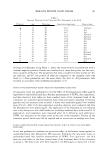
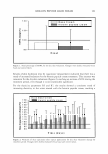
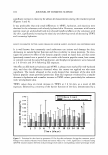
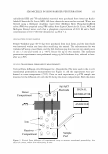
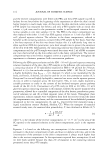
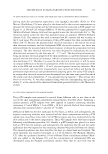
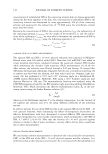
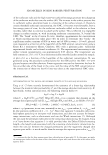
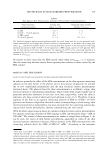
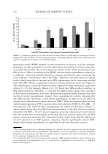
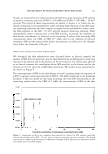
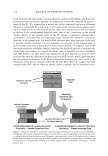
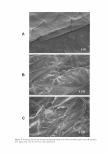
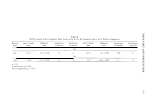
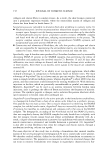
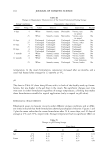
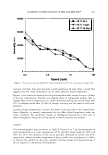
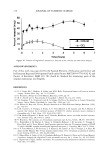
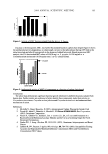
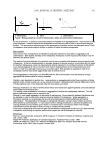
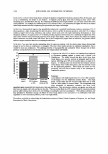
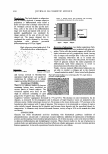
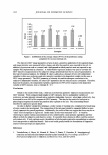
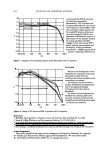
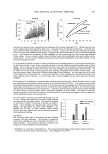
Initial time (TO) After 1 month's storage at 45°C DISSOLVABLE ANTI-WRINKLE FILM Table I Stability of the Dissolvable Adenosine-Containing Film Over Time Film weight (mg) (n = 20) 10.6 ± 0.5 11.3 ± 0.8 Water content (% w/w) (n = 15) 10% 10% Water activity (n = 3) 0.35 VISUALIZATION OF FILM DEPOSITION ON THE SKIN 151 Adenosine content (mg/film) (n = 5) 0.104 ± 0.001 0.100 ± 0.001 Scanning electron microscopy (SEM) showed that one hour after dissolution with water on the skin, the film formed a continuous and homogeneous layer fully covering the wrinkle area onto which it was applied (Figure 3B). After six hours, the film dried and the layer became partially discontinued as some solid pieces of the film detached. However, large skin surfaces were still covered with the film layer six hours after application (Figure 3C). EVALUATION OF ANTI-WRINKLE EFFICACY IN FEMALE VOLUNTEERS As measured by FOITS, both the Ra and Rz skin roughness parameters decreased following the application of the 1 % adenosine-containing film. The reduction in rough ness was evidenced as early as three weeks after starting product application and reached a level of -4.5% and -5.3% for Rz and Ra, respectively (Table II). At three weeks, the reduction of the skin roughness parameters obtained with the dissolvable film was significantly higher than that induced by the placebo cream. An improvement in the facial relief in the periorbital region was still observed at eight weeks (Table II). DISCUSSION The present study investigated the formulation and the efficacy of a thin, water-soluble film to deliver a cosmetic active ingredient, adenosine, onto the skin. Preformulation data showed that low-molecular-weight cellulose derivatives, e.g., hydroxypropylcellu lose or hydroxypropylmethylcellulose were suitable polymers to formulate such films. Indeed, other polymers widely used to formulate oral strips, such as pullulan, are less suitable for skin application. For example, upon drying, pullulan becomes very sticky, leading to unpleasant cosmetic effects (data not shown). The film we developed quickly dissolves in water and can be spread on the skin within seconds when applied with a drop of water. It also adsorbs moisture to a large extent when exposed to high RH. Water uptake of cellulose-based films was found to increase sharply in a high-water-activity environment (6). It is also hypothesized that the high level of glycerin present in the formulation (30%) strongly increases the water uptake of the film. It was previously reported that adding 30% glycerin in hydroxypropylcellulose films dramatically increases water permeability and film elongation (7). Howf'vf'r, in a suitable packaging, the film appears stable over time and no degradation of the active ingredient adenosine is detected. The film is a substantially dry dosage form and hence

A B C Figure 3. Scanning electron microscopy micrographs of the skin surface (A) before application, (B) one hour after application, and (C) six hours after application.
Purchased for the exclusive use of nofirst nolast (unknown)
From: SCC Media Library & Resource Center (library.scconline.org)