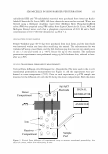
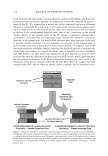
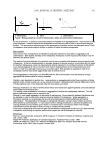
190 JOURNAL OF COSMETIC SCIENCE KEYNOTE AWARD LECTURE SPONSORED By RUGER CHEMICAL CORPORATION INTERPARTICLE INTERACTIONS IN COLOR COSMETICS Lorna M. Kessell, Ph.D. Uniqema R&D, United Kingdom Pigments are the primary ingredient of any color cosmetic and the way in which these particulate materials are distributed within the product will determine many aspects of product quality including functional activity (color, opacity, UV protection), stability, rheology and skin feel. The particulate distribution depends on many factors such as particle size/shape/surface characteristics, processing and other formulation ingredients but ultimately is determined by the interparticle interactions. The fundamental principles of preparation of pigment dispersions are briefly described. These include wetting, dispersion (or wet milling) and stabilisation. This is followed by a section on stability for both aqueous and non aqueous media. Finally the use of rheometry in assessing particulate dispersions will be described. Introduction Simple mixing of inorganic powder (eg titanium dioxide or zinc oxide) can produce a fluid dispersion even at 50% solids. However this is not necessarily an indication of a 'well dispersed' material and indeed a particle size analysis (and for UV attenuators spectral analysis) demonstrates that particle dispersion is not optimised. The addition of mechanical energy (through milling) can break the aggregates (present in all powders) into their discrete nano-particles but the level of added dispersant/stabiliser can be critical in achieving a usable and stable dispersion. A dispersion could be highly stable but be too thick to stir or so thin it sediments. Rheometry can be a very useful tool in determining stability and on the other hand the rheological characteristics can be modified to give the required aesthetics by a suitable choice of stabilising agents. Stabilisation All particles experience attractive forces on close approach. The strength of this van der Waals attraction VA (h) depends upon the distance h between particles of radius R and is characterised by the Hamaker constant, A. The strength of this attraction(A) depends upon the dielectric properties of the material and for some materials such as TiO2 this is exceptionally high so that (in non-aqueous media at least) despite their small size a dispersant is always needed to achieve colloidal stabilisation. a. Steric stabilisation This is usually obtained using adsorbed layers of polymers or surfactants. The most effective molecules are the A-8 or ABA block or BA0 graft polymeric surfactants4 where 8 refers to the anchor chain. For a hydrophilic particle this may be a carboxylic acid, an amine or phosphate group or other larger hydrogen bonding type block such as polyethylene oxide. The A chains are referred to as the stabilising chains which should be highly soluble in the medium and strongly solvated by its molecules. For non-aqueous dispersions the A chains could be polypropylene oxide, a long chain alkane or oil soluble polyester. When two particles with an adsorbed layer of hydrodynamic thickness � approach to a separation distance h that is smaller than 26, repulsion occurs as a result of two main effects: (i) unfavourable mixing of the A chains when these are in good solvent condition (ii) reduction in configurational entropy on significant overlap. b. Electrostatic stabilisation For some powders we have a second option. Inorganic oxides have ionisable groups on their surface which means that in aqueous media they can therefore develop a surface charge depending upon pH, which affords an electrostatic stabilisation to the dispersion. This stabilisation is due to the interaction between the electric double layers surrounding the particles (2). This double layer repulsion depends upon the pH and electrolyte concentration. When the pH of the disfersion is well above or below the isoelectric point or the electrolyte concentration is less than 10· 2 mol dm· 1 :1 electrolyte, repulsion is often sufficient to produce a dispersion without the need for added dispersant However, in practice this condition cannot be reached since at high solids content the ionic concentration from the counter and co-ions of the double layer is high and the surface charge is not uniform. Therefore a dispersant such as sodium polyacrylate is required to achieve this high solids content. This produces a more uniform charge on the surface and some steric repulsion due to the high molecular weight of the dispersant. Under these conditions the dispersion becomes stable over a wide range of pH at moderate electrolyte concentration. This is electrosteric stabilisation. A schematic representation of the energy -distance curves can help us visualise the stabilisation and how to improve it. A positive energy barrier on close approach is required to prevent aggregation. As the distance between the particles, h, decreases this is achieved in all three cases. A small G 0 (attraction) may remain in some cases and can be beneficial as will be described later.

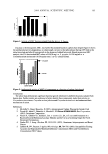
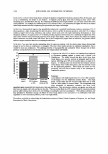
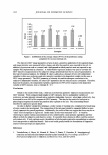
G ! ,_.... / ! I I . I \! h 2006 ANNUAL SCIENTIFIC MEETING ! \ \ h G a. electrostatic b. steric c. electrosteric Figure 1 Energy distance curves for electrostatic, steric and electrosteric stabilisation 191 So that is the theory. In practice, particulate powders are supplied in an aggregated state. They must be in order to be handleable. However they must be milled down to their individual units in order to provide their designed function. This process must allow transport of the dispersant to the particle surface and adsorption there. Finally the dispersion must remain stable to dilution or addition of further formulation components. Discussion There are two main consequences of instability in particulate dispersions- flocculation or aggregation and sedimentation. Both depend ultimately on the interparticle interactions and the viscosity of the medium and will determine the product quality. The required functional attributes of a particulate used in colour cosmetics often depends critically upon its state of dispersion. A titanium dioxide pigment for example, designed to provide opacity in a formulation will not realise its maximum hiding power unless it is dispersed and remains dispersed in its constituent particles of 200-300nm. A UV attenuating grade of TiO2 on the other hand must be dispersed down to its primary particle size of 50- 100nm in order to be optimally functional as a sunscreen agent. Both powders as supplied (in order to be handleable) however have similar agglomerate sizes of several microns. Particle aggregation or flocculation can also affect the skin feel of a formulation since the presence of large aggregates can be detrimental to sensory properties Stability is very dependent on particle size. Larger particles or aggregates particularly those consisting of dense pigment will be inclined to settle out in a low viscosity formulation. Remembering the density differences of some of these pigments even in their dispersed state this may require some tricks. Rheology modification can help to minimise these effects and indeed some pigment particles cannot be stabilised without help from rheological aids. This settling is often preceded by flocculation or aggregation if particles are inadequately stabilised. Thus the particle stabilisation again plays an important role. Although In most cases aggregation is detrimental to performance. Some interaction between the particles may be desirable in order to enhance the long-term physical stability of the dispersion. Weak aggregation or flocculation resulting in a reversible gel can provide enhanced dispersion stability effectively eliminating sedimentation. This dependence of rheology on interparticle interaction is a keen area of interest and will be demonstrated by some examples. In many cases however rheology modification is achieved by addition of a rheology modifier such as xanthan gum in water or a bentonite clay in non-aqueous media. The rheology characteristics can be described in terms of creep or oscillation measurements. A thorough understanding of the nature of gels and the selection of appropriate conditions to give both the state of dispersion and rheology for optimum performance is again the role of the dispersion scientist. References Fleer GJ, Cohen-Stuart MA, Scheutjens JMHM, Cosgrove T, Vincent B: Polymers at Interfaces. Chapman and Hall, London, 1993. Napper FH: Polymeric stabilization of Colloidal Dispersions. Academic Press, London, 1989. Kessell LM, Naden BJ, Tadros ThF: Attractive and Repulsive Gels From Inorganic Sunscreen Actives, Proceedings of the IFSCC 23rd Congress, October 2004.
Purchased for the exclusive use of nofirst nolast (unknown)
From: SCC Media Library & Resource Center (library.scconline.org)