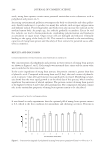
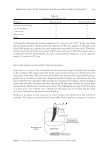
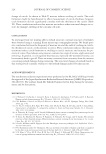
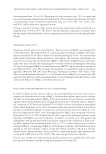
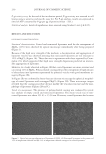
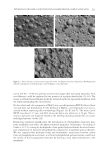
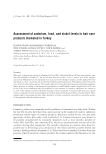
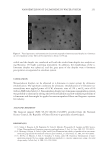
JOURNAL OF COSMETIC SCIENCE 220 absent, (ii) one small crack, (iii) several small cracks, (iv) a large crack in a narrow part of the cuticle, and (v) a large crack in a wide part of the cuticle. At fi rst, fi ve typical cross- sectional images agreed with these categories were selected from images of all 36 eyelash samples. Second, other 31 samples were ranked with resemblance to the typical images. Porosity of cortex. The electron density mapping of the reconstructed cross-sectional image of eyelash was binarized. The threshold value of binarized image was determined sensibly to fi t the pore space of each cross-sectional image. The porosity of cortex region was cal- culated using Image J (http://rsbweb.nih.gov/ij/). STATISTICAL ANALYSIS Statistical analyses were performed using SPSS 12.0J for Windows (IBM-SPSS Japan, Tokyo, Japan). The correlations among the categories of age distribution, frequency of mascara and/or eyelash curler, and degree of cracking in cuticle were analyzed by Spear- man’s method using the fi ve ranks of each category. The correlation analyses, thickness of cuticle and porosity of cortex, were performed using Pearson’s method. The correlation analyses between the each category and the each character mentioned above were per- formed using Spearman’s method. RESULTS AND DISCUSSION RECONSTRUCTED CROSS-SECTIONAL IMAGES OF EYELASHES Thirty-six eyelash samples were observed using a differential phase-contrast scanning X-ray microscopic CT system. Typical CT image of an eyelash measured with this system is shown in Figure 2. Three components (cuticle, cortex, and medulla) were observed in the structure of the eyelash. Melanin granules were observed as small white dots in the cortex, indicating that they are relatively dense. Small pores were observed as small black dots in the cortex. These characteristics are very similar to those of scalp hair observed in the previous study Figure 2. Cross-sectional image of an eyelash. The arrow head in the eyelash image indicates a crack in the cuticle.

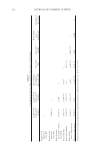
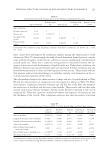
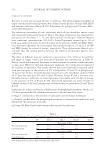
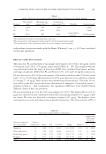
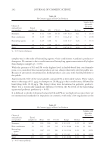
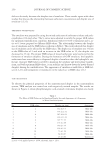
INTERNAL STRUCTURE CHANGES OF EYELASH INDUCED BY EYE MAKEUP 221 (5). The resemblance between eyelash and scalp hair is in agreement with the previous re- ports that observed eyelashes using transmission electron microscopy (TEM) (4,6). The difference of internal structure between eyelash and scalp hair is not clear at present. As shown below, the shapes and sizes of eyelashes were varied with samples from different- people. We have observed scalp hair samples from only one person (5), and the structural characteristics of scalp hair were in the range of variations of eyelash samples. Using the reconstructed cross-sectional images, the sizes of specifi c regions of the eye- lashes were measured (Table III). In the reconstructed cross-sectional images, cross sec- tion of eyelashes had an elliptical shape, the mean length of the major axis was 77.8 μm, and the mean length of the minor axis was 63.2 μm. They are consistent with a previous study in which eyelash diameter was measured from digital photograms (4). By contrast, the mean thickness of the cuticle layers was 2.0 μm in this study, whereas it was measured to be 5.3 μm from TEM images in the previous study (4). In the TEM observation, the eyelash samples were pretreated by many steps of procedures containing fi xation steps using glutaraldehyde and osmium tetroxide. In this study, the eyelash samples did not undergo prior processing. The pretreatments prior to TEM imaging might have induced morphological changes in the cuticle. The relationships among these measurements were investigated (Table IV). The area of the fi ber correlated positively with the length of the major axis of the fi ber and the length of the minor axis of the fi ber. The ratio of minor axis of length versus major axis length did not correlate with area of fi ber. These correlations indicate that eyelashes of different sizes tend to have a similar shape. In contrast, the area of the fi ber correlated positively with the ratio of fi ber area versus medulla area. This means that the percentage of medulla space in total fi ber space tends to be wider in larger eyelashes. Similar correlation has been found in scalp hair (7). The thickness of the cuticle correlated positively with the major axis length, but not with the minor axis of the length. This characteristic seems to refl ect the negative correlation between the ellipticity of fi ber, the ratio of minor axis of length versus major axis length, and the thickness of cuticle. EFFECT OF EYE MAKEUP ON EYELASH STRUCTURE Cracks were observed in the cuticles of eyelashes (indicated by arrows in Figure 2), and the extent of the cracks varied among the samples. Factors underlying the formation of Table III Shape and Size of the Eyelashes Mean Standard deviation Length of the major axis of the fi ber (μm) 77.8 13.3 Length of the minor axis of the fi ber (μm) 63.9 10.5 Ratio of minor axis length vs. major axis length 0.826 0.073 Area of the fi ber (×100 μm2) 39.9 12.6 Area of the medulla (×10 μm2) 31.1 20.0 Ratio of fi ber area vs. medulla area 0.076 0.034 Thickness of the cuticle (μm) 2.05 0.64
Purchased for the exclusive use of nofirst nolast (unknown)
From: SCC Media Library & Resource Center (library.scconline.org)