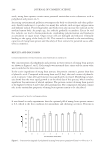
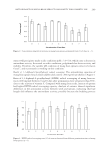
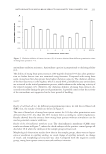
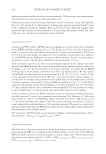
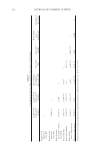
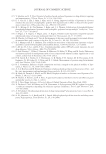
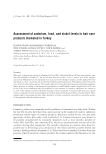
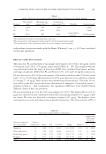
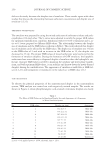
Table IV Correlations between the Shape and Size Characteristics of the Eyelashes Length of the major axis of the fi ber Length of the minor axis of the fi ber Ratio of minor axis length vs. major axis length Area of the fi ber Area of the medulla Ratio of fi ber area vs. medulla area Thickness of the cuticle Length of the major axis of the fi ber 1 Length of the minor axis of the fi ber 0.860 (**) 1 Ratio of minor axis length vs. major axis length − (*) 0.184 1 Area of the fi ber 0.961 (**) 0.958 (**) −0.077 1 Area of the medulla 0.610 (**) 0.703 (**) 0.1 0.677 (**) 1 Ratio of fi ber area vs. medulla area 0.438 (*) 0.533 (**) 0.067 0.480 (**) 0.841 (**) 1 Thickness of the cuticle 0.459 (*) 0.25 −0.436 (**) 0.361 (*) 0.068 -0.088 1 Correlations were analyzed using Pearson’s method. Correlation coeffi cients are shown. * 0.05, **p 0.01. JOURNAL OF COSMETIC SCIENCE 222

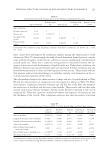
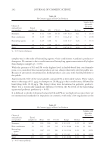
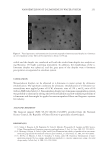
INTERNAL STRUCTURE CHANGES OF EYELASH INDUCED BY EYE MAKEUP 223 these cracks were investigated by correlation analysis among the characteristics of the volunteers (Table V). Interestingly, the rank of crack formation showed positive correla- tions with the frequency of mascara use, whereas it was not signifi cantly correlated with eyelash curler use. There was a relatively strong positive correlation between the fre- quency of mascara use and the frequency of eyelash curler use. Under these conditions, the difference between mascara and eyelash curler use was found. Similar correlation was also found between porosity of cortex and the frequency of mascara use. These results indicate that mascara induces structural changes to eyelashes, namely crack formation in the cu- ticle and increased porosity of the cortex. The relationships between the characteristics of shape and size of eyelash shown in Table III and the characteristics of volunteers were investigated as shown in Table VI. There were negative correlations between volunteer age and the area of the fi ber, the length of the minor axis of the fi ber, and the area of the medulla. These results indicate that older women tend to have thinner eyelashes. Similar results had been reported in the case of scalp hair (8). There was a positive correlation between the frequency of mascara use and the thickness of the cuticle. This correlation indicates that mascara induces structural Table V Correlations between the Characteristics of the Volunteers and Eyelash Structure Age of volunteer Eyelash curler use Mascara use Cracking of the cuticle Porosity of the cortex Age of volunteer 1 Eyelash curler use 0.15 1 Mascara use −0.133 0.528 (**) 1 Cracking of the cuticle −0.051 0.051 0.348 (*) 1 Porosity of the cortex 0.057 0.025 0.389 (*) 0.156 1 Correlations were analyzed using Spearman’s method. Correlation coeffi cients are shown. *p 0.05, **p 0.01. Table VI Correlations between the Properties Shown in Table V and the Eyelash Shape and Size Characteristics Age of volunteer Eyelash curler use Mascara use Cracking of the cuticle Porosity of the cortex Area of the fi ber −0.335 (*) −0.105 0.05 −0.054 0.061 Length of the major axis of the fi ber −0.309 −0.092 0.075 −0.021 0.134 Length of the minor axis of the fi ber −0.348 (*) −0.094 −0.008 −0.142 0 Area of the medulla −0.402 (*) 0.173 0.031 0.008 −0.021 Ratio of minor axis length vs. major axis length 0.097 −0.13 −0.223 −0.172 −0.274 Ratio of fi ber area vs. medulla area −0.368 (*) 0.283 −0.029 −0.068 0.111 Thickness of the cuticle −0.179 −0.069 0.361 (*) 0.282 0.263 Correlations were analyzed using Spearman’s method, with the exception of correlations with porosity of the cortex, which were analyzed using Pearson’s method. Correlation coeffi cients are shown. *p 0.05.
Purchased for the exclusive use of nofirst nolast (unknown)
From: SCC Media Library & Resource Center (library.scconline.org)