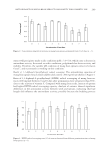
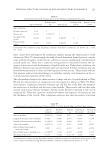
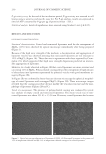
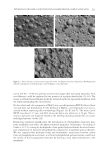
JOURNAL OF COSMETIC SCIENCE 210 increases the antioxidizing activity of certain smaller components. So, sprout extracts have good potential for use in food and cosmetic products as a new antioxidant, which is natural, pro-environment, and the production process relatively much simpler. Results of total antioxidant capacity. The experiment measuring the standard curve is y = 0.23x + 0.0101 (R2 = 0.9886, x: concentration of FeSO4 (mM) y:absorption value). The total antioxidant capacity of mung bean extracts (200 mg/ml) from 0 to 8 days after ger- mination was examined by the ferric reducing antioxidant power (FRAP) method. The total antioxidant capacity of mung bean extracts (200 mg/ml) from days 0 to 8 was examined by aFRAP test. As Figure 4 shows, the total antioxidant capacities of the ex- tracts from 2 and 6 days after germination are the highest, about 7.47 mmol/kg. The total antioxidant capacity of the samples from other days are lower than these two days, but compared with mung bean seed, mung bean sprouts have higher total antioxidant capacity. The FRAP assay showed that extracts from 2 and 6 days after germination had a high ferric reducing antioxidant capacity. We also observed a positive and signifi cant correla- tion between the concentrations of polyphenols in water extracts of mung bean sprouts and FRAP results (R2 = 0.989 and p = 0.020). As section on “Concentrations of Polyphe- nols and Proteins in Extracts” shows, the concentrations of polyphenols 2–3 days and 6–7 days after germination are higher than that on the other days. A correlation observed between FRAP and the concentrations of polyphenols in mung bean sprouts was also re- ported by Huang et al. (11), owing to the ability of polyphenols to act as hydrogen donors. Results of chelation abilities of ferrous ion. C helation abilities of ferrous ion of mung bean extracts (200 mg/ml) from 0 to 8 days after germination are shown in Figure 5. Antioxidants can quench reactive oxygen, accept free radicals, or chelate metal ions. Through these and other various ways of preventing free radical chain reactions, they can eliminate damage to the organism by the oxidation of the material, such as lipid peroxidation. Therefore, the chelating ability of Fe(II) is also commonly used to evaluate Figure 4. Total antioxidant capacity (mmol/kg) of extracts obtained from different germination times of mung bean sprouts (n = 3).

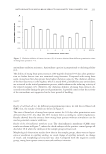
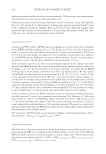
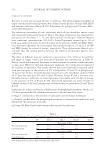
ANTIOXIDANTS IN MUNG BEAN SPROUTS AND SAFETY FOR COSMETIC USE 211 antioxidant oxidation resistance. Antioxidant capacity is proportional to chelating ability (12). The ability of mung bean sprout extracts (200 mg/ml) obtained 0–8 days after germina- tion to chelate ferrous ions was examined using ferrozine. Compared with mung bean seeds, mung bean fi rst-day sprouts have higher chelation capacity. The chelation abilities of the fi rst-day extract is the highest, which is nearly 80%, probably because antioxidants are activated in the initial germination process, which enhances the inducing activity of the related enzymes (13). However, the chelation abilities of mung bean extracts de- creased noticeably during the process of germination. A possible cause is that the activity of the antioxidant was suppressed in the later period of budding. SAFETY Results of red blood cell test. At different postgermination times, we did the red blood cell (RBC) test, the results of which are shown in Figure 6. The rates of hemolysis of mung bean sprout extract for 0–8 days after germination were all lower than 10%, less than the 20% excitant limit according to current regulations. Results showed that the extracts from mung bean sprouts without stimulation can be used as potential cosmetic additives. Results of the chorioallantoic membrane assay. The chorioallantoic membrane (CAM) assay results are shown in Figure 7, where the chick embryos of the positive control groups all died after 48 h while the embryos of the sample groups all survived. Morphological observation results show that in the sample groups, there were no hyper- emia or exudation in capillary ending, no visual change of capillary network, no change of vessel, and morphological structure was clear. Compared with the negative control group, mung bean sprout extracts were safe without irritation. Figure 5. Chelation abilities of ferrous ion rates (%) of extracts obtained from different germination times of mung bean sprouts (n = 3).
Purchased for the exclusive use of nofirst nolast (unknown)
From: SCC Media Library & Resource Center (library.scconline.org)