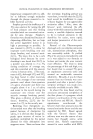
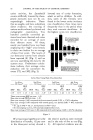
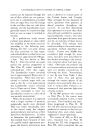
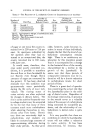
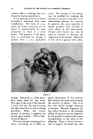
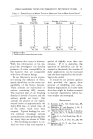
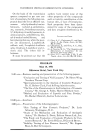
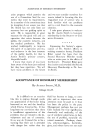
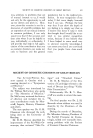
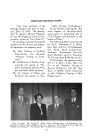
AMMONIATED DENTIFRICES 67 Figure 1.--Low magnification of thinly ground section of dental enamel with bacte- rial plaque over early carious lesion. turbed for rather long periods. Fig- ures 1 and 2 illustrate the bacterial plaque firmly attached to the enamel surface. My work on the possibility of re- ducing the activity of tooth decay with ammonia or ammonia-liberat- ing materials arose from a study of decay-resistant people. This con- cept originated from the idea that a study of individuals who had no dental caries might reveal informa- tion that was unobtainable in caries- susceptible persons because the lat- ter are lacking in decay-resisting factors. One of the characteristics of caries-free individuals is that their oral bacterial flora rarely con- tains Lactobacillus acidophilus. It has not been definitely estab- lished that this micro-organism is an etiologic factor in decay production but its presence or absence is widely accepted as an indication of decay activity. The evidence is so ex- tensive and convincing that a num- ber of state health departments have set up a salivary Lactobacilli count service for use by the dental pro- fession. We attempted to plant this species of bacteria into the oral flora of caries-resistant subjects but were not successful. Even when this organism was placed in the mouth by the millions in milk cul- Figure 2.--Bacterial plaque attached to enamel surface viewed under oil emersion.

68 JOURNAL OF THE SOCIETY OF COSMETIC CHEMISTS tures which had been prepared for this purpose the organism was com- pletely eliminated from the oral cavity within eight to twelve hours. This observation led to a series of experiments which determined that ammonia formed rather rapidly in broth cultures of saliva collected from caries-resistant individuals. It was subsequently determined in test tube experiments that certain salts of ammonia would inhibit the growth of Lactobacilli (2). The so-called acid salts of am- monia, that is, those made by com- bining ammonia with a strong acid such as ammonium chloride or am- monium nitrate when unmodified, had little effect on the development of Lactobacilli. But the ammonium salts prepared by combination with weaker acids such as ammonium carbonate, lactate, or di-ammonium phosphate had an inhibiting action. This observation leads us to believe that it is not so much the ammo- nium ion as it is ammonia gas that interferes with the growth of the Lactobacilli. Certainly ammonium chloride and sulfate ionize in saliva or culture medium and yet they do not alone check the development of these bacteria. We found ammo- nium carbonate to be the most effec- tive salt and the presence of 0.5 mg. of ammonium nitrogen from this source per milliliter of culture me- dium was sufficient to inhibit the growth of Lactobacilli. It was subsequently found that when dibasic ammonium phosphate, which seemed to be the most prac- tical of the ammonium salts to use for oral preparations, was combined with urea not only was the in vitro development of Lactobacilli in caries- active saliva checked but also the degradation of glucose to lactic acid, when added to that saliva, was stopped. Based on this information, a clinical study was started to deter- mine if the conscientious use of a dentifrice containing these materials would have an effect in the oral cavity similar to what we had ob- served in the test tube. The opinion has been widely held, and we believe correctly, that a dentifrice or mouth rinse could not have much influence on dental caries or other oral dis- eases because their action is of rela- tively o•'•'•* A.. • •.,. The and washing effect of saliva and the organic material contained in the mouth more or less rapidly inacti- vates the usual antibacterial agents. When the direct effect of such an agent has been dissipated the bac- terial population soon returns to its original state. However, if the ac- tion of an antibacterial substance can be specific so that it depresses certain bacterial species in the oral flora•perhaps the harmG1 ones• without interfering with other species whose proliferation might be desirable, then such an agent may have a prolonged indirect action beneficial to mouth health. Generally speaking, there are two types of bacteria that inhabit the oral cavity, those that are acido- genic and those that are proteolytic or putriGctive. The high carbo- hydrate diet that our population en-
Purchased for the exclusive use of nofirst nolast (unknown)
From: SCC Media Library & Resource Center (library.scconline.org)