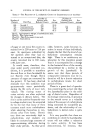
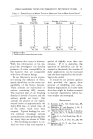
SYRIAN HAMSTERS TESTED FOR THERAPEUTIC DENTIFRICE STUDIES 91 TABLE I--TooTI• DECAY I•r MOLAR TEEXH Or HAMSTERS Fro) o•r HIOH SUOAR DIEXS* CaFious Molar Teeth, •---- Number of Cavities Number Total No. Large Medium Small 325 12 6 9 2 322 6 0 3 9 323 6 2 2 4 317 12 6 7 2 316 8 0 4 6 313 12 8 2 2 312 8 3 4 2 311 6 0 3 4 305 2 0 1 2 306 4 2 0 2 301 7 1 2 5 303 8 5 3 0 12) 91 i2) 33 12) 40 12) 40 av. 7.6'1' av. 2.9 av. 3.3 av. 3.3 * 90 days on diet. t Teeth may have more than one cavity. phenomenon also occurs in humans. With this information at his dis- posal the investigator can develop patterns of caries susceptibility in the hamster that are comparable with those of human beings. In our laboratory we are at pres- ent testing the influence of thera- peutic dentifrices on the caries sus- ceptibility of the Syrian hamster. These animals are maintained on rations containing 400-/0 sucrose. The maternal diet of our breeding females is devoid of sucrose and the salivary glands are intact. Our animals are placed on the experi- mental ration at approximately the thirty-fifth day, at which time all of the molar teeth have been erupted. Typical findings for con- trol (without brushing) animals maintained on caries-producing diets for ninety days are shown in Table 1. The brushing procedure is car- ried out once a day and requires a period of slightly more than two minutes. If it is desirable, the quantity of dentifrice can be in- creased or decreased, the number of daily applications can be increased and the time required for the brush- ing can be varied. It would be our present opinion that provided the agents show promise of inhibiting oral carbo- hydrate degradation in in vitro tests that they might be further screened in hamster experiments before hu- man studies are attempted. BIBLIOGRAPHY (1) Knutson, J. W., Pub. Health Rep., 59, 253-263 (1944). (2) Hollander, F., and Dunning, J. M., 5 t. Dent. Res., 18, 43-60 (1939). (3) "Dental Caries," ed. by K. A. Kaslick, St. Louis, The C. V. Mosby Company, 1948. (4) Arnold, F. A., Pub. Health Rep., 57, 43 (1942). (5) Lazansky, J.P., •t. Dent. Res., 26, 446 (1947). (6) Sognnaes, R. F., •t. dm. Dent. dssoc., 37, 676 (1948).

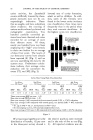
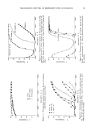
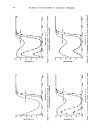
TRANSMISSION SPECTRA OF REPRESENTATIVE SUNSCREENS* By PEARL PERNICH and MARIAN GALLAGHER t School of Biological Sciences, Stanford Unversity, Stanford, Calif. IN PREVIOUS p•blications from this laboratory (1, 2) the ab- sorption spectra of dilute solutions of various sunscreens were pre- sented. The present communica- tion is an answer to requests for data on transmission rather than absorption spectra for a similar series of compounds and also data for solutions of higher concentra- tion. Transmission spectra of some oils are also presented. The Beck- man quartz spectrophotometer was used in all these studies. In each case a 0.5-cm. quartz cuvette was used for the solutions, therefore the thickness of solution reported is always 0.5 cm. In all cases (with the exception of quinine sulfate and violuric acid) the data are given for dilutions of 0.01, 0.1, and 0.5%. Absolute alcohol was used as the sol- vent in the earlier experiments, but a sample of 95% alcohol tested was found satisfactory and was used in all subsequent studies. Trans- mission spectra of absolute and 95% * The authors are indebted to Maison G. de Navarre for samples of various coumarins and other pyrone derivatives, propylene gly- col, and the various oils tested. t Submitted for publication Dec. 6, 1950. alcohol are given in Fig. 1. Ether was used to dilute some of the oils, and its transmission is given in Fig. 1. Propylene glycol is also used as a solvent in some sunscreen prepa- rations, and its transmission spec- trum is given in Fig. 2. Water was used as the solvent for naphthol sul- fonic, naphthoic, and tannic acids. Transmissions for the various oils are given in Figs. 2 and 3. Since undiluted olive oil, peanut oil, and corn oil transmit so little of the ultraviolet spectrum, samples were diluted 1:10 by volume with ether and the transmission determined (Fig. 2). In the remainder of the report transmission spectra of examples of the various families of sunscreens (1) are given: Figs. 4 and 5 show the transmission of two p-aminobenzo- ares, Figs. 6-8 for several salicyl- ares, Figs. 9-17 for pyrones such as cinnamates, umbelliferones, and coumarins, Figs. 18 and 19 for naphthol-sulfonic acids, Fig. 20 for naphthoic acid, Figs. 21-24 for benzylacetophenone, tannic acid, violuric acid, and quinine sulfate, respectively. 92
Purchased for the exclusive use of nofirst nolast (unknown)
From: SCC Media Library & Resource Center (library.scconline.org)