EVALUATING EVIDENCE ON AMMONIUM DENTIFRICE THERAPY 75 decrease in acid production was in proportion to the concentration of ammonium phosphate. However, it was also observed that parallel reductions in acid formation were found when equal molecular con- centrations of potassium phosphate were used. He observed, as did Kesel, that ammonium phosphate depressed the growth of Lactobacilli. Pearlman's work indicated that in concentrations of 5o7o ammonium phosphate, Lactobacilli grew poorly but the cultures were not killed. He attempted to determine if sodium or potassium phosphate would have a similar effect. He found that in equal molecular con- centrations, sodium was even more effective than ammonium and that potassium was somewhat less effec- tive. He further found that the citrates of these ions had a similar influence but that chlorides, sul- fates, and acetates did not. This introduced the question of whether the influence was a specific one or whether it was in part due to the influence of the resultant pH. It is quite well recognized that Lactobacilli grow poorly in medias with pH above 7.5. He found that when cultures containing potassium and ammonium phosphate were in- oculated with Lactobacilli at a pH of 7.5, both produced inhibition of growth with ammonium being more effective. However, if these cul- tures were incubated at a pH of 6.5 neither inhibited Lactobacilli mul- tiplication. This immediately raises the question of whether or not in vitro experiments of growth inhibi- tion are comparable to what hap- pens in plaque formation on the teeth which have known low pH values. Pearlman further made cultures containing the equivalent of 5o70 mixed sodium, ammonium, and potassium phosphates used in pairs. The result indicated that both sodium and ammonium go into competition with, or displace, potas- sium which is essential for Lacto- bacilli growth. This then implies that the effectiveness of sodium or ammonium is dependent upon, not only the concentration of these ele- ments, but also upon the availability of potassium. Because of the avail- ability of potassium in salivary se- cretions and accumulations within the mouth, the amount of sodium and potassium necessary to inhibit Lactobacilli growth may be ma- terially greater than that necessary to produce comparable conditions in in vitro experiments. It would appear then that the laboratory evidence to support the effectiveness of ammoniated denti- frices is not entirely in agreement and is certainly incomplete. While the evidence seems to be in agree- ment that in in vitro experiments, ammonium does influence bacterial growth, there is inadequate informa- tion on the manner in which it works or that these experiments are ap- plicable to the control of dental caries. Caries control must in the final analysis be measured by clini- cal experience. Kesel's demonstration of reduc- tion in Lactobacilli counts is impres-

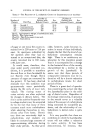
76 JOURNAL OF THE SOCIETY OF COSMETIC CHEMISTS sive but by his own admission is incomplete evidence of caries con- trol. His present study which is conducted on a very well controlled basis, should contribute valuable information on its effectiveness in actual practice. The only other published evidence of a clinical nature is the report of Henschel and Lieber'on a dentifrice with a high urea content. Casual examination of the results in the clinical control of caries shown by Henschel creates a definite imprint of its effective value. More careful examination leads one to question if the data presented are true rep- resentations of the effect of the dentifrice used. It is unfortunate that the experiment was performed in the manner presented. Dental caries is a disease which has its greatest activity in young people with definite tendency to level off after the age of 18-20. After that period, age becomes an important factor with a progres- sively decreasing incidence of caries with advancing years. In the ex- periment referred to it would have been much better had the work been .conducted on a younger group which would have been in a more suscep- tible period of life. It is observed that in the main group under ob- servation the average age at the end of the experiment was 37.5 years. Inasmuch as these patients were under observation for 13 years, it becomes evident that their average age at the beginning of the control period was 24 and at the beginning of the experimental period was 35. Klein and Palmer have shown the increment of carious surfaces at different ages. These figures, col- lected from the examination of 8,410 employees of a large life insurance company in New York City, in- dicate that the expected number of carious surfaces to occur between the ages of 20 to 25 are 8.92 from 25 to 30 are 7.54 from 30 to 40 are 3.98 for each five-year period. It would appear from these figures that the control group was in a much more susceptible period than the ex- perimental group. These figures indicate the susceptibility at the age of 37 to be approximately one- half that at the age of 22. Part of this decrease in suscepti- bility is undoubtedly due to the accumulation of restorations and the consequent reduction in areas which are susceptible to a new at- tack of caries. This is well illus- trated by the fact that these 100 in- dividuals, during the p. eriod of ob- servation in which they were used as controls, had accumulated an aver- age of 18.7 fillings and consequently had that many fewer susceptible surfaces during the period of the use of the experimental dentifrice. If we use 100 as the number of areas commonly susceptible to carious lesions the experimental group would be only 7•'/100 as susceptible as the control group. A further study of the group of 40 children using an ammoniated denti- frice which were without a control group gave a caries incidence of 1.72 D.M.F. teeth per year. These children started at an average age of
Purchased for the exclusive use of nofirst nolast (unknown)
From: SCC Media Library & Resource Center (library.scconline.org)