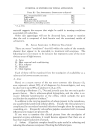
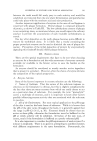
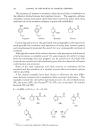
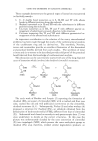
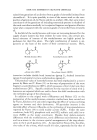
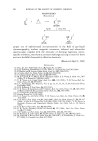
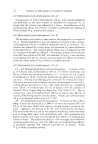
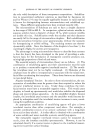
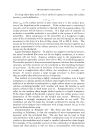
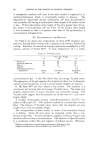
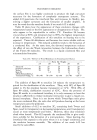
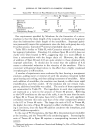
ODOR AND ISOMERISM IN OLFACTIVE CHEMICALS :263 These examples demonstrate the general types of isomerism encountered in this field, namely: 1. C--C double bond isomerism as in I, II, III and IV with alkene bonds in different position along the molecule 2. Skeletal isomerism as in II and III with the substituents in different positions along the molecule 3. Cis-trans isomerism as in III, IV and V with different spatial ar- rangement of substituents around a fixed or cyclic structure 4. Cis-trans isomerism like VI and VII with different geometrical ar- rangement of the alkene bond substituents An important contribution to the solution of the many stereochemical problems has been made through the study of the conformational analysis of the cyclohexane ring and its derivatives. The menthols, Nerones, irones and rosenoxides provide an excellent illustration of the theoretical and practical benefits derived from such studies. The synthesis of (neo) a-irone and cis-a-nerone to be described provide solid proof of the practical benefit derived from the knowledge of conformational analysis. This discussion can be conveniently started with one of the long disputed cases of isomerism which involved the rhodinol-citronello] structures. HO ' HO + HO (VIII) Rhodinal Citronellal LiA1H• (IX) LiA1H, / (X) / Rhodinol Citronellol Isopulegols (XI) (XII) (XVIII) The early work of Barbier and Loquin (3) reporting the formation of rhodinol (XI), an isomer of citronellol (XII) with a marked and finer rose odor, started the old and well publicized controversy on the citronellol- rhodinol structures (4, 5). Subsequently, Verley (4) and other workers (6) proposed a structure for rhodinal (IX), an aldehyde obtained from the dehydration of hydroxycitronellal (VIII), different from that of citronellal (X). Substantial work based on ozonolysis and spectroscopic data (7) was since undertaken to decide on the correct structures. In this case the picture was unfortunately clouded by the easy conversion of citronellal (X) into isopulegols (XIII) which possess the same methylenic group as rhodinal (IX) and, therefore, yielded similar degradation products on

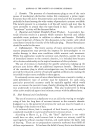
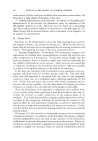
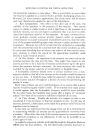
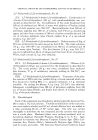
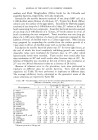
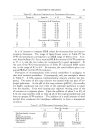
264 JOURNAL OF THE SOCIETY OF COSMETIC CHEMISTS ozonolysis. The issue remained undecided for a number of years, leading finally to the belief that rhodinal and citronellal as well as their correspond- ing alcohols and derivatives consisted of inseparable mixtures of the two structural forms (8). Recently (9) the citronellol-rhodinol controversy was definitely settled when it was demonstrated that both citronellol and rhodinol were capable of individual and separate existence. The syntheses of pure rhodinal and its derivatives were achieved, and no spontaneous equilibration between the rhodinyl and the citronellyl forms was ever noticed. Both rhodinal and citronellal were reduced by the Wolff-Kishner method to 2,6-dimethyl-l-octene and 2,6-dimethyl-2-octene, respectively. The ozonolysis of the olefin from rhodinal afforded 6-methyl-2-octanone and that from citronellal, 4-methyl-hexanol. The ozonolysis of rhodinol yielded 6-methyl-8-hydroxy-2-octanone whereas ozonolysis of citronellol resulted in a complex mixture of cyclic derivatives of 4-methyl-6-hydroxy- hexanal (9). Oilactive tests confirmed the more fragrant and subtle rosy character of the rhodinyl in comparison with the citronellyl series. Rhodi- nol and its esters as well as rhodinal in particular blend exceedingly well with rose and mugnet compositions. It is worthwhile mentioning in this connection that the first gas-liquid chromatographic studies with the rhodinyl and citroneilyl series met with one of the few instances of failures. Indeed, the two isomeric species always appeared in the chromatograms as single unresolved peaks. Only the discovery of the unusual stability of rhodinal toward mild acids (9), as compared to the easy cyclization of citronellal into isopulegols under the same conditions, made it possible to devise an adequate chromatographic analysis of a mixture of both aldehydes. Mixtures of citronellal, rhodinal and isopulegols were analyzed by gas- liquid chromatography using alternatively a neutral and an acidic column. Rhodinal was resolved as a distinct peak over an acidic Celatom FM73 column (9), from the common peaks of isopulegols which included the citrondial. In a neutral Chromosorb W column, on the other hand, both rhodinal and citronellal showed up as a single unresolved peak distinct from those of the isopulegols. The amount of citronellal was easily deduced by difference. Today the use of capillary chromatographic columns, coupled with the recently available ion detectors, has increased the sensitivity of the chromatographs resulting in a better separation of the citronellyl and rhodinyl species. The commercial availability of a pure grade of (citronellal-free) rhodinal is based on its resistance to acid cyclization and its separation from iso- pulegols through boration. The chemical solution of the citronellol- rhodinol problem has not as yet affected the custom, prevalent in the trade, of using the term, "rhodinol," to describe a grade of/evo-citronellol ob-
Purchased for the exclusive use of nofirst nolast (unknown)
From: SCC Media Library & Resource Center (library.scconline.org)