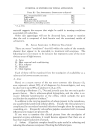
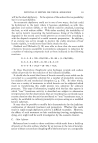
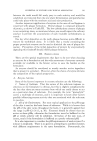
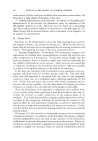
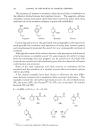
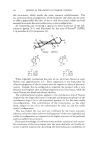
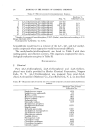
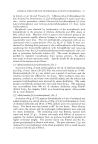
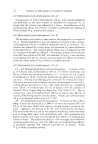
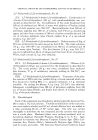
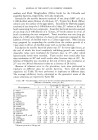
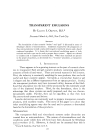
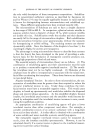
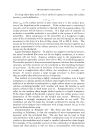
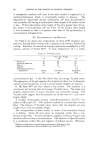
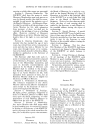
ODOR AND ISOMERISM IN OLFACTIVE CHEMICALS 265 tained from geranium oil as distinct from a grade of citronellol isolated from citronella oil. It is quite possible, in view of the recent work on the com- position of geranium oil, by Naves and his co-workers (10), that some minor constituents of the geranium oil including rosenoxide present in rhodinol of the trade contribute markedly to its superior fragrance and greater olfactive value when compared with the common grade of citronellol from citronella oil. In the field of the methylionones and irones an increasing demand for the supply of pure isomers has been evident for some time also certain pre- ferred mixtures of isomers of the methylionones are highly prized by perfumers for their fine odors. The right combination of isomers is ap- parently at the base of the secret of their commercial success. Here, Methyl-Ionones (XV) Isomethyl-Ionones (XIV) H H a-Irone (cis) (XVI) Iso-a-Irone (trans) (XVII) isomerism includes double bond isomerism (group 1), skeletal isomerism (group 2) and spatial cis-trans conformations (group 3). The practical value of isomethylionones has been emphasized in a recent patent by Beets and V. Essen (11) on the ways of preparation of the more fragrant a-isomethylionone (XIV), which possesses a finer violet note than methylionones (XV). Specific conditions for the reaction of citral with 2- butanone are reported which are said to favor the aldol condensation with the methylene group of the 2-butanone. In addition to the orignal work of Haarman and Reimer (12) on the preparation of the methylionones, extensive studies have been carried out by Naves, Kitchens (13) and others regarding the effect of various cyclizing agents on ionones and their derivatives. Of particular interest is the desirable effect of boron trifiuoride on the cyclization of trans-pseudoirones reported by Naves (14) to yield mainly a-irone (XVI). Under the same conditions, both 85% phosphoric acid and 62% sulfuric acid yield iso-a- irone (XVII) as the major constituent. Besides their skeleto-isomeric differences with the methylionones, steric differences exist between the a- and iso-a-irones in the cis-trans spatial arrangements of the ring substit- uents in the 2 and 6 positions (15). As reported by Naves (16), the olfac- tive value of the a-irone, which recalls iris odor, supersedes by far that of

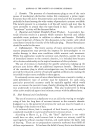
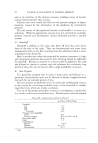
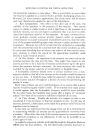
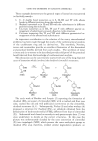
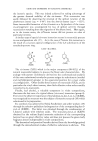
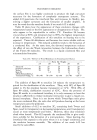
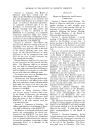
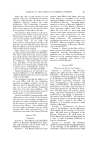
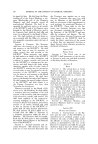
266 JOURNAL OF THE SOCIETY OF COSMETIC CHEMISTS the iso-a-irone, which recalls the more common methylionones. The cis- and trans-(neo)-arrangements of the butenone side chain do not seem to affect appreciably the odor of the a-and iso-a-irones, which are both assumed to acquire the most stable trans- or neo-configuration. An interesting case involving a spatial cis-trans isomerism of the sub- stituents (group 3) is well illustrated by the case of Nerone © (XVII), 1 - (p-menthen-6-yl)-l-propanone (2). H f XH(a) (a) Netone (XVIII) cis trans •r• = --133 ø st) = d- 44 ø no = 1.4711 no = 1.4736 d4 = 0.9087 d4 = 0.9110 When originally synthesized the ratio of cis- and trans-Nerone at equi- librium was approximately 2:1. Upon separation, it was found that the olfactive properties of the cis-isomer were far superior to those of the trans- isomer. Indeed, the cis-configuration imparted the product with a very pleasant and fragrant odor recalling bergamott and citrus leaves, while the trans-Nerone was bland and almost odorless. The conformational analysis applied to the cyclohexane ring of Nerone requires the two large substituents (isopropyl and propanone groups) of the cyclohexene ring to lie in the equatorial position (e) for the more stable cis-configuration. The conformation of the trans-isomer, on the other hand, assigns to one of its two substituents an axial (a) and less stable spatial configuration. This was indeed the case and was confirmed by the lower constants (density, refractive index and lower boiling point) of the more expanded and stable cis-configuration as compared to the higher constants of the puckered and less stable trans-structure. From past knowledge of conformational analysis a practical and success- ful conversion of the trans-isomer into the more desirable and stable cis- isomer could be expected by disturbing the thermodynamic equilibrium of
Purchased for the exclusive use of nofirst nolast (unknown)
From: SCC Media Library & Resource Center (library.scconline.org)