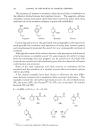
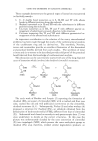
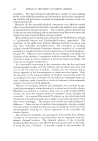
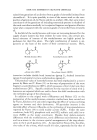
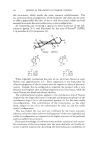
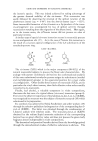
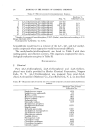
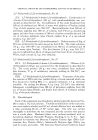
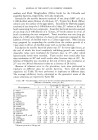
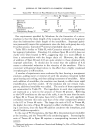
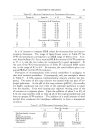
CHEMICAL STRUCTURE AND ANTIMICROBIAL ACTIVITY OF BIS-PHENOLS 275 DISCUSSION It may be noted from Table III that each of the isomers tested was found to be biologically active and that the activity varied over a wide range in certain instances. Compound No. 42, which has the methylene bridge in the 4,4'-positions, was found to be the least active, which is in agreement with previous findings (1, 9). Of the 3,3'-methylenebis compounds, the weakest was No. 66, followed by No. 40. Why these compounds were decidedly inferior to Nos. 65 and 67 cannot be explained at this time. The most active 3,3'-isomer was No. 67 in which the three chlorine atoms are adjacent to each other. It was shown previously (1, 9) that maximum antibacterial activity of halogenated bis-phenols was observed with compounds containing the 2,2'-methylene bridge the isomers of hexa- chlorophene are no exception to this rule. Hawever, this is apparently true only for bacteria against the dermatophytes the activity of the isomers was found to be of the same magnitude. Hexachlorophene and four of its isomers were very active against the Clostridia tested less active were Nos. 42 and 66, which were also the poorest against the aerobic bacteria. A similar pattern was observed with Chlorella vulgaris. Hexa- chlorophene and all isomers consistently lacked activity against the two yeasts, Candida albicans and Pityrcsporum ovale. Major differences in bacteriostasis may be noted with the Staphylococci and other Gram-positive organisms, compound No. 3 being of outstanding activity. It might be of interest to note that compound No. 3 is the only isomer which has no chlorine substituents adjacent to the hydroxyl groups. Only hexachlorophene and one of the 2,2'-isomers (compound No. 3) demonstrated activity against the more resistant Gram-negative bacteria such as Escherichia coli, Salmonella typhosa, Pseudomonas aeruginosa, Shigella sonnei and Klebsie#a l•neumoniae. Proteus vulgaris and Pseudo- mor,'as fluorescens were generally found to be extremely susceptible to all three 2,2'-isomers. SUMMA RY The broad spectrum antimicrobial activity of hexachlorophene and of seven of its nine isomers was investigated. Maximum activity against bacteria was shown by the 2,2'-methylenebis-phenols 2,2'-methylenebis- (3,4,5-trichlorophenol) was found to be generally more potent than hexa• chlorophene and the other 2,2'-isomer. Great variations between the 3,3'-isomers were noted the 4,4'-isomer was definitely the least active of the compounds tested. Against the dermatophytes the activity of the isomers was found to be of the same magnitude. None of the bis-phenols was active against C. albicans or P. ovale at a concentration of 100 ug./ml. (Received March 25, 1963)

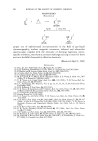
276 JOURNAL OF THE SOCIETY OF COSMETIC CHEMISTS REFERENCES (1) W.S. Gump and G. R. Walter, J. Soc. Cosmetic Chemists, 11,307 (1960). (2) G. R. Walter and W. S. Gump, Ibid., 13, 477 (1962). (3) H. H. Hodgson and A. Kershaw, J. Chem. Soc., 2920 (1929). (4) N. S. Johary, S.S. Guha and P. C. Guha, J. •[ndian Inst. Sci., $4, 287 (1952). (5) G. J. Tiessens, Rec. tray. chim., 50, 112 (1931). (6) D. L. Fox and E. E. Turner, J. Chem. Soc., 1853 (1930). (7) M. Kohn and S. Fink, Monatsh. Chem., 56, 407 (1930). (8) W. S. Gump and J. C. Vitucci, J. rim. Chem. Soc., 67, 238 (1945). (9) A. R. Cade and W. S. Gump, The Bis-phenols, in dntiseptics, Disinfectants, Fungicides, and Chemical and Physical Sterilization, edited by G. F. Reddish, 2nd Ed., Lea & Febiger, Philadelphia, 1957, p. 324.
Purchased for the exclusive use of nofirst nolast (unknown)
From: SCC Media Library & Resource Center (library.scconline.org)