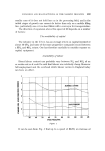
484 JOURNAL OF THE SOCIETY OF COSMETIC CHEMISTS 0.035 herringbone screen, and the powder was passed just once through this system. The pre-mix and the final mix were in an ordinary horizontal ribbon blender. MR. •R. J. CHUDZIKOWSKI: I have done a lot of work on micro-pulverisers and would like to ask about the time factor or number of passes through the mill which would have a bearing on the dispersion achieved and on the ultimate colours. I found in practice that if I used a pulverised portion mixture of pigment in white base I obtained differing colour in the first pass, but with subsequent passes through the same mill, or a longer time of milling, the colours gradually lightened up. It puzzled me at first because it was contrary to what I expected as the normal development of colours but I thought that with further milling gradual scattering of light becomes a dominant factor, and causes the visual lightening of the colours. That may also explain the differences between the performances of the hammer mill and the other mills. Would you like to comment? THE LECTURER: I have not come across colour lightening on extended pulverising the only thing I can imagine is that if you are pulverising colour into a largely talc base one does know that if you reduce the particle size of the talc itself drastically you get a much higher covering power o[ the talc and therefore this will tend to drown your colour more. For example, if you are working on a standard colour dilution which produces a given shade on pulverising into talc, one does know that talcs from differing sources, and of varying particle size, have a definitely varying covering power. DR. K. B. ALBERMAN: I would like to make one point about the current con- sumption of the very powerful mixing machines. Some of us are on a maximum demand tariff and I notice that the ¬hr mixing that you mention is very convenient because you are given •hr warning of overrunning. This could be a very expensive consideration at about •10/kw if one lets the machine run too long. THE LECTURER: We have to remember that when we say ¬hr mixing time this is for our basic, primary mix. Obviously on any of these processes one has to carry out colour correction and the further mixing that these powders get can vary quite markedly. DR. K. B. ALBERMAN: What is known about the heating effects on powders and pigments in these very powerful machines where you seem to be dissipating a great deal of energy into a relatively small amount of material? THE LECTURER: The Papenrneier has a much higher input, and it gave us a much higher temperature powder than, for example, the Moritz mixer, but we could not see any difference in colour. If you are handling a perfumed powder this could have an effect on your perfume. We certainly did not notice any change in colour due to over- heating of the powders. MR. P. F. CREED: We have noticed cases where overheating of iron oxides can turn them off shade, particularly in the hammer mills, when it can actually catch fire this has happened on a number of occasions. If it reaches the stage where we are about to get this sort of trouble then the colour does certainly start to go off.

J. Soc. Cosmetic Chemists 19 485-498 (1968) ¸ 19•8 Society of Cosmetic Chemists o•' (7rear Britain Expansion and function in the the manufacturing cosmetic industry j.P. SLATER* Presented at the Symposium on "Processing and Manu- facturing", organised by the Society of Cosmetic Chemists of Great Britain, at Leamington, Warwicks. on 13th November 1967. •qynopsis--Management techniques and philosophies are reviewed and discussed in relation to the overall manufacturing function. This includes the problems involved in the supervision of processing, packaging, quality control, the warehousing of components and ingredients, inventory control, purchasing, engineering and industrial engineering. Priorities and basic suggestions are stated as applied to the growth of a cosmetic plant from small beginnings to a large unit. Emphasis is placed on the necessity of versatility and flexibility, and the type of staffing and supervision required for success. MANUFACTURING AND PROCESSING IN THE COSMETIC INDUSTRY It is very appropriate that we discuss the wider implications of our work and consider more deeply the relationships which, as supervisory or management personnel, we should have in our industry. Education in the science of chemistry, and indeed in cosmetic chemistry, provides the necessary and appropriate backcloth for general manufacturing manage- ment within our industry. The scientific approach is vitally important in a competitive market, and in an expanding situation. Too often cosmetic chemists find themselves promoted from the laboratory bench and from the somewhat commercially limited atmosphere of the research department, into more administrative positions and they then find the need for more knowledge of management techniques and broader skills in human relation- *Avon Cosmetics Limited, Northampton 485
Purchased for the exclusive use of nofirst nolast (unknown)
From: SCC Media Library & Resource Center (library.scconline.org)