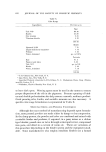
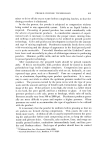
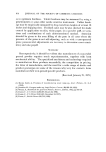
614 JOURNAL OF THE SOCIETY OF COSMETIC CHEMISTS as to optimum hardness. Tablet hardness may be measured by using a penetrometer or some other tactile sensitive instrument. Tablet break- age may be empirically measured by drop tests from heights of at least 18 inches and shipping tests. Finished cakes may be also checked for shade control by application on skin, white paper, on a powder puff, or varia- tions and combinations of each aforementioned method. Attention shrould be given to the even filling of the pans in all cases where the pressure of the press is not self-adjusting, such as with a cam-operated press pressure trial adjustments are necessary to determine exact consis- tency and cake payoff. SUMMARY Retrospectively, it should be evident that manufacture of a successful pressed powder requires much experimentation, together with keen mechanical ability. The specialized machinery and technology required to manufacture these products successfully, the competition in pricing, the labor of manufacture, and the need for a wide range of shades and product prototypes are some of the reasons why very few cosmetic firms manufacture their own pressed powder products. (Received January 21, 1971) REFERENCES (1) Macias Sarria J., Processes of manufacturi•g crude make-up, Amer. Perfurn, 59, 11-2 (1944). (2) Janowitz, H., Compact make-up, Soap, Perrum. Cosmet., 28, 649-50 (1955). (3) Winter, F., Handbuch der gesarnten Parrum. Kosrnet., 2nd Ed., 1932, pp. 615-20. (4) Factor, F., U. $. Patent 2,034,697 (March 24, 1936). (5) Factor, F., U. $. Patent 2,101,843 (December 14, 1937). (6) Factor, F., British Patent 501,732 (1939).

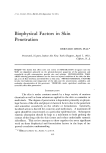
]. Soc. Cosmet. Chem., 22, 615-634 (Septcmber 17, 1971) Biophysical Factors Penetration in Skin BERNARD IDSON, Ph.D.* Presented, in part, before the New York Chapter, April 7, 1971, Clifton, N.J. Synopsis--The factors that affect rates and extent of PENETRATION of agents into the SKIN are dependent primarily on the physical-chemical properties of the penetrant and secondarily on pH, concentration, particle size, and vehicles. PHYSIOLOGICAL VARI- ABLES exerting penetrant influence are the intact or injured condition of the skin, the skin age, area of skin involved, and blood flow to that area. PHYSICO-CHEMICAL FACTORS involve the hydration and temperature of the skin and the concentration, solubility, and molecular characteristics of the penetrant. VEHICLES, under specialized conditions, can materially affect skin penetration. INTRODUCTION The skin is under constant assault by a huge variety of noxious chemicals as well as from substances applied to the skin as cosmetics or medicinals. The degree of penetration is dependent primarily on physio- logic factors of the skin and physical-chemical factors due to the penetrant and somewhat secondarily on the vehicle or formulation. Generally, localized action is desired for cosmetics and medicinals. A maximum of agent should be concentrated at a particular epidermal site. Subsequent systemic absorption should be kept to a minimum to both prolong the contact of the drug with the skin tissues and reduce undesirable systemic side-effects. This review attempts to draw together the more significant work on these biophysical and formulation factors in the hope of im- proved correlative understanding. •* Hoffman-La Roche Inc., Nutley, N.J. 07110. 615
Purchased for the exclusive use of nofirst nolast (unknown)
From: SCC Media Library & Resource Center (library.scconline.org)