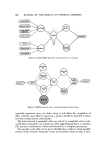
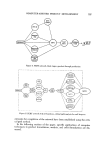
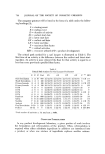
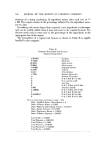
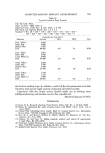
788 JOURNAL OF THE SOCIETY OF COSMETIC CHEMISTS The computer printout will be listed in the form of a table under the follow- ing headings (3) S = starting event E = ending event D = duration of activity ES = earliest start date LS = latest start date EF = earliest end date LF = latest end date F = maximum float factor **: critical activities RES = resources utilized (PD = product development) The critical path method for a nail lacquer is illustrated in Table I. The float time of an activity is the difference between the earliest and latest start- ing dates. An activity is near critical if the float for that activity is equal to or less than some previously specified float factor. Table I Critical Path Analysis for Nail Lacquer Production • S E D Cost ES LS EF LF F ** RES Base formulation I 2 10 600 12/12/72 12/12/72 12/18/72 12/18/72 0 CR Shade formulation I 3 2 120 12/12/72 12/18/72 12/12/72 12/18/72 8 PD Primaryoeormu]a 2 4 2 19.0 12/19/72 12/19/72 12/19/72 12/19/72 0 CR PD Primary formula 3 4 2 120 12/13/72 12/19/72 12/13/72 12/19/72 8 PD DUM 4 15 0 0 12/20/72 1/12/73 12/20/72 1/12/73 30 D DUM 4 6 0 0 12/20/72 12/29/72 12/20/72 12/29/72 10 D DUM 4 7 0 0 12/20/72 12/20/72 12/9.0/72 12/20/72 0 CR D DUM 4 8 0 0 12/20/72 1/12/73 12/20/72 1/12/73 30 D Paneltest 5 9 10 660 12/20/72 1/12/73 12/28/72 1/18/73 30 TS Safety 6 9 30 1500 12/20/72 12/29/72 1/11/73 1/18/73 10 OS Stability 7 9 40 240 12/20/79. 12/20/72 1/Vt/73 1/18/73 0 CR TS Analysis 8 9 10 600 12/20/72 1/12/73 12/28/72 1/18/73 30 TS Finaloeonnulation 9 10 2 120 1/19/73 1/19/73 1/19/73 1/19/73 0 CR Product 10 11 0 0 1/9.2/73 1/22/73 1/22/73 1/22/73 0 CR MM "Total number ooe activities = 14 total cost -- 4080. COMPUTER lrVOBMLILATIO1NI In any product development laboratory, a given portion of work involves the formulation and reformulation of the product. Often, reformulation is required ,vhen either substitute ingredients or additives are introduced into a product, or ,vhen one mixture of ingredients replaces another mixture.

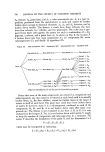
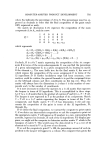
COMPUTER-ASSISTED PRODUCT DEVELOPMENT 789 Both the old formula and the revised formula are then subjected to various types of tests and evaluations to determine whether a change in the product is warranted. In making such a change, it is important to know exactly how the final composition of the product is affected, since the change in the per- formance of the product may be reflected in a change in the percentage of a particular ingredient. Knowing the performance at several concentrations of the particular ingredient, the formulator can extrapolate the concentration yielding optimum performance. It is desirable to know the amount of each ingredient for the purpose of costing, and it is sometimes required that the ex- act composition of each product be available for legal and medical purposes. Determining the composition of a product that is prepared by mixing sev- eral raw materials is simple. For example, the composition of a lacquer thinner that is the combination of three organic solvents is simply given by the weight percentage formula. But in a case where any of the main components added to the product at the final batch stage is a previously processed component, its formula must be substituted in the final formula where the composition is calculated. The process of determining the final composition becomes very complex when many preprocessed components containing common ingre- dients are involved, for the contributions of each ingredient from each compo- nent must be considered. Often, preprocessed components consist of prepro- cessed subcomponents, making the calculation of the final composition of the product all the more cliffcult and time consuming. A program has been written that determines the composition of a lacquer containing several main components which break down into components, sub- components, and finally ingredients. The computer program is not needed if one is dealing with pure ingredients which cannot be broken down. Our pro- gram utilizes a system of matrices that describes each breakdown step and allows quick changes to be made in the composition of any item that might occur in the product as new formulas are suggested. The chemist selects the formula of the product, and in a matter of minutes the final composition is printed out. At the request of the user, various analyses about the formula are determined and printed. Thus, before a single resin or solvent is mixed, the chemist has a good idea what the product will be like. In addition, these pro- grams are adaptable to any kind of formulary work. A matrix is required for each breakdown step of the formula (•4). The matrix may be thought of as a table of the breakdown-along the left-hand column are the components and along the top row are the subcomponents contained in the components. The elements of the matrix are the coefficients or percentages of the subcomponents found in the components. The system requires first that the various breakdown steps be recognized, and that the components, subcomponents, and ingredients be recognized and assigned identification letter. For example, let us consider the breakdown of a lacq•er designated X. X is made from four main components: A• is a flow additive
Purchased for the exclusive use of nofirst nolast (unknown)
From: SCC Media Library & Resource Center (library.scconline.org)