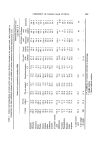
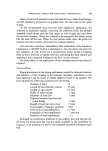
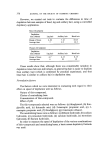
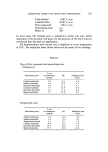
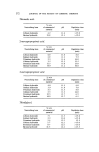
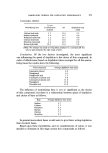
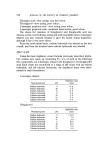
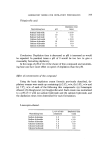
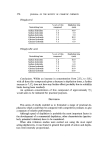
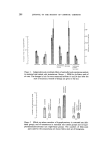
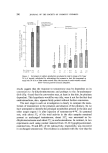
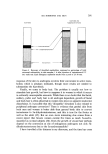
CHEMISTRY OF HUMAN HAIR CUTICLE 363 contain mainly A-layer and cell membrane complex, with the 45-min fraction containing a small amount of undissolved exocuticle and the 90-min fraction having had some A-layer removed (cf. Fig. 1). As in the case of the membrane fraction, the accuracy of the amino acid analyses is limited by the presence of non-proteinaceous components. A more serious limiting factor is the difficulty of obtaining a well-characterized sample of the A-layer and cell membrane complex free from other contaminants such as exocuticle but not having lost any of the A-layer. Since digestion of the A-layer is essentially complete in less than 7 h, small errors in sampling time or inefficiency of quenching the enzyme reaction result in substantial variations in composition. These difficulties are reflected in the coefficients of variation shown in the third column of Table I. In spite of these limita- tions the calculated differences in amino acid composition between the '90-minute' and '3-day' fractions shown in the fifth column of Table I, approximate to the composition of the A-layer, and show major differences from the composition of the intact cuticle. The A-layer thus contains higher concentrations of aspartic acid, basic and aromatic amino acids and lower concentrations of serine, proline and cystine than the whole cuticle. The low content of sulphur-containing material in the A-layer/membrane residues was confirmed semiquantitatively by X-ray microanalysis where the sulphur peak/background ratio for the '90 minute residue' was substantially lower than that obtained from intact cuticle or from exocuticle isolated by pronase digestion according to the methods of Bradbury and Ley (3). The A-layer is probably a complex mixture of different types of proteins. Analysis of residues remaining after various times of digestion between 45 min and 3 h showed that the relative concentration of aromatic amino acids increased as digestion proceeded, as indicated in Table II. No such trends were shown by the other amino acids. Table II Residue as •o by weight of cuticle 27 14.3 13.3 12.4 9.8 Moles/1000 tyrosine 17.2 18.4 33.7 41.9 48.9 Moles/1000 phenylalanine 4.25 11.6 23.5 30.9 40.7 These results indicate the presence of a component rich in aromatic amino acids and more resistant to proteolytic enzymes than the rest of the A-layer, though whether or not this component forms a discrete lamella close to the membrane is not yet clear.

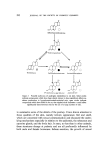
364 JOURNAL OF THE SOCIETY OF COSMETIC CHEMISTS The low cystine content of the A-layer is surprising and contrary to electron histochemical evidence (7, 11). It is possible that a cystine-rich component has been removed specifically from the A-layer during the enzyme digestion but this is considered unlikely since our electron micro- scope observations indicate that the overall structural integrity and electron opacity of this layer is maintained for the analysed specimens. A further possibility is that the electron histochemical methods are not as specific in their staining of cystine or cysteine residues as has been claimed. Using an organomercurial method, Dobb, Murray and Sikorski (11) have shown a near-stoichiometric uptake of mercury by cysteine in reduced wool. On the other hand the uptake of mercury in such minor components as the A- layer may not be necessarily related to the presence of cysteine, for other amino acids or non-proteinaceous material could be involved in the reaction. In this respect it is interesting to note that Levy (12) has demonstrated reaction between an organomercurial halide and the amino groups of insulin. Indeed this reaction may explain the existence of the thin layer stained by mercury adjacent to the cuticle cell membranes of wool and described by Dobb et al. (11). Such a reaction would be consistent with our observations of high lysine concentrations in the membrane-associated fractions and the staining of a thin layer either side of the cuticle cell mem- branes complex by dodecatungstophosphoric acid. With respect to the silver-methenemine method for the electron histochemical demonstration of cystine, anomalous staining of the A-layer of human hair cuticle has been described already (7). The silver globules used in the latter method as a criterion for the presence of cystine (7, 13) have a physical appearance which is quite different in the A-layer than in the other components of the hair, perhaps indicating that the histochemical reaction is modified by groups other than cystine. In the light of these discrepancies in the electron histochemical demonstrations of cystine in the A-layer, we believe that our analyses showing the low cystine content of this component are realistic. The chemistry of papain/dithiothreitol digestion One striking feature of the present work is the rapidity with which human hair cuticle dissolves in mixtures of papain and dithiothreitol compared with papain alone (usually negligible) or mixtures of papain and sodium bisulphite (55•o dissolves after 8 h rising to 70•o after 28 h). One of the main reasons for this is undoubtedly the high percentage reduction of the keratin cystine by dithiothreitol (14, 15). Whereas complete reduction of
Purchased for the exclusive use of nofirst nolast (unknown)
From: SCC Media Library & Resource Center (library.scconline.org)