J. Soc. Cosmet. Chem. 25 367-377 (1974) ¸ 1974 Societ. v of Cosmetic Chemists of Great Britai•t Use of a laboratory model to evaluate the factors influencing the performance of depilatories T. J. ELLIOT* Presented h• part on the 14th November 1973 in Nottingham, at the Symposium on 'Evaluation of Product Performance', organized by the Society of Cosmetic Chemists of Great Britain. Synopsis--The use of laboratory MODELS to evaluate the performance of COSMETIC and TOILETRY products is full of pitfalls, and subjective assessments nearly always give more accurate results. However, the investigation of the comparatively large number of variables which influence the speed of action of DEPILATORIES cannot conveniently be carried out on a subjective assess- ment basis and requires the use of a suitable laboratory model. The particular model developed (referred to as a DEPILOMETER) was designed to simulate practical use conditions as closely as possible and it enabled the more important formulation variables to be studied quickly. In-use tests on final depilatory formulations gave good correlation with the DEPILOMETER findings. INTRODUCTION The main problem of testing depilatories with a users panel on a day- to-day basis is the practical difficulty of the necessary time required to re- grow the hair in between tests. Another problem is the known variability of hair coarseness between individuals so that in extreme cases this can be a more significant factor in speed of depilation than changes in formulation. There have been several attempts in the past to develop an in vitro test for measuring the effectiveness of depilatories and these have mostly been * Beecham Products, Beecham House, Brentford, Middlesex TW8 9BD. 367

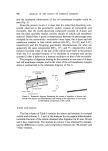
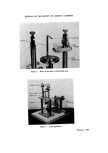
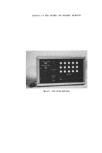
368 JOURNAL OF THE SOCIETY OF COSMETIC CHEMISTS based on measuring the breaking time for mechanically stressed hair in contact with the depilatory preparations. Yablonsky and Williams (1) criticized these methods and developed their own test based upon the measurement of time of maximum hair swelling of individual hairs suspended in the depilatory preparations. The essential criteria for our own laboratory test model was that the the instrument should simulate as closely as possible the conditions under which the depilatory would normally be used and the important factors in this context were seen as follows: (a) use of leg hair and under-arm hair (b) application of product for predetermined time without use of mechanical force (c) use of moderate force after this time to produce breakage (simulat- ing the use of a spatula). PROCEDURE The development of the instrument or 'depilometer' was handed over to Beecham Special Services laboratory, and I am indebted to Mr J. D. Cheshire and Mr H. Ashmore for developing this piece of equipment. Mode of action Ten similar hairs are tested together. After the application of the depilatory product to the hairs, a suitable time interval elapses before a mechanical force (load) is applied for 10 s at each successive minute until the hairs break. The procedure is automatically timed, requiring attention only to fit new hairs and apply the depilatory. The key observa- tion made is the number of minutes taken to break the hairs. Apparatus and operations The instrument is in two parts--the load applicator and the control box and timer--joined by a cable. (1) Load applicator. The mechanism consists of a load bar which falls transversely across the mounted hair sample. The load bar is mounted on the plunger assembly which consists of a circular table for carrying ring weights, an axial support rod which slides freely in a sleeve and a guide rod to prevent rotation. The axial support normally rests on a platform which drops away when the solenoid is energized.
Purchased for the exclusive use of nofirst nolast (unknown)
From: SCC Media Library & Resource Center (library.scconline.org)