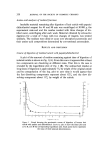
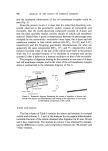
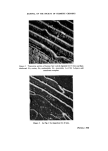
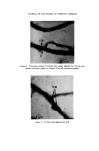
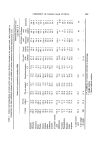
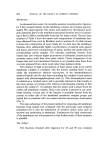
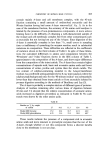
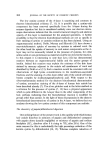
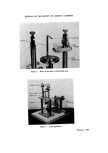
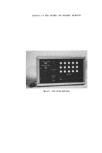
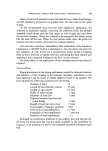
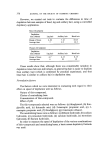
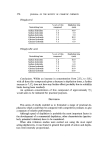
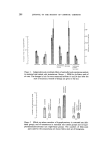
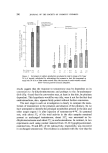
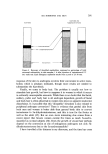
SEX HORMONES AND SKIN 389 with testosterone then results in a much lower level of secretion than when the pituitary is present (26, 27). There is general agreement about this, but considerable dispute about how the facts should be explained (28). Shuster and Thody maintain that the increment actually due to testosterone is the same whether or not the pituitary is present, but that pituitary hormones have an independent effect on the skin, either directly or indirectly through other endocrine organs. They claim that MSH is the major, indeed the only, pituitary hormone acting directly on the skin (29), and they suggest that thyrotrophic hormone, acting through the thyroid gland, indirectly but independently affects the sebaceous glands (30). A full response to testo- sterone thus requires the additive effects of all these hormones. I do not dispute that thyroid hormone or pituitary factors may have direct and independent effects on sebaceous secretion. The disagreement arises because I believe that irrespective of any such effects, the pituitary may actually potentiate the response to testosterone, producing a synergistic effect over and above any purely additive one. Moreover, I do not believe MSH has been established as the sole pituitary factor growth hormone and prolactin are still candidates. That pituitary factors play such a permissive role in the response to testosterone was indicated in experiments, performed about 20 years ago by Rothman and his co-workers (31) and by myself (32), using gland size as the criterion. The conclusion is amply borne out by hair fat measure- ments. During the last 7 years we have measured the effect of testosterone on sebum secretion in 52 castrated rats using matched litter mates as un- treated controls, and in 44 hypophysectomized castrated rats similarly matched (Figs 2 and 3). The mean increment due to testosterone in the hypophysectomized animals was only 223/0 of that in those with intact pituitaries (27). Moreover, in somewhat smaller groups of rats, we have been able to restore the full response with preparations of growth hormone (Fig. 3) or prolactin (26). The concept of a permissive role in the response to androgens for one or more pituitary factors may be important. Following the evidence that testosterone is metabolized in its target tissues to 5•z-dihydrotestosterone, we tested the effect of this steroid on sebaceous secretion. In castrated rats the response was similar to that of testosterone, but in hypophysectomized rats it was relatively greater (33). We were similarly able to demonstrate significant responses to androstenedione (33) and to 5•z-androstane-3[•, 1713-diol (34), though a number of other metabolites, including 5•z-andro- stanedione and androsterone, gave insignificant responses (Fig. 3). These

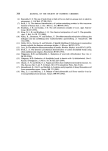
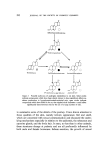
390 JOURNAL OF THE SOCIETY OF COSMETIC CHEMISTS Castrated + tes rosterone 06_ 05 04 O3 02 O.I 0 No. of pa•rs 52 t 2 Student's / 90 70 Castraled and hypohysectornlzed + lestosterone •$TH 13 19 9 06 16 01 Castrated+ hypophysectormzed 44 8 •3 [5 2'9 52 4 8 37 Figure 3. Increments in sebum production produced in rats by doses of 0.2 mg/ 24 h of steroid, calculated by subtracting the increase in hair fat (expressed as mg/g hair/24 h) in a litter mate control from the increase in each treated animal. STH=bovine growth hormone (Squibb). results suggest that the response to testosterone ]nay be dependent on its conversion to 5a-dihydrotestosterone and perhaps to the 5a-androstane- diols (Fig. 4) and that the conversion may, at least in the skin, be pituitary dependent. This hypothesis would be very tidy, were it not for the fact that androstenedione, also, appears fairly potent without further conversion. The next stage in such an investigation is clearly to compare the meta- bolism of testosterone in the presence and absence of the pituitary. So we have attempted to identify the principal metabolites present in the skin and other target organs 1 h after injection of testosterone-4-•4C. In castrated rats, only about 5•o of the total activity in the skin samples remained present as unchanged testosterone about 35• was recovered as 5a- dihydrotestosterone and about 5•o as androstenedione. In contrast, in two experiments each using pooled material from 25-30 hypophysectomized- castrated rats, 70 and 40•o of the radioactivity, respectively, was recovered in unchanged testosterone. The evidence is consistent with the view that the
Purchased for the exclusive use of nofirst nolast (unknown)
From: SCC Media Library & Resource Center (library.scconline.org)