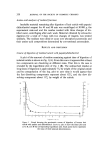
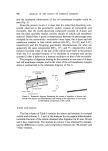
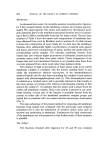
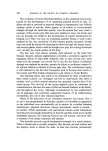
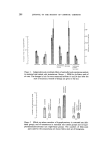
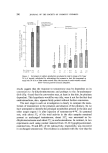
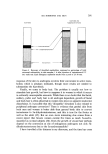
SEX HORMONES AND SKIN 387 the periphery. Clearly there are two main components of secretion: the formation of new cells and the synthesis of sebum within them. It was therefore of great interest to discover whether steroid hormones act at one or both of these points. The rate of cell division was determined by mitotic counts in histological sections, the rats being injected with colchicine 5 h before they were killed, a procedure which arrests dividing cells in the metaphase. The somewhat unpredictable conclusion, confirmed a number of times, was that whereas testosterone does indeed greatly increase cell division, oestradiol has little or no effect on it, even though in low doses it markedly depresses secretion (23). By administering both steroids simul- taneously, it is thus possible to produce a high rate of mitosis coupled with a low rate of secretion (24). It must, therefore, be concluded that oestradiol reduces secretion not by inhibiting cell replacement but by interfering with sebum synthesis within the cells themselves. The opportunity for further testing of this hypothesis arose by the dis- covery of steroids which were anti-androgenic but not oestrogenic. It was of obvious interest to see whether such compounds would, in common with oestrogens, reduce sebum secretion in animals stimulated by testosterone. But, if the compounds are anti-androgenic as distinct from oestrogenic, they ought, unlike oestrogens, also to reduce cell division. We were able to show that this was true for several anti-androgenic steroids. In an experiment on cyproterone acetate (25), six litter-mate groups of six castrated male rates were used (Fig. 1). A dose of 2 mg per day of the anti-androgen significantly reduced both sebum secretion and sebaceous mitoses in rats treated with testosterone implants giving an uptake of 0.2 mg per day. A dose of oestra- diol of the order of only 2 [tg per day, however, caused a much greater reduction in sebum secretion, without significantly affecting mitosis. If the two suppressing steroids are acting at different points, their effects when administered together should be greater than either by itself. This is so. When 2 [tg of oestradiol was added to 2 mg of cyproterone acetate, the result was a further reduction in sebum secretion. If the steroids had acted at the same point, it is inconceivable that any effect would have been pro- duced by increasing the dose by one-thousandth. These results ought to dispose of the view that oestrogen competes with androgens in any 'anti- androgenic' sense. They are also evidence against the view that oestrogens reduce sebaceous secretion by suppressing endogenous androgen produc- tion, for that would inevitably result in reduced sebaceous mitosis. Sebaceous secretion is also influenced by the pituitary (Fig. 2). Removal of the pituitary reduces sebum production in castrated rats and treatment

388 JOURNAL OF THE SOCIETY OF COSMETIC CHEMISTS IO O.5 0 Untreated Oestradlol Testosterone Testosterone Testosterone Testosterone C yproterone Oestrad•ol Cyproterone acetate acetate Oestradml 5O 40 • •0 • o_ 2O 2 Figure 1. Independent and combined effects of oestradiol and cyproterone acetate in castrated rats treated with testosterone. Means • SEM for six litters, each of six rats. The changes in hair fat were measured between 16 and 24 days after the start of treatment. Details of dosage are given in the text. J'O - "-05 - .G __ o •o +• o -o © 12 52 Figure 2. Effects on sebum secretion of hypophysectomy in castrated rats (left- hand group), and of testosterone in castrated rats (centre group) and in hypo- physectomized-castrated rats (right-hand group). The numbers of litter-mate pairs used for the comparisons are shown below each set of histograms.
Purchased for the exclusive use of nofirst nolast (unknown)
From: SCC Media Library & Resource Center (library.scconline.org)