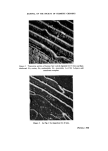
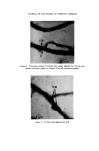
CHEMISTRY OF HUMAN HAIR CUTICLE 357 centrifugation, washed twice with distilled water, dried in vacuo over phosphorus pentoxide and weighed. Examination of morphological sites of digestion of human hair cuticle by papain/dithiothreitol For this work, root-ends of brown Caucasian hair were embedded with Spurr's resin (5) in Beem capsules (LKB Produkter). It is noteworthy that these resins are unlikely to diffuse into the fibres, but nevertheless bonding of the resin with the fibre surface is sufficiently strong to provide the rigid support of the hair for subsequent thin sectioning. Transverse sections of the hair approximately 60 nm thick were cut on a diamond knife (Du Pont de Nemours) at a Porter-Blum MT-2 ultramicrotome (Sorvall) and collected on 100 mesh gold electron microscope grids (Polaron) previously covered with a thin collodion/carbon support film. Papain/dithiothreitol reagent, of the same composition as that used in the gravimetric experiments, was pre- pared and filtered immediately before use through 0.45 •tm Millipore discs. The grids were immersed in the reagent at 50øC, and after various times of digestion, rinsed briefly in a solution containing dithiothreitol and buffer, then in two changes of distilled water each for 5 min and dried. Some of the grids were 'shadowed' by the oblique vacuum evaporation of carbon/ platinum on to the upper side of the grids (subtending an angle of 30 ø with the grid surfaces). The shadowing technique did not permit the discrimina- tion of structure within the cell membrane complex on subsequent examina- tion in the electron microscope. The remainder of the grids were therefore stained with various heavy metal compounds according to the following scheme, designed to yield maximum structural information: grids were immersed at room temperature successively in 2•o aqueous osmium tetroxide for 2 h, distilled water for 1 h, saturated aqueous uranyl acetate for 2 h, distilled water for 1 h, Reynold's lead citrate (6) for 10 min, 0.02 • sodium hydroxide for 10 s, distilled water for i h and then dried. The various digested hair sections, shadowed or stained, were examined in a JEM 7 transmission electron microscope at 80 kV and using a 20 gm diameter objective aperture. In the case of the shadowed sections it is already known (7) that the surfaces of undigested hair sections are not flat and that the irregularities are related to the underlying morphological structure of the sections. On the other hand the present digestions so cleanly removed some of the structures of the hair cuticle that no confusion arose with the original irregularities of the hair section surfaces.

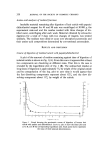
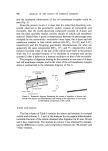
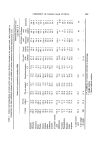
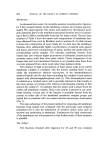
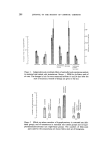
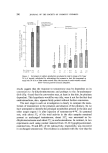
358 JOURNAL OF THE SOCIETY OF COSMETIC CHEMISTS Amino acid analyses of isolated fractions Insoluble material remaining after digestion of hair cuticle with papain/ dithiothreitol reagent for 45 and 90 min was centrifuged at 30 000 g, the supernatant removed and the residue washed with three changes of dis- tilled water, centrifuging after each wash. Material obtained by exhaustive digestion for a total of 3 days with two changes of reagent, was treated similarly. The residues were dried in vacuo over phosphorus pentoxide and their amino acid compositions determined by conventional autoanalysis. RESULTS AND DISCUSSION Course of digestion of isolated cuticle with papain/dithiothreitol A plot of the amount of residue remaining against time of digestion of isolated cuticle is shown in Fig. 1 (A). From this curve it appears that at least two components are dissolving at different rates. That this is the case is revealed by the logarithmic plot of Fig. 1 (B). The undissolved residue at long times of digestion is approximately 7• by weight of the original cuticle and by extrapolation of the log. plot to zero time it would appear that the fast dissolving components represent about 82•o and the slow dis- solving component about 11•o by weight of the cuticle. •oo (B) • 5o • 3o _ m 8 ? 6 5 1 1 I I I I 2 3 4 5 A e, e -•---.//• e-- e., 6 7 8 18 24 72 Digest,on t•me (h) Figure 1. Graph showing the gravimetric course of digestion of human hair cuticle with papain and dithiothreitol. Curve A, axis A show the linear plot and curve B, axis B the corresponding logarithmic plot. Each point shown represents the mean of three separate determinations.
Purchased for the exclusive use of nofirst nolast (unknown)
From: SCC Media Library & Resource Center (library.scconline.org)