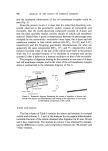
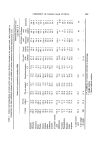
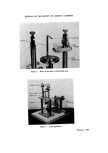
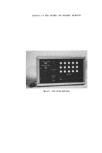
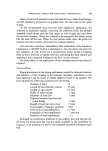
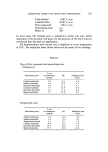
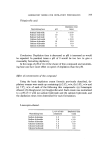
LABORATORY MODELS FOR DEPILATORY PERFORMANCE 369 Hairs are laid with minimal tension between the two rubber-lined clamps, and the depilatory preparation is applied where the hair rests on the nylon bridge. At the programmed time intervals after depilatory application, the solenoid is energized rapidly, removing the platform from the plunger assembly which drops onto the hair under its own weight and rests there for the load duration. When the solenoid is de-energized, the return spring lifts the load off the hair. When the hair breaks under load, the guide rod actuates the micro-switch and arrests the timing indicator. (2) Control box and timer. Immediately after application of the depilatory preparation, a START button is depressed to zero the timer and start the test sequence. A cam driven by a synchronous motor causes a stepping relay to move forward at regular intervals, indicating the time elapsed and applying a short duration loading to the hair via the solenoid. An initial delay to the application of hair loading may be introduced if required. Test conditions Simple alterations to the timing mechanism enable the intervals between and duration of hair loading to be changed. Similarly, alterations in the load applicator can be made to enable different loads to be applied. We have adopted the following conditions for all testing: Number of hairs Length of hairs between clamps Length of hair treated Width of nylon bridge Diameter of load bar Distance between load bar and nylon bridge Height of load bar above hair Total weight of plunger assembly Time of first load application Frequency of load application Duration of load application 10 55 mm 3-5 mm 3 mm 3 mm 8 mm 5O g 1-5 min 1 per min 5s Although we would have preferred to use axillary hair and leg hair for the tests, we found that this was not easily available in the quantities we required, so of necessity we had to use standard untreated European head hair.

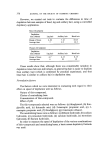
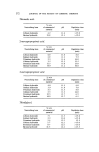
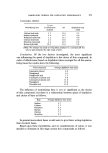
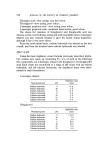
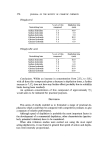
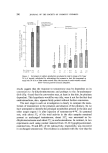
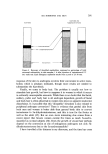
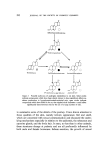
370 JOURNAL OF THE SOCIETY OF COSMETIC CHEMISTS However, we carried out tests to evaluate the differences in time of depilation between samples of head, leg and axillary hair, using a controlled depilatory application. Men (10 subjects) Depilation time (Meter) Leg hair Axillary hair Head hair Range of times 6-10 7-12 10-15 Average time 7 9.5 12.5 Women (10 subjects) Depilation time (Meter) Leg hair Axillary hair Head hair Range of times 4-7 6-13 8-15 Average time 6 10 10 These results show that, although there was considerable variation in depilation times between individuals, in general leg hair is easier to depilate than axillary hair (which is confirmed by practical experience) and that head hair is similar to axillary hair in depilation time. Formulation factors The factors which we were interested in evaluating with regard to their effect on speed of depilation were as follows. Nature of thio-compound. Choice of neutralizing base. Concentration of thio-compound. Effect of pH. The thio-compounds selected were as follows: (a) thioglycerol, (b) thio- glycollic acid, (c) thiomalic acid, (d) 2-mercapto propionic acid, (e) 3- mercapto propionic acid, (f) thiodiglycol, (g) 2-mercapto ethanol. The neutralizing bases were as follows: (a) lithium hydroxide, (b) sodium hydroxide, (c) potassium hydroxide, (d) calcium hydroxide, (e) strontium hydroxide, (f) barium hydroxide. In order to measure the speed of depilation of the various combinations of thio-compounds and neutralizing bases, a basic cream depilatory formula was used:
Purchased for the exclusive use of nofirst nolast (unknown)
From: SCC Media Library & Resource Center (library.scconline.org)