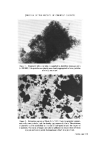
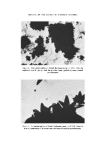
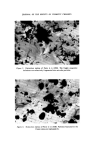
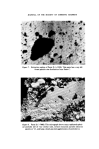
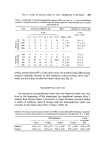
478 JOURNAL OF THE SOCIETY OF COSMETIC CHEMISTS Gels and gums cannot be directly examined in electron-beam equipment because the high vacuum and the interaction of the electron beam with the specimen lead to calamitous distortions. There is a possibility that the un- coated (i.e. lacking a vacuum-deposited electrically conducting and/or secondary electron-emitting coating) frozen toothpaste could be examined in the scanning electron microscope, as and when an efficient freezing-stage becomes available. In this case a fresh fracture-face, possibly cleaved actually in the microscope's specimen chamber, would be the most suitable area for examination. Such a fracture-face may be examined by replication for the transmission electron microscope. The technique is known as 'freeze, fracture and replication' (freeze-fracturing) and is used in conjunc- tion with 'etching' (freeze-etching), on biological material. The method described below was applied to a range of toothpastes covering a wide spectrum of liquid and solid phases. The main feature of this method is that it can be used to study the conditions of various com- ponents of toothpastes under exactly the same conditions as they would be applied to the teeth during normal usage. Thus, phenomena that were previously impossible to study were examined, for example, the distribution of solid and liquid components, and the deterioration of the structure of solid particles caused by formulation stresses and long term storage. Examples considered in this paper are categorized in Table I, according to their appearance and types of solid particles. Table I. Proprietary toothpastes and the proposed British Reference paste studied by the freeze-fracturing technique, listed in descending order of abrasivity with respect to dentine Paste code Solid constituent Optical properties British Reference (BR) Chalk White, opaque A Chalk White, opaque B Silica Pink, clear C Silica Pink, clear D Silica Pink, clear E Polymer spheres White, opaque METHOD This procedure utilizes an Edwards High Vacuum freeze-etch module mounted upon an Edwards El2 E4 vacuum coating unit. Equivalent results

EXAMINATION OF PARTICULATE INCLUSIONS IN TOOTHPASTE 479 have been obtained previously with improvised equipment added to the conventional work chamber of the El2 E4 coating unit. The toothpaste under examination is formed into beads 3 to 5 mm in diameter on the specimen mounts supplied with the freeze-etch module up to six samples can be prepared at one time. Freezing of the toothpaste depends upon the nature of the major component. Aqueous formulations are quenched in liquid Freon 12 held at its freezing point (c. --158 ø) in liquid nitrogen excess Freon is shaken from the mount as it is transferred into liquid nitrogen prior to mounting on the specimen saddle under liquid nitrogen. Glycerin-based formulations are solidified either by cooling the specimen mounts on solid carbon dioxide or by cooling mounts and saddle directly on the freezing-stage. Glycerin-based formulations required slower and less extreme (c. --130 ø max.) cooling than water-based formulations to prevent spontaneous fracturing. The solidified specimen/mount/saddle assembly is transferred to the freezing stage of the freeze-etch module. The temperature is held at between --80 ø and --100 ø to defrost the stage assembly, as the vacuum chamber is evacuated to better than 10 4 torr. The freezing-stage is then cooled to the minimum temperature attainable with the specimen under examination. The specimens are fractured by a microtome which is cooled by liquid nitrogen. The fresh fracture surfaces are immediately shadowed with plati- num/carbon at a nominal grazing angle of 30 ø, and backed by carbon evaporated normal to the specimen surface. The vacuum chamber is brought to atmospheric pressure by admitting dry air. The specimen-mounts are quickly removed from the stage and saddle, and the replicas stripped from the fracture surfaces. Three tech- niques have been adopted for stripping the replicas from the toothpastes: (a) on to ammonia solution (Specific Gravity 0.88, freezing point --84 ø cooled in a solid carbon dioxide/alcohol bath to --72ø (b) on to distilled water at room temperature (c) on to tap water at room temperature. The cooled ammonium hydroxide bath was employed so that the toothpastes remained solid during stripping the surface tension and freezing point of ammonia solution make it suitable for the process. Stripping on to distilled water is a normal practice during replication, but since water-based tooth- pastes are made up in tap-water, the effect of the reduced salt concentration on the particulate inclusions was examined by stripping on to tap water. The free replicas are cleaned on fresh baths of the appropriate stripping agent and recovered on bare nickel grids. The dry replicas are examined.
Purchased for the exclusive use of nofirst nolast (unknown)
From: SCC Media Library & Resource Center (library.scconline.org)