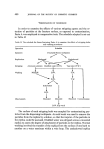
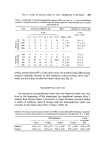
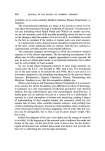
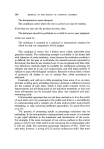
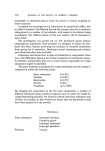
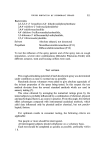
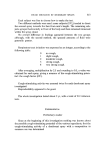
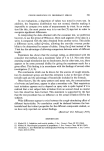
480 JOURNAL OF THE SOCIETY OF COSMETIC CHEMISTS VERIFICATION OF TECHNIQUE In order to examine the effects of various stripping agents and the re- tention of particles at the fracture surface, as opposed to contamination, Paste A was employed in comparative tests. The schedule adopted is set out in Table II. Table II. The schedule for freeze-fracturing Paste A to examine the effects of stripping baths and washing procedures Operation Specimen Schedule Fractured frozen toothpaste Replication Shadowed Unshadowed Stripping Washing Observations Ammonia solution Distilled water (D.W.) NH!OH D!W. 0.01N HCI D.W. Mo nted Mou Tap water (T.W.) T.Wo •ted Mou •ted Contal tination D.W. drip wash The surface of each stripping bath was sampled for contaminating par- tides from the dispersing toothpaste. An acid wash was used to remove the particles from the replica by solution, so that the imprint of the particles in the replica could be assessed. Distilled water was dripped across a mounted replica to assess the degree of attachment of particles to the replica. Normal washing involved the transfer of the replica from the surface of one bath to another on a water meniscus within a wire loop. The unshadowed replica

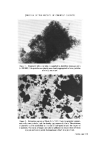
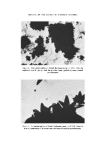
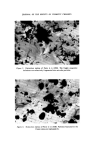
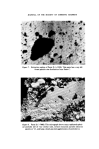
EXAMINATION OF PARTICULATE INCLUSIONS IN TOOTHPASTE 481 permitted closer examination of extracted particles without the confusion of the shadowed fractures. RESULTS AND DISCUSSION There was no appreciable difference between replicas stripped on to any of the three baths characteristics considered were type, form, size range, distribution, and the detail of the fracture faces. The cold ammonia solution did not attack the inclusions and the presence or absence of salts from the water did not appear to affect the size and shape of the particles. Stripping from the frozen surface did not appreciably reduce the amount of adhering material. The particles adhere to the replica, be it shadowed or not, to an extent sufficient: (a) to withstand gravitational separation of the larger from the smaller particles, and (b) to resist the cross-flow of washing reagents. The extent of the adhering surfaces is small and probably confined to points on the particles. The type and form, size range and distribution of the particles compares with samples of the materials prior to formulation. It is therefore concluded that the 'extraction replica' is a valid method for assessing the particulate content of gums and gels, and for monitoring the homogeneity of the base. The findings on the shape, size, and condition of solid particles, made using the method outlined above, confirm observations made on particles before they are incorporated in toothpastes (Figs I and 2)*, and after they are extracted by solvent extraction methods. Information is also given about the distribution of particles and liquids within the formulated paste. British Reference paste Particles within the British Reference paste were well distributed, and consisted of a powder of crystalline calcite of fairly narrow size range. The particles were characterized by many conical protuberances. The latter were sufficiently fragile to undergo limited fragmentation during formulation (Fig. 3), and a close examination of the particles suggested that some of the fragmented cones were hollow (Fig. 4). * Note: All micrographs are presented unreversed, that is, with pale shadows the direction of shadowing is indicated by the arrowheads.
Purchased for the exclusive use of nofirst nolast (unknown)
From: SCC Media Library & Resource Center (library.scconline.org)