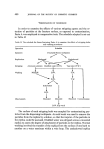
504 JOURNAL OF THE SOCIETY OF COSMETIC CHEMISTS and this may involve measurement both on the product itself (e.g. viscosity of a shampoo) and on the total system (e.g. viscosity of lather in the presence of greasy hair). The selection process is far more critical than the elaboration of techniques. Furthermore the selected property may need to be examined in the appropriate light at each of the stages we have just discussed. Taking them in reverse order, we start first with the screening process whereby an in- gredient or very simple formulation is checked against the basic hypothesis. Such a hypothesis will be that an improved functional performance should be obtained by a certain change--a new ingredient, a new solvent or vehicle, etc. The first stage must therefore always be to check whether the hypo- thesis can be invalidated. Note--not that 'it is correct' but that 'it cannot be invalidated': a hypothesis cannot be proved, it can only be disproved. Since it is most important to reject incorrect hypotheses which cause vast wastes of time and plug up the whole research process, the initial screening of properties must be done under the conditions most favourable for a positive result, because if the test system fails in these conditions, it can be happily written off. Typically this means using apparently excessive dosage, long dwell times, etc. This screening stage gives the scientist con- fidence to proceed to the next stage and is typically on-bench in vitro, although occasionally animals or even humans must be used (such as in screening new perfume ingredients). In the second stage, which I called assessment, a prototype system is created by the development chemist so that he may check that the sought- for properties do indeed exist. Again favourable conditions are used and standardized techniques with high levels of control to reduce intrinsic variability. This stage also is essentially in vitro, although small animals or small panels may be used if no in vitro technique exists. This stage not only gives further confidence and information to the scientist, but may be essential for giving authority to Patents, Marketing or external authorities. A further value of the use of instrumental methods in early development is that of economy in safety testing. Unless a development is shown as potentially worthwhile, the time and expense of rigorous consumer safety testing is not incurred the resource is then available for the extensive testing needed by favourable developments. Having obtained confidence that proceeding to the rationale can pro- duce the desired effect, the next stage is the in-use confirmation, the physical evaluation of functional performance. Incidentally, it may be that the hypothesis is scientifically not too sound, but in some circumstances

THE PROMISE AND THE PRODUCT 5O5 this is irrelevant if the effect is right--a new research programme is needed on the mechanism! Here we look to see that the effect is maintained under conditions of expected variability, whether these be biological variation in hair and teeth or human variation in quantities or efficiency of use. Typically this is the clinical test stage, the salon trial, the sweat room. It should not be expected that average effects are anything like as dramatic as observed in the more controlled earlier stages, but they should be maintained under these conditions of variability. In more subjective fields where physical functionality is less dominant, the consumer panel is of course mandatory, because here we are asking the user to be the measuring instrument, not the expert clinician, hairdresser or physiologist. These three stages of evaluation may call for different techniques despite the fact that the property being judged is the same. Thus the property of colouring hair may initially be judged on small switches on watch glasses cooked for a long time, in later stages on bigger switches treated with realistic liquor ratios and times and, finally, in the salon. In other instances the same instrument could in fact be used at all three stages, but might well be judged and reported in different ways. The final stage lies outside the scope of this paper and is the test market situation where different rules apply. We want to call attention to the attri- butes with cues supporting the effect we know to be there, so that the product not only has the right to live in the market but will live. NON-FUNCTIONAL PROPERTIES The scientist must be alive to the danger of underestimating the immense importance of the so-called non-functional properties. These contribute very significantly to the attribute profile, yet provide a source of great difficulty because they are so idiosyncratic. I speak of: Perfume and flavour (these can also be a functional activity). Pack (aesthetic properties). Price. Convenience (or rather 'lack of inconvenience'--convenience can be functional). Availability. Keepability (on the edge of functional performance). For many products there is a minimum functionality which admits the product to its 'class' and thereafter choice--and satisfaction--is based on
Purchased for the exclusive use of nofirst nolast (unknown)
From: SCC Media Library & Resource Center (library.scconline.org)