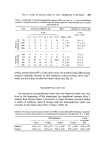
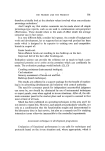
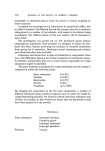
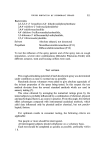
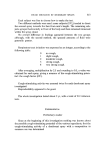
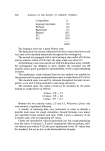
514 JOURNAL OF THE SOCIETY OF COSMETIC CHEMISTS Composition 7o Isopropyl myristate 0.3 Perfume 0.2 Bactericide 0.2 Ethanol 24.3 F11 25.0 F12 50.0 100.0 The fragrance used was a green flowery type. The bactericide was chosen arbitrarily from the six types listed above and was used as the standard bactericide throughout the investigation. The aerosol was equipped with a valve having a stem orifice of 0.45 mm and an actuator orifice of 0.50 mm the spray angle was about 16 ø. All preliminary tests were carried out with this deorodant spray initially the investigation was designed to show whether the consumer test did actually ensure good quantitative reproducibility of the cough-stimulating irritation. This preliminary study indicated that the test method was suitable for the purpose and the spray mentioned above gave a cough factor (CF) of 6.0. This standard spray was used for reference throughout the main investi- gation, a run with it being included in each large test series. The standard spray was tested, overall on 22 occasions by the panel, leading to cough factors as follows: 4 times: CF = 5.5 12 times: CF = 6.0 6 times: CF = 6.5 Between the two extreme values, 5.5 and 6.5, Wilcoxon's Q-test only once showed a significant difference. A number of screening tests were performed, in order to identify a possible main cause for cough stimulation. Several formulae were tested, one ingredient being omitted each time. Table I gives a summary of the formulae used, with corresponding CF values. Clearly the formulation without bactericide was less cough-stimulating than the others. Formulae C, E and G (respectively without perfume, with- out ethanol and without F12) also gave significantly lower CF values than the standard, but not as low as the bactericide-free formula.

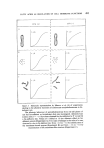
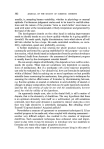
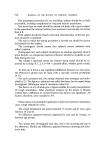
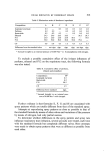
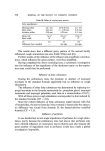
COUGH IRRITATION BY DEODORANT SPRAYS Table I. Elimination series of deodorant ingredients 515 Composition: A B C D E F G* Isopropyl myristate 0.3 -- 0.3 0.3 0.3 0.3 0.3 Perfume 0.2 0.2 -- 0.2 0.2 0.2 0.2 Bactericide 0.2 0.2 0.2 -- 0.2 0.2 0.2 Ethanol 24.3 24.6 24.5 24.5 -- 24.3 24.3 F11 25.0 25.0 25.0 25.0 49.3 -- 75.0 F12 50.0 50.0 50.0 50.0 50.0 75.0 -- CF 6.0 6.0 4.5 1.5 4.5 6.5 4.5 Difference from the standard value -- not sign. sign. sign. sign. not sign. sign. * Aerosol brought to an internal pressure of 0.009 Nm -• (= 8 atmospheres) with nitrogen. To exclude a possible cumulative effect of the irritant influences of perfume, ethanol and F12 on the respiratory tract, the following formula was also tested. Table 1I. Cumulative effect of perfume, ethanol and propellant Composition: H* Isopropyl myristate 0.3 Bactericide 0.2 Fll 99.5 CF 4.5 Difference from standard sign. * Aerosol brought to an internal pres- sure of 0.009 Nm -• with nitrogen. Further evidence is that formulae E, F, G and H are associated with spray patterns which are totally different from that of the standard spray. Attempts at reproducing spray patterns as close as possible to that of the standard formula by means of other valves and variations of the pressure by means of nitrogen, had only partial success. To determine whether differences in the spray pattern and spray rate influence respiratory tract irritation, several aerosols were tested, each time with the standard formula but completely different valves. Here attempts were made to obtain spray patterns that were as different as possible from each other.
Purchased for the exclusive use of nofirst nolast (unknown)
From: SCC Media Library & Resource Center (library.scconline.org)