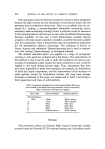
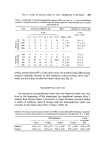
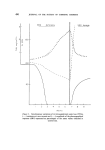
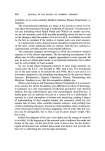
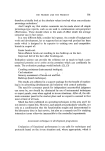
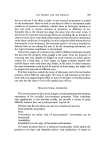
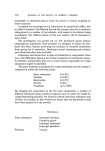
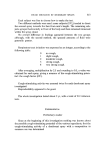
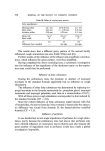
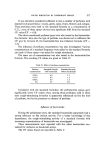
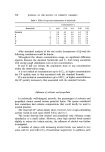
516 JOURNAL OF THE SOCIETY OF COSMETIC CHEMISTS Table III. Effect of varying spray pattern Valve specification: Housing orifice 2.0 mm 2.0-0.50 mm 2.0 mm Stem orifice 0.45 mm 2 x 0.50 mm 0.45 mm Actuator orifice 0.50 mm 0.50 mm 0.33 mm Spray rate 1 g s 4 0.6 g s -x 0.4 g s 4 Spray angle 16 ø 10 ø 12 ø CF 6.0 5.5 6.0 Difference from standard -- not sign. not sign. The results show that a different spray pattern of the aerosol hardly influenced cough stimulation (see also Table VII(a) and (b)). Further studies of the influence of the ethanol and propellant concentra- tions, which influence the spray pattern, were thus simplified. Having completed the above screening tests, a systematic investigation into the influence of the ingredients of the deodorant spray on the respira- tory tract could then be performed. Influence of fatty substances During the preliminary tests, the presence or absence of isopropyl myristate in the standard formula apparently had no influence on cough stimulation. The influence of other fatty substances was determined by replacing iso- propyl myristate in the formula successively by: propylene glycol, isopropyl isostearate and isopropyl palmitate, each time at a concentration of 0.3•. With all these sprays cough stimulation corresponded to that induced by the standard formula (CF = 6.0). Since the irritant influence of fatty substances might interact with that of bactericides, the above formulae were re-tested in bactericide-free sprays no difference was found from formula D, the bactericide-free modified formula (CF = 1.5). Influence of perfumes It was decided not to test single ingredients of perfumes for cough stimu- lation, partly because the preliminary tests had shown that perfumes only had a limited influence on respiratory tract irritation and also because the great number of ingredients used in perfumes would have made a global investigation impossible.

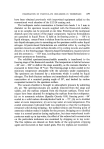
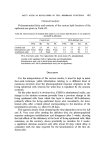
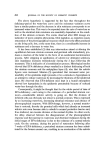
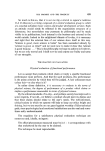
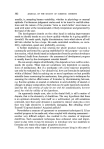
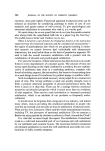
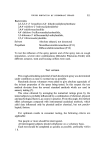
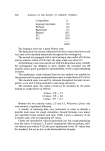
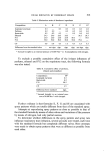
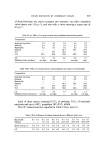
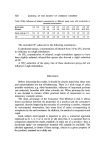
COUGH IRRITATION BY DEODORANT SPRAYS 517 It was therefore considered sufficient to test a number of perfumes with distinctive characteristics' woody, green, spicy, fruity, flowery and cologne. These perfumes were used in the standard formula at a concentration of 0.2%' none of these sprays showed any significant shift from the standard CF value (CF = 6.0). The above-mentioned perfume types were also tested in the bactericide- fi'ee formula' here also the type of perfume was shown not to influence the CF give by formula D, the bactericide-free low-irritation formula (CF -- 1.5). The influence of perfume concentration was also investigated. Various concentrations of a standard fragrance were added to the standard formula and each of these sprays was tested for cough stimulation. The same set of concentrations was also tested in the bactericide-free formula. The resulting CF values are given in Table IV. Table IV. Effect of perfume concentration Perfume Standard formula Standard formula concentration with bactericide without bactericide O.2O% 6.O 1.5 0.13% 6.5 1.5 O.O6% 6.O 1.5 O% 4.5 O.5 Compared with the standard formulae, the perfume-free sprays gave significantly lower CF values thus, among those perfumes used in these tests cough-stimulating irritation is apparently influenced not by the kind of perfume, but by the presence or absence of perfume. Influence of bactericides During the preliminary tests, the standard bactericide apparently had a strong influence on the irritant activity. For a better knowledge of this dependence, the cough-stimulating activity of a standard formula with increasing concentrations of bactericide was investigated. These measurements were repeated with five other bactericides con- sidered for inclusion in deodorant sprays. The CF values found are reported in Table V.
Purchased for the exclusive use of nofirst nolast (unknown)
From: SCC Media Library & Resource Center (library.scconline.org)