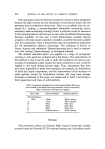
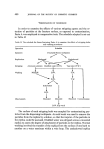
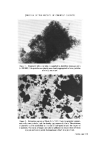
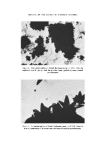
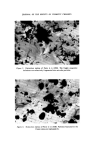
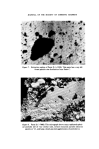
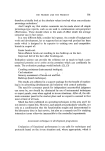
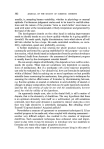
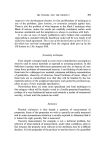
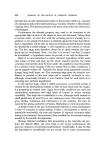
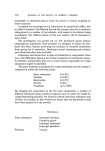
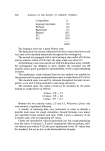
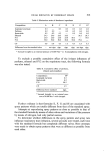
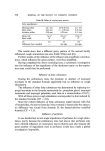
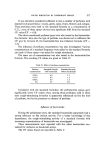
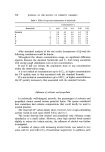
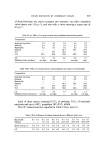
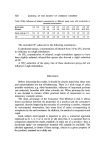
482 JOURNAL OF THE SOCIETY OF COSMETIC CHEMISTS Chalk-containing paste (A) This paste contained more fragile particles than the British Standards reference paste. The particles were well distributed and characterized by many acicular crystals growing from a solid core. Fragmentation of the particles was extensive in this paste (Fig. 5). Silica-containing pastes (B, C, D) Extruded strips of the clear silica-containing pastes were visually very similar. Micrographs of the freeze fracture extraction replicas confirmed this similarity at the microscopic level. Paste B contained two types of amorphous, expanded silica particles (Fig. 2), one type being relatively fine and fluffy, the other being coarser and more continuous in outline and morphology. Pastes C and D (Figs. 6 and 7) were similar to each other and differed only slightly from Paste B in the size-range and morphology of the particles. Polymer sphere-containing paste (E) In contrast to the well distributed, inorganic particles observed in most pastes this paste contained poorly distributed polymer spheres. The polymer spheres were frequently observed aggregated into close-packed arrays (Fig. 8). Toothpaste performance The performance of a toothpaste can be summarized mainly in terms of its 'cleaning' and abrasive properties. The cleaning power or cosmetic value, of dentifrices is thought to be directly proportional to their dentine abrasi- vity (1, 2) while the clinical acceptability has been related to the reciprocal of the dentine abrasivity. The reason for this may be twofold: (a)fear of excessive abrasivity may have caused over-reaction against the more abrasive pastes, or (b) abrasivity with respect to dentine is the most easily

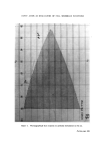
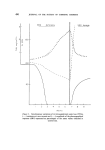
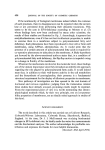
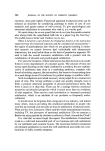
JOURNAL OF THE SOCIETY OF COSMETIC CHEM1STS .: • . ß .. Figure 1. Expanded silica particles as supplied to dentifrice manufacturers ( x 200 000). Sub-particles are cl•rly s•n closely aggregated to form particles of cloudy struct•e. Figure 2. Extraction replica of Paste B ( x 7000). Note the granular appear- ances of some particles, and the cloudy appearance of others. The structure of particles can be controlled by the size of sub-particles and the degree of expansion. The mass of larger particles is sufficient to render them electron opaque and consequently homogenously black in appearance. Facittg page 482
Purchased for the exclusive use of nofirst nolast (unknown)
From: SCC Media Library & Resource Center (library.scconline.org)