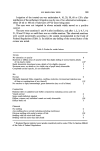
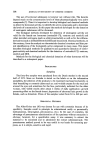
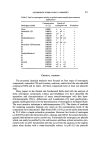
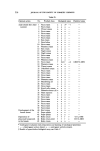
OESTROGENIC SUBSTANCES IN COSMETICS 311 Table I. Test for oestrogenic activity in spiked cream samples (percutaneous application) Concentration Result of Oestrogens added in (%) cytological test Evaluation None 0.0000 a a a -- Oestradiol-17[• 0.00025 e e/f c + Id. 0.00050 e/f f e + Id. 0.00100 f e/f f + Diethylstilbestrol 0.00025 fid f/d f/d + Id. 0.00050 f f f + Id. 0.00100 e/f f/d e/f + Oestradiol-17[•-benzoate 0.00250 f f f + Id. 0.00350 f f f + Id. 0.00750 f f f + Id. 0.01500 f f f + Diethylstilbestrol 0.00250 f f f + Id. 0.00350 f f f + [d. 0.00750 f f f + Id. 0.01500 f f f + Oestriol 0.00050 e/f d e/f + Id. 0.00250 e/f e e/[ + Id. 0.01500 e/f f d/e + CHEMICAL METHODS The proposed chemical methods were focused on four types of oestrogenic compounds, oestradiol- 1713 and its esters, oestrone, oestriol and the non-steroidal compound DES and its esters. All these compounds have at least one phenolic ring. Many papers in the clinical and biochemical fields deal with the analysis of these oestrogenic compounds. Lisboa and Dicsfalusy (11) have described the separation and characterization of many steroid-oestrogens with thin layer- chromatography (TLC). Adlercreutz and Luukkainen (12) used gaschromato- graphic techniques (GLC) for the determination of oestrogens in biological fluids. The most sensitive technique is radioimmunoassay (13). The choice of methods for analysing cosmetics depends very much on the concentration levels of the compounds to be determined. High levels (0.05 or 0.5•o) can be easily determined by TLC after a simple extraction procedure. However low levels of oestrogens !,ca 0.0035•o) after the extraction need a cleanup step before the actual chromato- graphic determination can be carried out. Fortunately the oestrogens are phenols which can easily be purified by the well-known add/base solvent extraction pro- cedures (14): at pH 1 the phenolic steroids move from the aqueous to the organic phase when shaken with a water-immiscible solvent. At pH 10.5 the phenolic

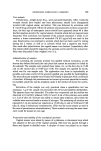
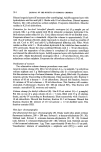
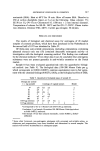
312 JOURNAL OF THE SOCIETY OF COSMETIC CHEMISTS steroids remain in the organic phase, permitting the removal of a great quantity of interfering compounds. At pH 13 the phenolic steroids moved to the aqueous phase. An alternative cleanup procedure is column chromatography, as described by Jones (15). For identification TLC is the most convenient and generally applicable method. Visualization in case of samples with low-level oestrogen is however a problem, as too many interfering compounds of the cream matrix respond to the chromogenic sprays. Only in samples containing DES a more specific method of visualization is available (16), namely by u.v. radiation, which converts DES into a yellow phenanthrene derivative, which fluoresces under long-wave u.v. light. For the steroidal oestrogens we find a GLC confirmation very useful. Gas chromato- graphy alone is however not practicable. GLC-data of a natural mixture of (silyl- ated) steroidal compounds clearly shows that GLC alone cannot make a good identification. Combinations of TLC and GLC generally result in reliable results. Outline of the chemical analysis The outline of the analysis on Table H is mainly based on the information of each product regarding its claimed cosmetic action. Procedures Reagents: Acetic acid, acetonitrile p.a., n-hexane, acetone, pentane, toluene p.a., ethanol p.a. (96•o), chloroform, ethylacetate p.a., benzene p.a., sodium hydroxide (4•a and 0.5M), hydrochloric acid (4ta), potassium hydroxide (0.5•a in ethanol), sulphuric acid (98•o), anhydrous sodium sulphate, sodium chloride, hyflosupercel (filtering aid), alumina for column chromatography (activity II, neutral and activity IV, basic), anisaldehyde, oestradiol-17[•-di- benzoate (Merck), oestradiol-17[• (Organon and Merck 8964), N, O-bis(trimethyl- silyl) acetamide, carbon disulphide, oestrone (Merck 8966), oestriol (Organon and Merck 24609 Lab) and diethylstilbestrol (British Drug Houses). Extraction Three extraction procedures (A, B and C) are described. General extraction procedure (A) (0.5 g sample per ml extract). Weigh 2 g of the sample. Add 10 ml of toluene. Distil off the azeotrope toluene/water, in a rotational evaporator under reduced pressure. Add to the dehydrated residue 10 ml of 96•o ethanol, 10 ml of acetonitrile and 20 ml of pentane. Shake vigorously and wait until the phases have separated well. Discard the pentane fraction. Evaporate the acetonitrile/ethanol fraction and dissolve the residue in 4 ml of chloroform. Extraction for low-level 'free' phenolic oestrogens (B) (4 g sample per ml extract). Use 2 ml of extract A. Evaporate solvent. Dissolve residue in 5 ml sodium hy- droxide 4•a. Shake successively with 2 x 5 ml chloroform and 1 x 5 ml pentane.
Purchased for the exclusive use of nofirst nolast (unknown)
From: SCC Media Library & Resource Center (library.scconline.org)