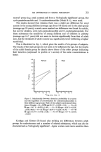
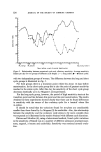
SEX DIFFERENCES IN ODOUR PERCEPTION 323 DIFFERENCES IN VARIABILITY OF THE SENSITIVITY Although women are in general perhaps more sensitive to odours than men, they also show larger variations in their sensitivity. These variations seem to be linked with variations in sex hormone production. Le Magnen (2) was the first to demonstrate that for exaltolide there existed a relationship between the olfactory sensitivity in women and the course of their ovulatory cycle. During menstruation the sensitivity is at its lowest. Shortly after- wards the sensitivity goes up to a maximum situated in time around or just before ovulation. Then there is a rather sharp fall in sensitivity to a level just above the one found at menstruation. This level is maintained until the onset of menstruation. Vierling and Rock (11) confirmed Le Magnen's (2) finding with exaltolide, however, they found two increases in sensitivity: one just before the theoretical ovulation (17 days before menstruation) and one during the luteal phase (8 days before menstruation). Le Magnen (2) had also found such a second peak in acuity in a woman with a long cycle. In line with this specific hypothesis Le Magnen (2) supposed that his result would be specific for exaltolide and other 'biologically significant' odours. He used several other substances, but the curves obtained for these substances show very little variation over the same period. Meixner (12) also confirmed Le Magnen's (2) result with exaltolide but found that the acuity for pyridine, a urinoid odour according to Le Magnen (2), did not parallel the fluctuations found for exaltolide but was probably related to the phases of the menstrual cycle, whereas sensitivity to two neutral odours, although varying together, was not related to the menstrual cycle. The results indicated specific rather than generalized changes in olfactory sensitivity during the female sexual cycle. Kahn (13) obtained inconsistent data for three neutral odours, but the number of measurements in this experiment was small. Schneider and Wolf (14), using a neutral odour (citral) as a stimulus found a decrease in the sensitivity during menstruation, but they did not find the marked increase of the sensitivity around ovulation. Since the decrease in sensitivity during menstruation may well have been an artefact resulting from lack of motiv- ation during that period, Le Magnen's (2) claim of the specificity of the effect was not seriously challenged by these results. However, in a number of experiments, K/Sster (15, 16) was able to show that similar variations of the olfactory sensitivity with the ovulatory cycle could be found for another 'neutral' odour (m-xylene), although the variations were definitely less pronounced than in Le Magnen's (2) study. He also found that the variations observed are dependent upon ovulatory cycle duration. Women with short (28 days or somewhat less) cycles behave exactly in the way described by Le Magnen (2), but women with long cycles behave in the opposite way. This has been confirmed in two separate experiments

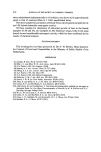
324 JOURNAL OF THE SOCIETY OF COSMETIC CHEMISTS 4O 35 30 25 2O I,,• I I I I 12181 I .... ......... I I I I I I ..... -33 - - 5 - o -15 -io -5 o M t (tong) M t (short) M 2 (tong +short) Doys before onset of second menstruotlon Figure 2. Relationship between menstrual cycle and olfactory sensitivity. Average sensitivity indices per day for two groups of different cycle length. O--O long cycles O- - -O short cycles. with two independent groups of women. The difference between the long and short cycle groups is illustrated in Fig. 2. For both groups there is a transition point which lies about 14 days before menstruation. In the short cycle group this is also the point of greatest sensitivity reached in the entire cycle. After this day the sensitivity of the short cycle group decreases drastically as in Le Magnen's (2) experiments. For the long cycle group, however, the period of high sensitivity starts at the transition point and lies between this point and the next menstruation. The results obtained in these experiments showed clearly that there can be found differences in sensitivity with the course of the ovulatory cycle for a 'neutral' odour like m-xylene. It should be noted that the variations found for m-xylene are considerably smaller than those found by Le Magnen (2) for exaltolide. Also, the relationship between the sensitivity and the ovulatory cycle seems to be more complex than was expected as is illustrated in the results obtained with different cycle durations. Pietras and Moulton (4), using a behavioural method, found cyclic variations in the sensitivity of female rats to a number of different substances (cyclopentane- none, eugenol, a-ionone and exaltolide). Sensitivity was maximal around ovula- tion.
Purchased for the exclusive use of nofirst nolast (unknown)
From: SCC Media Library & Resource Center (library.scconline.org)