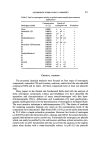
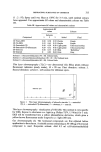
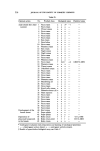
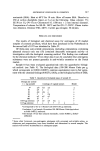
OESTROGENIC SUBSTANCES IN COSMETICS 317 acetamide (BSA). Heat at 60øC for 10 min. Blow off excess BSA. Dissolve in 250 [tl carbon disulphide. Inject ca 3 [tl on the following. Glass column: 5•o SE-30 (or 5•o OV-17) on Chromosorb G. 1500 mm x 2 mm internal diameter. Temperature of column for SE-30: 190øC and for OV-17' 230øC. Flame ioniza- tion detection. Detector FID, 240øC. Carrier gas nitrogen' 30 ml/min. RESULTS AND DISCUSSION The results of biological and chemical assay for oestrogens of 45 market samples of cosmetic products, which have been purchased in the Netherlands in the second half of 1973 are tabulated in Table IV. Of thirty-nine anti-wrinkle preparations (including preparations containing placental extract) only one (18) contained detectable oestrogenic activity on investigation with the biological screening method. This finding was confirmed by the chemical methods.* From these data it can be concluded that oestrogenic substances were not present generally in anti-wrinkle cosmetics on the Dutch market. Sample 18 has been evaluated quantitatively with the quantitative biologi- cal method. (see Table V). The biological data (100-200 Mouse Units per g, which corresponds to 0.0010-0.0020•o oestrone equivalents) were in fair agree- ment with the chemical findings (0.0025•o DES), as the biological activity of DES, Table V. Quantitative biological assay of sample 18 Dosage per animal (~ mg sample) Cytology of vaginal smears Result 5* a/b f/d a/c 10 e/f e e + 10 d/e d/e e + 20 f f f/d + 40 e/f e/f e/f + lOO f/f f f + 0.075 Ilg oestrone e/f e/f e/f b/c c + 0.15 [tg oestrone f e f f f e + *Corresponds to 0.5 to 1 Mouse Unit (0.05--0.10 t•g oestrone). Conclusion: 1 g of sample 18 contains 100-200 Mouse Units (equivalent to 0.001--0.002 % oestrone). N.B. Sample 18 has been assayed chemically results 0.0025 •o diethyl- stilbestrol. * Some other hormonal, non-oestrogenic substances with presumed anti-wrinkle action, as ethisterone and pregnenolone, have been identified and determined in several samples. The analysis will however be described in a subsequent paper.

318 JOURNAL OF THE SOCIETY OF COSMETIC CHEMISTS when administered subcutaneously in oil solution, was shown to be approximately equal to that of oestrone (Huis in 't Veld, unpublished data). The three samples for promotion of female breast development (samples 40, 41 and 42) lacked detectable oestrogenic activity. Of three samples for depression of abnormal growth of hair in the female (samples 43, 44 and 45), two (samples 43, 44) 'Hairstop' cream, both of the same brand, showed considerable oestrogenic activity, which has been confirmed by the results of chemical analysis. ACKNOWLEDGMENT This investigation has been sponsored by Drs P. H. Berben, Head Inspector for Control of Food and Commodities to the Ministry of Public Health of the Netherlands. REFERENCES (1) (2) (3) (4) (5) (6) (7) (8) (9) (10) (11) (12) (13) (14) (15) (16) Zondek, B. Klin. Wschr. 8 2229 (1929). Eller, J. J. and Eller, W. D. Arch. Derm. Syph. 59 449 (1949). U.S. Patent 2, 845, 381 Organon (1954). Scherm, A. J. Soc. Cosmet. Chem. 17 727 (1966). Ebling, F. J. J. Soc. Cosmet. Chem. 25, 381 (1974). U.S. Patent 2, 791,543, May 1957. U.S. Patent 2, 988, 486 (Helena Rubenstein). McBryde, C. M. J. Am. Med. Ass. 112 1045 (1939). Everse, J. W. R. In: Fette Seifen, Anstrichm. 75 203 (1973). Allen, E. and Doisy, E. A. J. Am. Med. Ass. 81 819 (1923). Lisboa, B. P. and Diczfalusy, E. Acta Endocrin. 40 60 (1962). Adlercreutz, H. and Luukkainen, T. Gas phase chromatographic methods for estrogens in biological fluids. in: Gas Phase Chromatography of Steroids, by K. B. Eik-Nes and G. C. Horning Springer Verlag (1968). Wu, C. H. and Lundy, L. E. Steroids 18 91 (1971). Smith, W. G. and MacNeill, E. E. An. Chem. 44 1084 (1972). Jones, L. N., Seidman, M. and Soutworth, B.C. J. Pharm. ScL 57 646 (1968). Schuller, P. L. J. Chrom. 31 237 (1967).
Purchased for the exclusive use of nofirst nolast (unknown)
From: SCC Media Library & Resource Center (library.scconline.org)