330 JOURNAL OF THE SOCIETY OF COSMETIC CHEMISTS An illustration of the practical merit of the book is shown in the advice to use square patches, since irritant responses are usually confined to the original shape (and size) of the patch whereas sensitization mostly leads to an extending reaction, often rounded. The distinction would be missed if circular patches are used. Such advice ought not to be dis- missed as merely anecdotal the authors, in the course of carrying out many thousands of patch tests, have accumulated a wealth of experience which is now made available to every- one. Rather less than half the pages are devoted to methodology, the remain- der being mainly concerned with the current 'standard tray' of twenty relatively common sensitizers listed by the International Contact Dermatitis Research Group and going into con- siderable detail to show possible sources of exposure to these and chemically-related substances. In treating an individual patient, the demonstration of a positive patch test response is only part of the story the next stage is to identify opportunities for exposure to the allergen and to show that avoidance of contact leads to relief of the skin condition... only then, incidentally, may the correctness of the patch-test diagnosis be taken as confirmed. The snag is that a standard array of common sensitizers becomes out- dated fairly quickly. So do references to uses of chemicals included in the tray. This part of the book cannot therefore retain its usefulness indefi- nitely but presumably revised editions will follow when necessary. Most of the contents insofar as they relate to the problems of individual patients, will not be directly appli- cable to the cosmetic scientist's work. Good advice abounds nevertheless, e.g. suggestions for non-irritating, non- sensitizing solvents for general patch- testing use. One of our main problems is not answered, namely what action to take, if any, following the demon- stration of positive allergic patch-test responses to our formulations in one or two patients. Should we regard these patients as odd and forget about them or should the formulation be deemed obnoxious and in need of alteration? A book such as the one now being reviewed will at least provide some of the underlying knowledge on the basis of which we may attempt to draw rational conclusions. N. G. VAN ABBi•

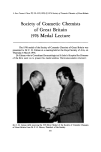
J. Soc. Cosmet. Chem. 27, 331-332 (1976) ¸ 1976 Society of Cosmetic Chemists of Great Britain Society of Cosmetic Chemists of Great Britain 1976 Medal Lecture The 1976 medal of the Society of Cosmetic Chemists of Great Britain was presented to Dr C. D. Calnan at a meeting held at the Royal Society of Arts, on Thursday 4 March 1976. Dr Calnan who is Consultant Dermatologist at St John's Hospital for Diseases of the Skin went on to present his medal address 'Dermatocosmetic relations'. . . .. : Dr C. D. Calnan (left) receiving the 1976 Silver Medal of the Society of Cosmetic Chemists of Great Britain from Dr F. G. Brown, President of the Society. 331
Purchased for the exclusive use of nofirst nolast (unknown)
From: SCC Media Library & Resource Center (library.scconline.org)