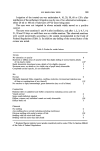
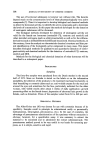
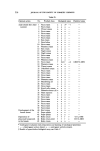
EYE IRRITATION TESTS 303 Irrigation of the treated eye was undertaken 4, 10, 20, 30, 60 or 120 s after instillation of'the surfactant. Irrigation was by one of' two alternative techniques-- either 20 ml or 100 ml of lukewarm (37øC) water being used. The eyes were not irrigated in eleven animals which served as a positive control. The eyes were examined 1 and 4 h after instillation, and after 1, 2, 3, 4, 7, 14, 21, 28 and 35 days or until there was no visible reaction. The observed reactions were scored numerically according to the system recommended in the Code of' Federal Regulations (Table 1). In addition any dulling of the normal lustre of' the cornea was noted. Table I. Grades for ocular lesions Cornea No ulceration or opacity 0 Scattered or diffuse areas of opacity (other than slight dulling of normal lustre), details of iris clearly visible (1)* Easily discernible translucent areas, details of iris slightly obscured 2 Nacreous areas, no details or iris visible, size of pupil barely discernible 3 Completed corneal opacity, iris not discernible 4 Iris Normal 0 Markedly deepened folds, congestion, swelling, moderate circumcorneal injection (any of these or combinations of any thereof) (1)* No reaction to light, haemorrhage, gross destruction (any or all of these) 2 Conjunctivae Redness (refers to palpebral and bulbar conjunctivae excluding cornea and iris) Vessels normal 0 Some vessels definitely injected 1 Diffuse, crimson red, individual vessels not easily discernible (2)* Diffuse beefy red 3 Chemosis No swelling Any swelling above normal (including nictating membrane) Obvious swelling with partial eversion of lids Swelling with lids about half closed Swelling with lids more than half closed 0 1 * Bracketed figures indicate lowest grades considered positive under Title 16, Section 1500.42 of the Code of Federal Regulations.

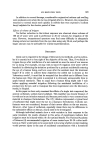
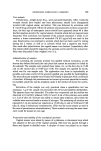
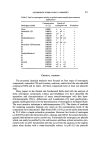
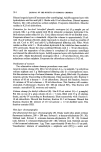
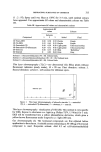
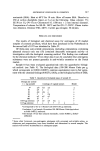
304 JOURNAL OF THE SOCIETY OF COSMETIC CHEMISTS RESULTS Effects of various exposure times (Table II) In every rabbit where irrigation of the eye was commenced after a delay of 20 s or longer after instillation of sodium lauryl sulphate, corneal opacity or a dulling of the normal corneal lustre was produced. The reaction observed in the eyes of animals exposed to sodium lauryl sulphate for 20 or 30 s was similar to the effect seen in the eyes of animals where irrigation was delayed for up to 2 min, and only slightly better than that seen in eyes receiving no irrigation at all. Where the exposure time was reduced to under 20 s, fewer rabbits showed any corneal damage, and where there was corneal involvement, this was less severe, and less persistent (Table III). Only one of twenty-four rabbits developed a corneal opacity when irrigation was initiated within 10 s. Exposure of the eyes to sodium lauryl sulphate for 4 s did not elicit any opacities, although a dulling of the corneal lustre was seen in four animals. It may be concluded therefore that the critical exposure time before corneal damage is produced in the rabbit eye after instillation of a 10•o sodium lauryl sulphate is in the region of 4-10 s. Table II. Numbers of rabbits showing corneal damage after instillation of 10 % sodium lauryl sulphate Delay time before irrigation of eyes (s) No 4 10 20 30 60 120 irrigation No opacity 7 4 ..... Lack of lustre 4 8 5 7 5 4 2 Opacity grade 1 -- 1 3 2 5 4 8 2 -- -- -- I -- -- 1 3 -- -- -- ! -- -- -- Total no. eyes treated 11 13 8 11 10 8 11 Table III. Mean duration of corneal damage and conjunctival irritation after instillation of 10% sodium lauryl sulphate (days) Delay time before irrigation of eye after instillation of 10 % sodium lauryl sulphate (s) 4 10 20 30 60 120 No irrigation Cornea 0.5 2 3 8 4 4 Conjunctiva 4 5 5 9 8 9 4.5 9
Purchased for the exclusive use of nofirst nolast (unknown)
From: SCC Media Library & Resource Center (library.scconline.org)