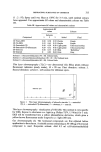
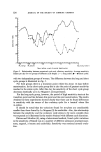
SEX DIFFERENCES IN ODOUR PERCEPTION 325 Amoore et al. (17) failed to demonstrate cyclic changes in women's sensitivity to the odour of pentadecalactone (Thibetolide), but Schiffman (18)found an in- creased sensitivity at the eleventh day of the cycle for cyclopentadecanone. Good et al. (19) with a signal detection procedure also confirmed Le Magnen's (2) findings and found further indications of a hormonal influence on olfactory sensitivity with pregnant and hypogonadal subjects. DIFFERENCES IN THE QUALITATIVE APPRECIATION OF ODOURS For most odours men and women do not differ in their appreciation in a systematic way. However, there are some odours in the 'biologically significant' group which seem to smell differently to men and women. Moncrieff (20) in- vestigated odour preferences within a group of ten odours with a large number of subjects. Men and women did not differ of opinion when very agreeable or very bad odours were concerned. Men preferred the smell of musklactone more than women did. This difference in preference seems to develop around puberty and is less outspoken after the age of 40, because after that age the odour is much more preferred by women than before it. Men seem to be more stable in their preferences through life than women (see Fig. 3). ? I I I I I 1 i 0 20 30 40 50 60 Age {years) Figure 3. Relationship between age and preference for the odour of musk lactone (from Moncrieff (18)). x-- x males ¸- - -¸ females. One group of substances, androstenone and related substances, demands special attention here, since these odours seem to be perceived very differently by different people.

326 IOURNAL OF THE SOCIETY OF COSMETIC CHEMISTS Beets and Theimer (21) asked a number of men and women to characterize three of these substances, including androstenone itself, with a set of predeter- mined adjectives. Women found the odours to be more often sweaty than men. Men in turn used the terms animal and sexual more often. Both groups qualified the odours most frequently as a urine odour. Differences in these kinds of experiments may be due in part to experience and socio-cultural factors like a female hesitance to use the term 'sexual'. Furthermore the state of health of the subject and his absolute threshold, which for the sense of taste was found to be correlated with preferences, may play a role (Kaplan (22)). In some studies differences in preference might be due to differences in sensitivity. Griffiths and Patterson (8) using 5a-androst-16-en-3-one found that women judged the smell of it significantly more unpleasant. Furthermore they found that the more sensitive a subject was the greater was his or her dislike of the odour, but within groups with the same threshold women disliked the odour more than did men. Fischer (23) also found that men liked the odour of a natural musk more than women did. CONCLUDING REMARKS In all cases in which sex differences are found these differences seem to be more pronounced for substances like musks which are used as sexual attractants in the animal world or for substances like androstenone and related steroids which are also clearly sex-linked. Male odours are usually characterized as musky, which was corroborated recently by Russell (24) who found that the sex of a person can be determined by the odour of his clothing, and female odours are characterized as sweet. REFERENCES (I) Toulouse, E. and Vaschide, N. Mesure de l'odorat chez l'homme et chez la femme. C. r. Soc. Biol. 51 381 (1899). (2) Le Magnen, J. Les ph6nom6nes olfacto-sexuels chez l'homme. Arch. ScL Physiol. 6 125 0 952). (3) Le Magnen, J. Les ph6nom•nes olfacto-sexuels chez le rat blanc. Arch. Sci. Physiol. 6 295 0952). (4) Pietras, R. J. and Moulton, D. G. Hormonal influences on odour detection in rats. Physiol. Behav. 12 475 0974). (5) Broverman, D. M., Klaiber, E. L., Kobayashi, Y. and Vogel, W. Roles of activation and inhibition in sex differences in cognitive abilities. Psychol. Rev. 75 23 (1968). (6) Koelega, H. S. Extraversion, sex, arousal and olfactory sensitivity. Acta Psychol. 34 51 (1970). (7) Koelega, H. S. and K6ster, E. P. Some experiments on sex differences in odour perception. Ann. N.Y. Acad. Sci. 237 234 (1974).
Purchased for the exclusive use of nofirst nolast (unknown)
From: SCC Media Library & Resource Center (library.scconline.org)